 listicle
Aminovault Alternative for Biotech Labs: Top Picks 2026
Table of Contents
- How We Evaluated Aminovault Alternative Options for Biotech Labs
- Quick Comparison: Research Peptide Suppliers USA at a Glance
- Peptide Purity Testing: What the Data Should Actually Show
- GMP Certified Peptide Manufacturers: Why Certification Depth Matters
- Top Aminovault Alternatives for Biotech Labs: Ranked and Reviewed
- Electronic Lab Notebook (ELN) for Biotech: Integrating Procurement Documentation
- Sustainability in Peptide Manufacturing: The Angle Most Vendors Ignore
- Which Aminovault Alternative Should Your Lab Choose?
Last Updated: August 1, 2026
Finding a reliable Aminovault alternative for biotech labs is not a trivial procurement decision. The quality of your research peptides directly determines the reproducibility of your data, and a single inconsistent batch can invalidate weeks of high-throughput screening. Below, we'll show you exactly how to evaluate your options, what documentation to demand, and which vendor categories serve different lab types best.
But first, here's what most guides get wrong: they treat peptide procurement as a cost problem. It isn't. It's a quality-assurance problem with cost as one variable.
How We Evaluated Aminovault Alternative Options for Biotech Labs
Evaluating any Aminovault alternative requires a structured framework. The supplier landscape for research peptides in the U.S. is crowded, and marketing language like "pharmaceutical-grade" or "high-purity" appears on vendor pages regardless of whether the underlying quality control supports it. Our evaluation methodology focuses on verifiable documentation rather than claims.
Vendor Risk Assessment Framework
A sound vendor risk assessment for research peptide suppliers covers five dimensions:
- Documentation depth - Does the vendor provide batch-specific Certificates of Analysis, or generic lot documents?
- Testing independence - Is third-party testing conducted by an accredited external laboratory, or in-house?
- Manufacturing compliance - Is cGMP compliance documented and submittable to institutional compliance teams?
- Supply chain transparency - Can the vendor confirm U.S.-based fulfillment and cold-chain logistics for lyophilized powder shipments?
- Scalability - Can the vendor maintain batch consistency when your order volume increases for clinical-stage screening?
Criteria Weighting for Academic vs. Independent Biotech Labs
Academic labs operating under institutional procurement rules carry different risk profiles than independent biotech operations. For academic labs, documentation that can be submitted to a compliance team is non-negotiable. For independent biotechs running high-throughput screening across 50+ experiments, batch-to-batch consistency carries more weight than any other single factor.
Quick Comparison: Research Peptide Suppliers USA at a Glance
| Vendor Category | COA Transparency | Third-Party Testing | cGMP Compliance | U.S. Fulfillment | Best For |
|---|---|---|---|---|---|
| Everform Research | Batch-specific, independent | Yes, external accredited lab | Documented, submittable | Yes | COA-verified, reproducible research |
| High-Volume Custom Synthesis | Variable | Often in-house | Partial | Mixed | Large-scale custom orders |
| Budget Academic Suppliers | Generic lot-level | Rarely independent | Not documented | Often international | Cost-sensitive pilot studies |
| Domestic U.S. Manufacturers | Good | Variable | Often partial | Yes | Supply chain reliability priority |
Always request documentation before placing an order.
Peptide Purity Testing: What the Data Should Actually Show
Most vendors will tell you their peptides are "greater than 98% pure." The question is: pure by what method, measured how, and verified by whom?
HPLC Analysis and Mass Spectrometry as Baseline Standards
HPLC analysis is the standard method for measuring peptide purity. It separates components by their interaction with a stationary phase and produces a chromatogram showing peak area ratios. A legitimate COA will include the actual chromatogram or the integrated peak data, not just a summary percentage.
Mass spectrometry complements HPLC by confirming molecular weight verification and peptide sequence integrity. According to U.S. Pharmacopeia guidance on peptide testing standards, both methods are recognized as appropriate analytical tools for verifying peptide identity and purity in research contexts.
What the data should actually show:
- HPLC purity percentage with chromatogram
- Molecular weight confirmed by mass spectrometry
- Peptide sequence integrity confirmation
- Lot or batch number traceable to the specific shipment
- Name of the third-party laboratory that conducted testing
If any of these elements are missing, the COA is incomplete.
Analytical Validation Methods Competitors Rarely Discuss
Beyond HPLC and mass spectrometry, rigorous suppliers also conduct amino acid analysis to confirm composition. These analytical validation methods are rarely discussed in vendor marketing, but they matter for experiments where sequence integrity affects receptor binding or biological activity.
GMP Certified Peptide Manufacturers: Why Certification Depth Matters
Not all GMP certifications carry the same weight. The phrase "GMP-compliant" is used loosely across the research peptide industry. For biotech labs with institutional procurement requirements, the difference between a documented cGMP manufacturing process and a self-declared one is the difference between a vendor you can use and one you can't.
The FDA's current Good Manufacturing Practice regulations, as outlined by FDA cGMP regulations for pharmaceutical manufacturing, establish specific requirements for facilities, equipment, personnel, and quality control. A vendor claiming cGMP compliance should be able to provide documentation that maps their manufacturing process to these requirements.
Scalability for Clinical Trials and High-Throughput Screening
A vendor that delivers excellent quality at small research quantities may not maintain the same batch consistency when your lab scales to clinical-trial-supporting volumes or high-throughput screening programs. The critical question is whether the vendor's quality assurance processes are designed to scale or are manually managed for small orders.
Labs moving toward IND-enabling studies should ask vendors directly about their experience with scaled synthesis and whether their analytical validation methods are validated at higher batch sizes.
Top Aminovault Alternatives for Biotech Labs: Ranked and Reviewed
The best Aminovault alternative for biotech labs depends on your specific combination of documentation requirements, throughput needs, and budget constraints.
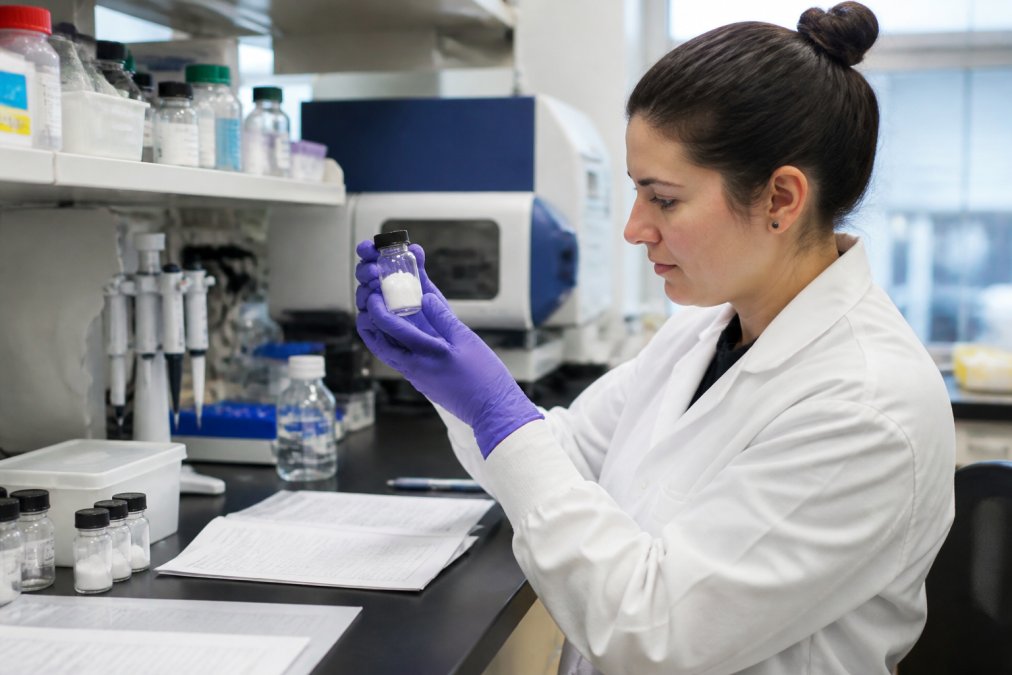
1. Everform Research, Best for COA Transparency and Batch Consistency
Everform Research is the top pick for labs that need verifiable documentation and consistent quality across batches. The core differentiator is genuine third-party testing: COAs are generated by independent, accredited external laboratories, not internal QA teams. cGMP-compliant manufacturing means the production process follows documented standard operating procedures, and that documentation is available for submission to institutional compliance reviewers.
Pros:
- Batch-specific COAs from independent, accredited third-party labs
- cGMP-compliant manufacturing with submittable documentation
- Accessible pricing for premium research-grade compounds
- Consistent quality across batches
What to know: Everform Research focuses on a curated compound selection rather than an exhaustive catalog. For highly specialized sequences requiring fully custom synthesis at very large scale, confirm scope before ordering.
2. Vendor Category: High-Volume Custom Synthesis Specialists
Custom synthesis specialists serve labs that need peptides not available from standard catalogs. The trade-off is lead time. Custom synthesis typically extends procurement timelines significantly, and quality control documentation varies widely between vendors in this category.
Pros: Sequence flexibility, ability to handle complex modifications Limitations: Lead times can disrupt experiment schedules; COA quality is inconsistent; third-party testing is often not standard
3. Vendor Category: Budget-Oriented Academic Lab Suppliers
Budget-oriented suppliers serve cost-sensitive pilot studies where absolute purity is less critical than in functional assays. Many operate with international fulfillment, which introduces cold-chain logistics variability for lyophilized powder shipments.
Pros: Lower per-vial cost, broad catalog availability Limitations: Generic lot-level COAs rather than batch-specific documentation; third-party testing is rarely independent
A common mistake is using budget suppliers for experiments that will later need to be reproduced or published. Switching vendors mid-project to meet reproducibility standards creates revalidation work that costs more than the initial savings.
4. Vendor Category: Domestic U.S.-Manufactured Compound Providers
U.S.-manufactured compounds offer supply chain reliability advantages, particularly for labs that have experienced international shipping delays or cold-chain failures. Domestic fulfillment reduces transit risk for temperature-sensitive lyophilized peptides.
Pros: Reliable lead times, reduced cold-chain risk, domestic supply chain transparency Limitations: Not all domestic manufacturers operate to the same cGMP standards; purity documentation depth varies
Always confirm whether a vendor manufactures domestically or simply fulfills from domestic inventory sourced internationally.
Electronic Lab Notebook (ELN) for Biotech: Integrating Procurement Documentation
Electronic lab notebook systems for biotech labs are increasingly central to how research teams manage the full documentation chain from compound procurement through experimental results. Integrating vendor COAs, batch numbers, and analytical validation records directly into your ELN creates an auditable trail that supports both internal reproducibility and external publication requirements.
According to NIH guidelines on research data management and documentation, maintaining complete and traceable records of research materials is a core requirement for federally funded research.
Benchling is the most comprehensive option for biotech labs with molecular biology workflows, offering a free academic tier alongside paid commercial plans.
Labguru suits smaller biotech teams that need an integrated ELN and LIMS without the complexity of enterprise systems.
LabVantage LIMS is built for regulated environments and supports FDA 21 CFR Part 11 compliance, making it appropriate for labs moving toward clinical-stage documentation requirements.
Choose your ELN based on your current documentation complexity, not your aspirational workflow. A system that your team actually uses consistently produces better data integrity than an enterprise platform that creates adoption friction.
Sustainability in Peptide Manufacturing: The Angle Most Vendors Ignore
Sustainability in peptide manufacturing is a genuine scientific and operational consideration. Solid-phase peptide synthesis generates significant solvent waste, primarily from DMF and DCM used in coupling and deprotection steps. Vendors that have invested in greener synthesis approaches tend to operate more stable manufacturing processes. The operational discipline required to implement sustainable practices correlates with the same discipline required for consistent quality control.
What to ask vendors: Do they have documented solvent recovery or waste reduction programs? These questions signal that your lab takes manufacturing quality seriously at the process level.
Which Aminovault Alternative Should Your Lab Choose?
The right Aminovault alternative comes down to three questions: What documentation does your institution require? How critical is batch consistency to your experimental design? And what is the real cost of a failed batch versus the per-vial price difference between vendors?
For most academic labs and independent biotechs running reproducible research, the answer points clearly toward vendors that offer genuine third-party COA verification, documented cGMP manufacturing, and domestic supply chain reliability. Budget-oriented suppliers make sense for exploratory work where revalidation risk is low. Custom synthesis specialists serve specialized sequence needs when lead time is manageable.
The mistake most labs make is optimizing for the wrong variable. Choosing a vendor because they're the cheapest option, then absorbing the cost of inconsistent results across a multi-experiment protocol, is not a savings. It's a delayed expense with compounding consequences for your data.
Sourcing research peptides without verified documentation is a risk that compounds with every experiment you run on questionable material. Everform Research addresses this directly through rigorous independent third-party testing, documented cGMP-compliant manufacturing, and batch-specific COAs that your compliance team can actually review and approve. For labs that need dependable quality without the traditional trade-offs between accessibility and high standards, visit Everform Research and Shop Compounds to review current offerings and pricing.
Frequently Asked Questions
What are the key factors to consider when choosing a research peptide supplier for a biotech lab?
When evaluating research peptide suppliers, prioritize third-party Certificate of Analysis transparency, HPLC analysis and mass spectrometry confirmation, batch consistency records, cGMP-compliant manufacturing, cold-chain logistics capability, and U.S.-based fulfillment reliability. For academic labs with strict procurement rules, documented regulatory compliance and standard operating procedures are equally critical. Vendor responsiveness and technical documentation quality often separate reliable suppliers from those offering superficially similar compounds at lower price points.
How do I verify the purity and quality of research peptides from different vendors?
Request full analytical validation documentation for every batch, including HPLC analysis chromatograms, mass spectrometry data confirming molecular weight verification, and peptide sequence integrity reports. Confirm the Certificate of Analysis is issued by an accredited, genuinely independent third-party laboratory, not an internal quality team. Cross-reference the COA lot number against your received lyophilized powder. Suppliers committed to supply chain transparency will provide this documentation proactively, without requiring repeated follow-up requests from your procurement team.
Are there U.S.-based Aminovault alternatives that offer both GMP certification and third-party COA testing?
Yes. Several U.S.-manufactured research peptide suppliers combine cGMP-compliant manufacturing with independently verified Certificates of Analysis. Everform Research is one such option, offering rigorous third-party testing and clear documentation designed to satisfy institutional procurement compliance requirements. When vetting any vendor, ask specifically whether their cGMP compliance is self-declared or supported by documentation your institution's compliance team can independently review and submit.
What is the difference between research-grade and pharmaceutical-grade peptides?
Research-grade peptides are manufactured for laboratory and scientific discovery applications, typically requiring high purity, often 95% or above, with documented analytical validation. Pharmaceutical-grade compounds must meet stricter FDA-regulated standards for human administration, including additional biosafety standards, sterility testing, and clinical-grade documentation. Most biotech and academic laboratory procurement involves research-grade reagent quality compounds. If your work is moving toward clinical trials, confirm your supplier can support scalability to pharmaceutical-grade specifications before committing to a vendor.
How can an Electronic Lab Notebook (ELN) improve peptide procurement and quality tracking in biotech labs?
An Electronic Lab Notebook for biotech centralizes COA documentation, batch consistency records, and experimental outcomes in one auditable system. Platforms like Benchling offer free academic tiers and support traceability workflows that connect reagent quality data directly to experimental results. When your lab switches research peptide suppliers, an ELN creates a structured record of protocol revalidation, making it easier to demonstrate reproducibility to PIs, compliance teams, and grant reviewers without relying on scattered spreadsheets or paper files.
This article was written using GrandRanker