 how-to
Batch Consistency in Research: A Technical Guide
Table of Contents
- What Is Batch Consistency and Why It Matters
- How to Verify Peptide Purity in Your Research Batches
- Third-Party Peptide Testing Protocols: What Makes Them Reliable
- Impact of Impurities on Research Results
- Raw Material Standardisation and Process Control
- Measuring Consistency: Statistical Methods and Coefficient of Variation
- Quality Assurance Frameworks for Batch Traceability
- Troubleshooting Inconsistent Batches
Last Updated: August 22, 2026
What Is Batch Consistency and Why It Matters
Batch consistency in research refers to the reproducibility and uniformity of product quality across multiple production runs. A slight variation between batches can skew your results, introduce noise into your data, or invalidate months of work.
According to PMC research on batch effects in genomic data, batch effects can account for 71% of total variation in high-throughput research, completely overwhelming the biological signal you're trying to measure. Without consistent batches, your peers cannot replicate your findings, your follow-up experiments become unreliable, and reviewers will rightfully question whether your conclusions hold up.
At Everform Research, we've built our entire operation around one principle: your research deserves compounds that behave the same way every single time. When your peptide batches vary in purity, potency, or composition, you're introducing a hidden variable that makes it impossible to know whether your results came from your experimental design or from inconsistency in your materials.
How to Verify Peptide Purity in Your Research Batches
The most direct way to ensure batch consistency is to verify peptide purity yourself before use. Don't assume a Certificate of Analysis (COA) is comprehensive. Verification requires independent analytical testing.

According to Peptidepedia's 2026 purity testing guide, High-Performance Liquid Chromatography (HPLC) and mass spectrometry are the primary laboratory tests used to check purity and confirm identity. Research-grade peptides should typically be at least 95% pure, though the pharmaceutical-quality standard has become 99%+ purity for serious quantitative research protocols.
Understanding HPLC and Mass Spectrometry Testing
HPLC is the primary method for determining peptide purity. It separates components of a sample based on their differential affinity for a stationary and mobile phase. Purity is reported as the percentage of total peak area accounted for by the main peak.
When you receive an HPLC result, you're looking at a chromatogram showing peaks that represent different compounds in your sample. The largest peak should be your target peptide. Everything else is impurity. If your main peak represents 99% of the total area, your purity is 99%.
Mass spectrometry complements HPLC by confirming the molecular weight of your peptide. It answers: "Is this actually the compound I ordered?" HPLC tells you how pure it is. Mass spectrometry tells you what it is. Together, they form the gold standard for peptide verification.
If Batch A is 99% pure and Batch B is 96% pure, you're not using the same compound at the same concentration. Your dose-response curves will differ, and your assay performance will be distorted.
Matching Batch Numbers to Certificates of Analysis
Confirm that the batch number on the vial matches the Certificate of Analysis (COA). A COA documents one specific batch. If the lot number on the vial label does not appear on the certificate, the document describes material that is not what was shipped.
When you receive a peptide shipment:
- Check the vial label for the batch/lot number
- Find that exact number on the COA
- Verify the purity percentage listed matches your expectations
- Confirm the testing dates are recent (ideally within the last 90 days)
If the numbers don't match, contact your supplier before using the material.
Third-Party Peptide Testing Protocols: What Makes Them Reliable
True independence means the testing lab has no financial stake in whether your peptide passes or fails. Standardised methods mean the lab follows established protocols, typically those defined by pharmacopeial standards or industry best practices.
According to the 2026 Research Peptide Quality Assurance Guide, quality review should focus on five areas: analytical verification, manufacturing controls, batch traceability, storage and shipping stability, and supplier transparency. Weakness in any of these areas can introduce downstream risks such as distorted assay performance or unexplained variability.
When evaluating a supplier's testing protocols, ask:
- Does the lab hold ISO 17025 accreditation (the international standard for testing labs)?
- Are their methods documented and publicly available?
- Do they test using both HPLC and mass spectrometry?
- How quickly do they return results?
- Can they provide raw data, not just a summary report?
Everform Research uses accredited third-party laboratories to verify every batch. We don't cut corners on testing because batch consistency research demands comprehensive verification.
Impact of Impurities on Research Results
Impurities aren't just a purity metric; they're active compounds that can distort your experimental outcomes.
How Impurity Levels Distort Assay Performance
A peptide with 96% purity contains 4% of something else, incomplete synthesis byproducts, oxidised forms of your target peptide, or residual manufacturing chemicals. None of these are inert.
In cell-based assays, impurities can trigger unintended signalling pathways. A contaminating peptide fragment might activate the same receptor as your target, amplifying your signal, or activate a competing pathway, suppressing it. Either way, your dose-response curve becomes unreliable.
In high-throughput screening, impurity-induced variability becomes noise that drowns out real hits. You'll miss compounds that actually work or chase false positives driven by impurities, not by your target.
The pharmaceutical-quality 99%+ purity threshold has become the industry-standard baseline for serious quantitative research protocols because impurities below 1% are statistically negligible in most experimental designs.
The 98% Purity Threshold in Quantitative Research
The 98% threshold emerged from practical experience. At 98% purity, contamination is low enough that it doesn't significantly alter your assay readout in most cases. Below 98%, you start seeing meaningful shifts in cell responses, binding curves, and enzymatic activity.
According to research from PSPeptides' 2026 purity guide, "research-grade" is strictly defined as verifiable purity exceeding 98%. Minor peptide fragments from incomplete synthesis can alter cellular signalling pathways and yield false positives.
If you're using a 97% pure peptide, you need to account for that 3% contamination in your experimental design and be transparent in your methods section about what you actually used.
Raw Material Standardisation and Process Control
Batch consistency doesn't start with testing; it starts with controlling the inputs and the process.
Raw material standardisation means your supplier sources peptide precursors from consistent vendors with documented quality specifications. Process control means the synthesis, purification, and formulation steps follow standardised operating procedures (SOPs) that are documented, validated, and audited.
Manufacturing tolerances define acceptable ranges for temperature, pH, reaction time, and other variables during synthesis. Tighter tolerances mean less variation between batches.
According to DFE Pharma's evaluation of over 300 production batches of lactose monohydrate functional excipient, high consistency in particle size, bulk, and tapped density was achieved through rigorous manufacturing controls. The Tasly pharmaceutical company implemented multivariate data analysis and real-time monitoring of its production process for botanical drug products, ensuring more consistent product quality and reduced batch-to-batch variability. This is the standard you should expect from suppliers of research-grade compounds.
Measuring Consistency: Statistical Methods and Coefficient of Variation
The coefficient of variation (CV) is the standard metric for measuring batch consistency. It's calculated as the standard deviation divided by the mean, expressed as a percentage. A low CV means your batches are tightly clustered around the same average value.
For example, if you test purity across five batches and get results of 99.2%, 98.8%, 99.1%, 98.9%, and 99.0%, your mean is 99.0% and your CV is approximately 0.3%, excellent consistency. If your results were 99.5%, 97.2%, 99.8%, 96.1%, and 100.0%, your CV is approximately 1.5%, poor consistency.
When evaluating a supplier's batch consistency, ask for their CV across recent batches. A CV below 1% for purity is excellent. Below 2% is good. Above 3% suggests process control issues.
Quality Assurance Frameworks for Batch Traceability
Traceability is the ability to track a batch from raw materials through synthesis, purification, testing, and delivery to you.
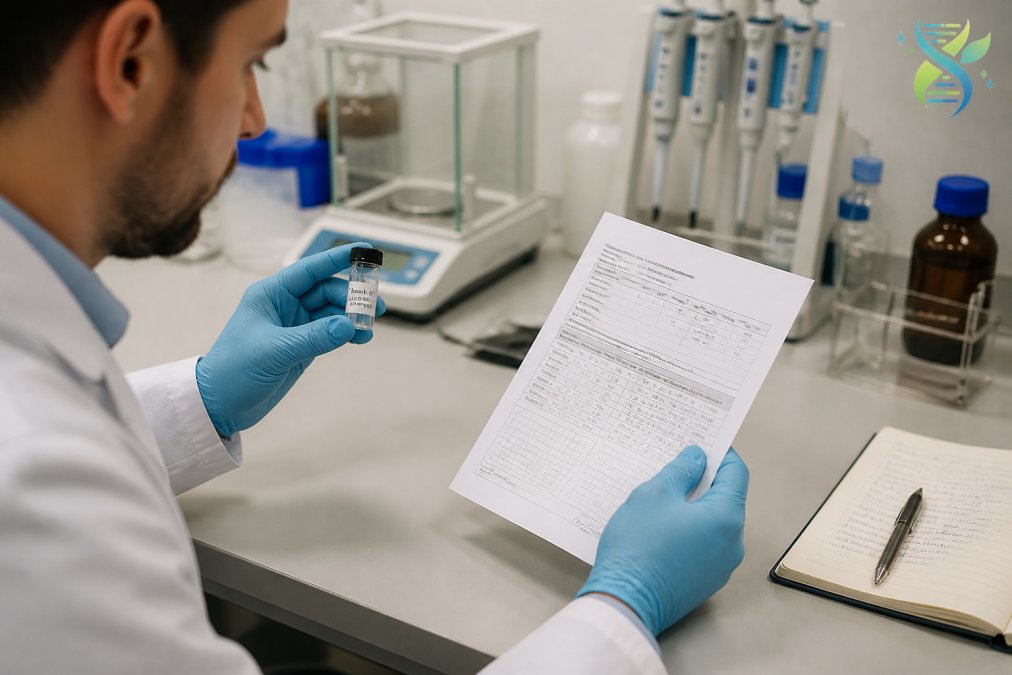
A strong traceability system documents source and lot numbers of all raw materials, dates and conditions of each synthesis step, in-process testing results, final purity and potency testing, storage conditions and expiration data, and chain of custody from manufacturing to your lab.
This documentation allows you to trace any quality issue back to its source and provides evidence that the batch was handled properly throughout its lifecycle. A study assessing batch-to-batch consistency of a herbal product found that different batches had the same physico-chemical parameters, UV spectrometry, and HPLC fingerprinting results, assuring reproducibility, efficacy, and safety. This level of consistency is only possible with comprehensive documentation and standardised processes.
When selecting a supplier, ask to see their batch records. A supplier confident in their quality will be transparent about this.
Everform Research maintains detailed batch records for every compound we supply. You can request documentation that traces your peptide from synthesis through final testing.
Troubleshooting Inconsistent Batches
First, verify the batch number matches the COA. If the numbers match but the purity is lower than specified, contact your supplier immediately.
Document everything: the batch number, the purity you received, the purity you expected, and any experimental problems you encounter. Run a positive control with a known-good batch from a previous shipment. If your assay works fine with the old batch but fails with the new one, the new batch is the problem. If both batches fail, the problem is in your experimental setup.
Request a replacement batch from your supplier. If the replacement also shows low purity, you have a supplier problem. Switch vendors. If the replacement is consistent, the first batch was an anomaly.
For your own records, create a simple tracking table:
| Batch Number | Order Date | Purity (COA) | Purity (Your Testing) | Assay Performance | Notes |
|---|---|---|---|---|---|
| ER-2026-0847 | June 15 | 99.2% | 99.1% | Excellent | Baseline batch |
| ER-2026-0912 | July 8 | 98.7% | 98.5% | Good | Minor variation, acceptable |
| ER-2026-1003 | August 2 | 97.9% | 97.6% | Poor | Below threshold, replaced |
This table becomes your quality history, showing you which suppliers are truly consistent.
Ensuring batch consistency in research isn't a luxury; it's a prerequisite for work that actually means something. When your starting materials vary, your conclusions become unreliable. The good news is that batch consistency research is entirely within your control. You can demand third-party testing, verify batch numbers, track consistency metrics, and switch suppliers when they don't meet your standards.
At Everform Research, we've built our entire operation around delivering compounds that meet the 98%+ purity standard consistently, batch after batch. Our cGMP-compliant manufacturing, third-party analytical testing, and detailed batch documentation mean you can trust that what you receive is exactly what you ordered. When your research depends on reproducible, high-quality peptides, that consistency matters.
Get started with Everform Research and experience the difference that true batch consistency research makes. Use code EVER15 for 15% off your first order.
Frequently Asked Questions
Why is batch-to-batch consistency critical in peptide research?
Batch-to-batch consistency ensures experimental reproducibility and prevents false results from confounding variables. When peptide purity varies between batches, assay performance becomes unpredictable, making it impossible to isolate the true effect of your experimental intervention. A study of Ad5-nCoV vaccine batches involving 1,050 participants demonstrated that immunogenicity consistency was well established across three consecutive production batches, proving that rigorous quality control can maintain reliability. Inconsistent batches introduce variability that compromises your data integrity and wastes research resources.
How do variations in peptide purity affect experimental outcomes?
Peptide impurities below 1% are typically negligible in most experimental designs, but anything below 98% purity introduces enough impurity mass to potentially distort dose-response relationships and experimental outcomes. Minor peptide fragments from incomplete synthesis can alter cellular signalling pathways and yield false positives. For high-throughput screening where you need identical purity across 50+ experiments, a shift from 98% to 96% purity between batches will ruin your data consistency. This is why the pharmaceutical-quality 99%+ purity threshold has become the industry standard for serious quantitative research protocols.
What documentation should accompany a consistent research batch?
Every batch must include a Certificate of Analysis (COA) that documents one specific batch. The batch number on your vial label must match exactly on the certificate; if the lot number does not appear on the document, it describes material that is not what was shipped. The COA should include analytical verification results (HPLC and mass spectrometry purity data), manufacturing controls documentation, batch traceability records, storage and shipping stability information, and supplier transparency statements. This documentation enables you to verify that you received exactly what you ordered and that it meets the quality standards required for your research.
What role does third-party testing play in ensuring batch reliability?
Third-party testing provides independent verification that seller-provided test sheets alone cannot guarantee. Peptide purity is confirmed through High-Performance Liquid Chromatography (HPLC) paired with mass spectrometry, which together assess how much of a sample matches its intended compound and identify any other substances present. Independent laboratories verify that batch numbers on vials match certificates and that purity claims are accurate. This removes the conflict of interest inherent in supplier self-testing and gives you confidence that your research compounds meet the stated specifications before you use them in your experiments.
This article was written using GrandRanker