 ultimate-guide
Causes of Batch to Batch Variability: A 2026 Guide
Table of Contents
- What Is Batch to Batch Variability?
- Raw Material Quality and Its Role in Batch Consistency
- Manufacturing Process Inconsistencies
- Peptide Purity Standards and Analytical Sensitivity
- Analytical Documentation for Peptides and Traceability
- Peptide Synthesis Quality Control and Process Validation
- Storage, Handling, and Environmental Factors
- Human Factors and Data-Centric Approaches to Minimisation
Last Updated: August 27, 2026
What Is Batch to Batch Variability?
Batch-to-batch variability refers to inconsistencies in product quality, composition, or performance between different manufacturing runs of the same compound. For peptide researchers and manufacturers, this means that two batches produced using identical protocols and raw materials can still deliver measurably different results in purity, potency, or stability.
The stakes are real. According to McKinsey analysis on pharmaceutical quality systems, delays caused by quality-related issues can cost five to ten times more than the original manufacturing expense, largely due to lost time and revalidation efforts. When you're running high-throughput screening across 50+ experiments or validating a new therapeutic candidate, a 2% difference in purity between batches can invalidate months of work.
What makes batch-to-batch variability particularly challenging is that it often occurs without triggering out-of-specification results. A batch might pass all release tests yet still perform differently in your assay than the previous batch. This is where most teams stumble: they see the batch certificate and assume consistency, only to discover mid-experiment that their data is scattered across results that shouldn't vary.
Raw Material Quality and Its Role in Batch Consistency
Raw material inconsistency is the foundation of virtually every batch-to-batch problem. Even when suppliers deliver materials that meet specification, natural variation in particle size distribution, density, moisture content, and flow behaviour creates a ripple effect through your entire manufacturing process.
For botanical peptide precursors and synthesised intermediates, the variability starts before synthesis even begins. According to research from ResearchGate on batch variation in processability, the source of variation in full-scale processability of 131 batches of 5-aminosalicylic acid was directly related to differences in the combined effects of particle size and packing behaviour. This wasn't a specification failure, it was raw material heterogeneity that passed acceptance criteria.
Climate, harvest timing, and storage conditions compound this for natural-derived materials. A botanical extract harvested in autumn has a different chemical profile than one harvested in spring. Fertilisation methods, soil composition, and even rainfall patterns during growth influence the final product's behaviour during synthesis and purification.
The real problem isn't that materials vary, it's that most teams don't characterise that variation systematically. You receive a certificate of analysis showing that particle size falls within 10-50 micrometres. That's a massive range. A 10-micrometre particle behaves completely differently in your mixing vessel than a 50-micrometre one. Without granular particle size distribution data, you're flying blind.
Manufacturing Process Inconsistencies
This is where batch-to-batch variability truly multiplies. Even with identical raw materials and documented procedures, the manufacturing process introduces dozens of subtle variables that accumulate into measurable differences between batches.
Mixing Processes and Equipment Degradation
Mixing is deceptively complex. The sequence in which you charge materials, the mixer geometry, operating parameters like speed and duration, and equipment cleanliness between batches all influence final blend uniformity. According to industry analysis, batch-to-batch variability often results from multiple small influences acting together, powder behaviour, fill level, mixing dynamics, transfer steps, environment, and human interaction.
One technician might charge the dry powder first and add the binder slowly. Another might reverse the sequence or increase mixer speed by 10 RPM. Both follow the same written procedure, but their batches behave differently. This is where standard operating procedures become critical: they must specify not just what to do, but how to do it with enough detail to eliminate technician-dependent variation.
Equipment degradation is another silent culprit. A mixer's internal baffles wear over time. Seals degrade. Calibration drifts. Predictive maintenance can catch some issues, harmonic resonance in centrifuges, bearing wear in mixers, but only if you're actively monitoring for it. Most facilities don't.
Peptide Synthesis and Purification Steps
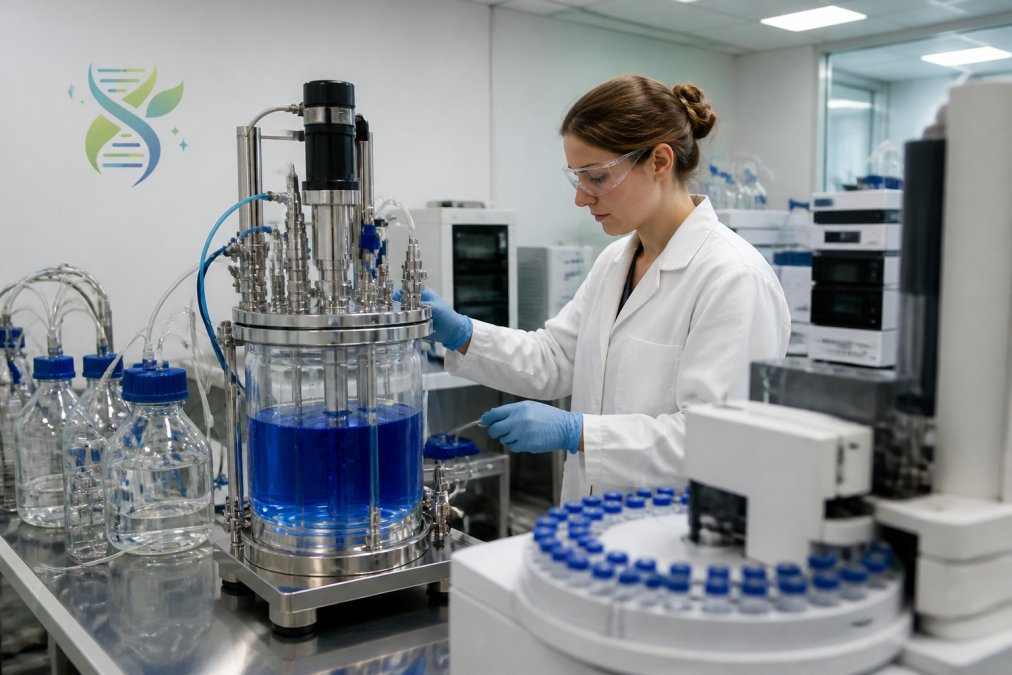
Peptide synthesis is a multi-step chemical cascade. Each step, coupling, deprotection, washing, cleavage, introduces opportunity for variation. A 30-second difference in reaction time, a 2-degree shift in temperature, or inconsistent solvent ratios can alter the final product's purity and identity.
Purification via high-performance liquid chromatography (HPLC) compounds this. Two batches of crude peptide might require slightly different gradient conditions to achieve equivalent purification, yet most teams use a fixed method for all batches. One batch might need a shallower gradient to prevent co-elution of impurities. Another might benefit from a different mobile phase pH. If your purification method isn't adaptive, you're accepting batch-to-batch inconsistency as inevitable.
The research is unambiguous: PMC study on dry powder inhalers, examining batch-to-batch pharmacokinetic variability, found that all pairwise comparisons between different batches failed the pharmacokinetic bioequivalence statistical test, demonstrating substantial differences between batches despite identical formulation specifications.
Peptide Purity Standards and Analytical Sensitivity
Purity is not a binary outcome. A peptide declared "95% pure" might contain 3% of a closely related impurity that behaves identically to the active compound in your assay, plus 2% of unrelated degradation products. Two batches can both be 95% pure yet have completely different impurity profiles.
The problem deepens when your analytical method lacks sensitivity to detect batch-to-batch differences. If your HPLC method has a detection limit of 0.5%, you won't catch impurities below that threshold. Yet those sub-detection impurities can still influence your experimental outcomes, especially in sensitive bioassays or cell-based work.
Analytical sensitivity must match your experimental needs. For high-throughput screening, you need purity data at the 0.1% level. For preliminary research, 1% sensitivity might suffice. The gap between what your supplier measures and what you actually need is where batch-to-batch variability hides.
Analytical Documentation for Peptides and Traceability
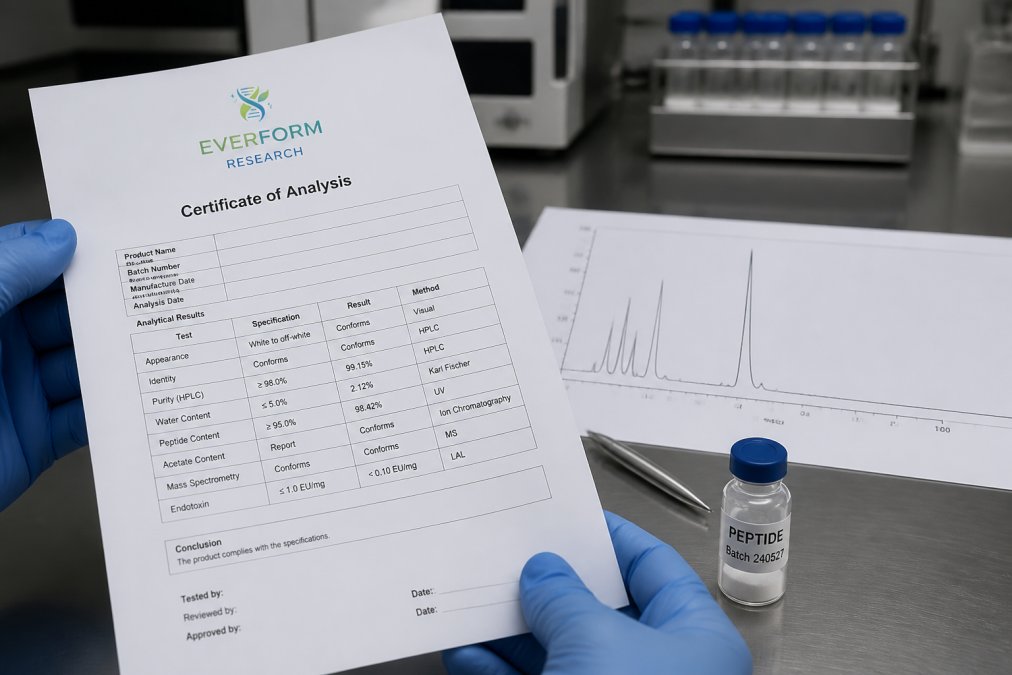
A batch number without a linked Certificate of Analysis (CoA) and analytical data is not a complete traceability system. In 2026, batch-specific CoAs with HPLC chromatograms and mass spectrometry confirmation are the minimum documentation standard for research-grade compounds.
Yet many suppliers still provide generic CoAs that list only final test results. You see "Purity: 98%" but no chromatogram. You see "Identity: Confirmed by MS" but no mass spectrum. This opacity creates a critical vulnerability: if your results don't match expectations, you cannot determine whether the batch was actually different or whether your assay conditions shifted.
Everform Research prioritises transparent documentation because inconsistent batches become immediately apparent when you have detailed analytical data to compare. A chromatogram from batch A versus batch B reveals whether purity differences stem from a specific impurity or from broader compositional drift.
Incomplete traceability is a false economy. Yes, detailed documentation costs more upfront. But when you discover mid-project that your last three batches have drifted in purity, you'll wish you had chromatograms to pinpoint when and why the change occurred.
Peptide Synthesis Quality Control and Process Validation
Quality control that focuses only on final product testing is reactive, not preventive. You catch the problem after it exists. True batch consistency comes from controlling the process itself, validating that every step performs consistently and that deviations are detected early.
Process validation for peptide synthesis requires documenting the performance envelope for each critical step: coupling efficiency, deprotection completeness, wash solvent carry-over, cleavage yield. When you know that your coupling reaction should reach 98% completion within 45 minutes at 25°C, you can flag a batch where coupling only reached 94% as a potential problem before it compounds through subsequent steps.
Design of Experiments (DoE) and Quality by Design (QbD) principles are essential here. Rather than fixing all parameters and hoping for consistency, you systematically explore how variables interact. This reveals which parameters truly drive batch-to-batch variability and which are noise. A well-designed DoE might show that solvent ratio matters far more than temperature, allowing you to relax temperature control and tighten solvent specifications.
Statistical process control charts, plotting key parameters over time, make trends visible. If your coupling yields gradually drift from 98% to 96% over 12 batches, you'll see it in the chart long before a batch fails specification. This early detection is what separates manufacturers who achieve consistency from those who accept variability.
Storage, Handling, and Environmental Factors
Peptides are fragile molecules. A 10°C increase in ambient temperature can double the rate of chemical degradation for most synthetic sequences. Yet many research labs store peptides at room temperature or in standard refrigerators, not freezers.
The stability window for reconstituted peptides is significantly narrower than for lyophilised powder. A lyophilised vial stored at -20°C might remain stable for years. The same peptide reconstituted in solution degrades measurably within weeks, even under refrigeration. If you're comparing results from a freshly reconstituted batch against one that's been in solution for three weeks, you're not comparing batches, you're comparing degradation states.
Cold-chain management during transit is equally critical. A peptide shipment that sits in a warm warehouse for 24 hours before reaching you has already begun degrading. Rigorous cold-chain protocols, temperature-monitored shipping containers, overnight delivery, thermal insulation, cost more but preserve batch integrity.
Environmental factors in your own facility matter too. Humidity fluctuations can affect peptide powder hygroscopicity and flow behaviour. Temperature swings during the day influence dissolution rates and stability. A climate-controlled environment costs money, but it's the difference between reproducible results and mysterious batch-to-batch scatter.
Human Factors and Data-Centric Approaches to Minimisation
Here's the uncomfortable truth: most batch-to-batch variability is caused by human inconsistency, not equipment failure or material shortage. Different technicians follow the same procedure differently. One person charges materials faster, another slower. One mixes for exactly 15 minutes, another for 15 minutes plus however long it takes to "look right."
This is why written procedures must be obsessively detailed. Not just "Mix for 15 minutes", but "Mix at 60 RPM for exactly 15 minutes, starting from the moment the last material enters the vessel, using a calibrated timer." Not just "Add solvent slowly", but "Add solvent at a rate of 2 mL per minute using a calibrated peristaltic pump."
But even detailed procedures fail without monitoring. A data-centric approach means capturing real-time data at every step: actual mixing speed, actual temperature, actual timing, actual flow rates. These data points reveal where procedures are being followed inconsistently and where equipment is drifting.
Monitoring and analysing data at each manufacturing stage enables identification of trends, early deviation detection, and proactive process adjustments. A batch that looks fine at the end might show warning signs in the raw data, a coupling yield 2% below target, a wash step that ran 10 seconds short, a temperature excursion of 3°C. Collectively, these small deviations explain why the batch performs differently downstream.
Batch-to-batch variability is solvable, but it requires systems thinking. Raw material characterisation, process validation, analytical documentation, and real-time monitoring are not optional luxuries, they're the foundation of reproducible research.
At Everform Research, we've built our entire operation around eliminating the variability that frustrates researchers. Third-party testing, cGMP-compliant manufacturing, and detailed analytical documentation mean you get batches that perform consistently. No surprises mid-experiment. No unexplained scatter in your data.
Ready to work with peptides you can actually trust? Shop our compounds today and use code EVER15 for 15% off your first order. Your research deserves better than batch roulette.
Frequently Asked Questions
What are the primary sources of batch to batch variability in peptide production?
Batch to batch variability stems from multiple sources acting together: raw material inconsistencies (particle size, density, supplier lot differences), manufacturing process deviations (mixing parameters, equipment degradation, purification variations), storage and handling conditions, environmental factors, and quality control gaps. No single factor typically causes the problem; rather, multiple small influences compound to create measurable differences between batches.
How does peptide purity standards affect batch consistency?
Peptide purity standards define the acceptable composition of each batch and directly influence how variability is detected and managed. When analytical sensitivity is high enough to measure small differences in purity, impurity profiles, and identity markers, variability becomes visible. Inconsistent purity between batches signals process control issues. Research-grade compounds require batch-specific Certificates of Analysis with HPLC chromatograms and mass spectrometry confirmation as the minimum documentation standard. Rigorous purity standards enable early identification of process drift before it causes research failures.
Why is analytical documentation for peptides critical for identifying variability?
Analytical documentation creates traceability and accountability. A batch number without linked analytical data is incomplete in 2026 quality standards. Documentation reveals whether variability results from the manufacturing process itself or from sampling and testing errors. When batch-specific Certificates of Analysis include detailed chromatographic and spectrometric data, researchers and manufacturers can diagnose root causes, identify trends across multiple batches, and make targeted process improvements. Without this documentation, variability remains invisible until it impacts research outcomes or product performance.
What role does peptide synthesis quality control play in reducing batch variability?
Peptide synthesis quality control operates at every stage: raw material characterisation, process parameter monitoring, purification validation, and final product testing. Quality by Design (QbD) principles and Design of Experiments (DoE) identify which process variables most significantly impact batch consistency. Statistical process control methods detect when parameters drift outside acceptable ranges. Multivariate data analysis reveals hidden interactions between variables that cause variability. Organisations implementing holistic quality control, combining real-time monitoring, early deviation detection, and proactive adjustments, achieve substantially more consistent batches and reduce the costs associated with batch failures and revalidation.
This article was written using GrandRanker