 how-to
Ensuring Reproducible Results With Peptides
Table of Contents
- Why Reproducibility Matters in Peptide Research
- Peptide Purity Analysis Methods That Ensure Consistency
- Peptide Storage and Stability Best Practices
- LC-MS Peptide Quantification for Accurate Assay Performance
- Batch-to-Batch Consistency and Quality Control
- Building a Reproducible Peptide Research Protocol
- Conclusion
Last Updated: August 10, 2026
Why Reproducibility Matters in Peptide Research
Reproducible results with peptides are fundamental to research integrity. When peptide quality varies between batches, downstream assays become unreliable, data scatter increases, and conclusions drawn from one experiment may not hold when repeated. Published findings lose credibility, follow-up studies fail to replicate results, and resources are wasted on troubleshooting rather than advancing science.
Peptides are complex molecules. Small variations in synthesis, purification, or storage alter their physical and chemical properties. A batch at 98% purity behaves differently from one at 96%. Sequence variants introduce unexpected interactions. Degradation products interfere with binding assays. These are practical problems that derail experiments every day in labs worldwide.
At Everform Research, we've seen firsthand how batch-to-batch inconsistency undermines years of work. Principal investigators who switch to rigorously characterised peptides often discover that their assays become more stable, their controls tighten, and their results become publishable.
Peptide Purity Analysis Methods That Ensure Consistency
Peptide purity analysis methods form the foundation of reproducible results. No amount of good experimental technique downstream can compensate for starting material that's contaminated or degraded. The analytical methods you choose determine whether you can trust your data or spend months chasing artefacts.
Mass Spectrometry and LC-MS/MS Validation
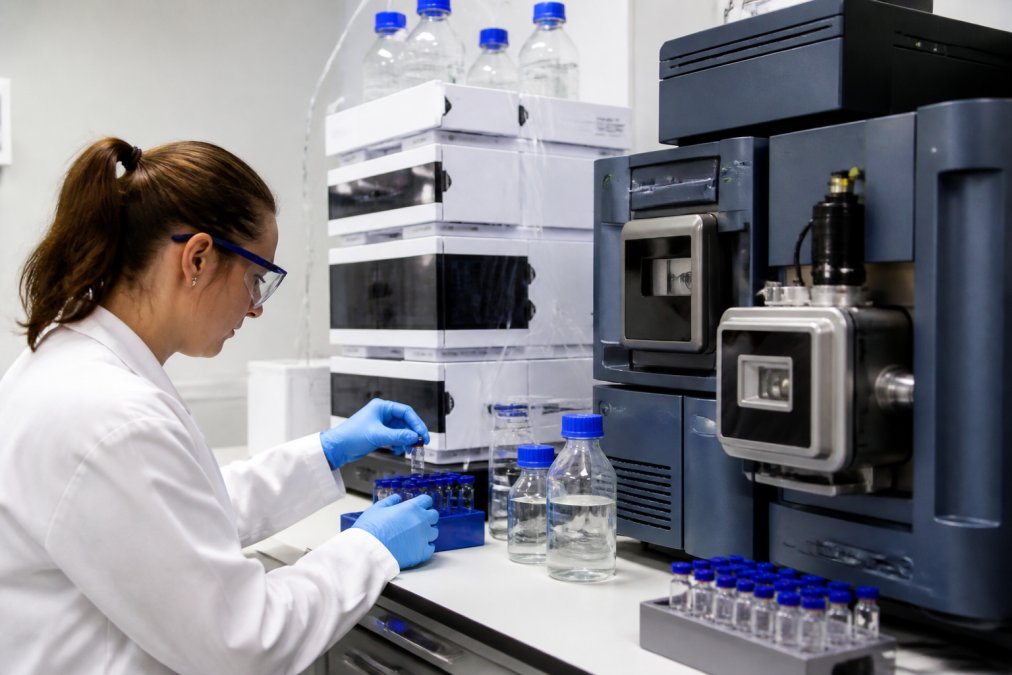
Liquid chromatography paired with tandem mass spectrometry (LC-MS/MS) is the gold standard for peptide characterisation. This method separates peptides by their physical properties, then identifies them with absolute certainty via mass spectrometry. The result is both a purity assessment and definitive sequence verification in a single run.
LC-MS/MS works by ionising peptide molecules and fragmenting them in a predictable pattern. Each peptide has a unique mass-to-charge ratio and fragmentation signature. When your sample contains the target peptide plus contaminants, the instrument detects each separately, showing exactly what percentage is the desired compound versus unwanted by-products or degradation fragments.
Unlike HPLC, which relies on UV absorbance and assumes all peaks are peptides, LC-MS/MS provides absolute identification. A peak that looks like your peptide on an HPLC trace might actually be a host cell protein with similar retention time. Mass spectrometry eliminates this ambiguity entirely.
For reproducible research, you're not guessing about what's in your vial. You have data proving the exact molecular composition. When you run the same assay with the same peptide batch, you get the same result because the starting material is genuinely identical.
High-Performance Liquid Chromatography (HPLC) for Sequence Verification
HPLC is the most widely used method for assessing peptide purity in routine quality control. It's faster and less expensive than LC-MS/MS, making it practical for screening large numbers of batches. However, HPLC has a fundamental limitation: it measures UV absorbance at 214 nm but doesn't identify what the peaks actually are.
In HPLC, your target peptide elutes at a specific time based on its hydrophobicity and size. Contaminants elute at different times, creating separate peaks. The instrument calculates the percentage of total area. If your target peptide peak represents 96% of the total area, the purity is reported as 96%.
The catch: HPLC assumes all peaks are peptides. A synthesis by-product, host cell protein, or partially degraded fragment will absorb UV light and create a peak. You see a number, 96% pure, but you don't know whether the 4% is a truncated version of your peptide (which would ruin your assay) or an inert salt (which wouldn't matter).
For reproducibility, HPLC is useful as a screening tool and consistency check. High-quality suppliers pair HPLC with mass spectrometry for both speed and certainty.
Peptide Storage and Stability Best Practices
How you store peptides after arrival determines how long they remain fit for use. Peptides are fragile molecules. Heat, moisture, light, and time degrade them. A peptide stored carelessly at room temperature for six months may lose 10-20% of its activity. The same peptide stored properly at -20°C in a sealed vial will retain nearly all activity for years.
Temperature Control and Buffer Compatibility
The single most important storage variable is temperature. Peptides degrade faster at higher temperatures because molecular motion increases, accelerating hydrolysis and oxidation reactions. Degradation rates roughly double for every 10°C increase in temperature.
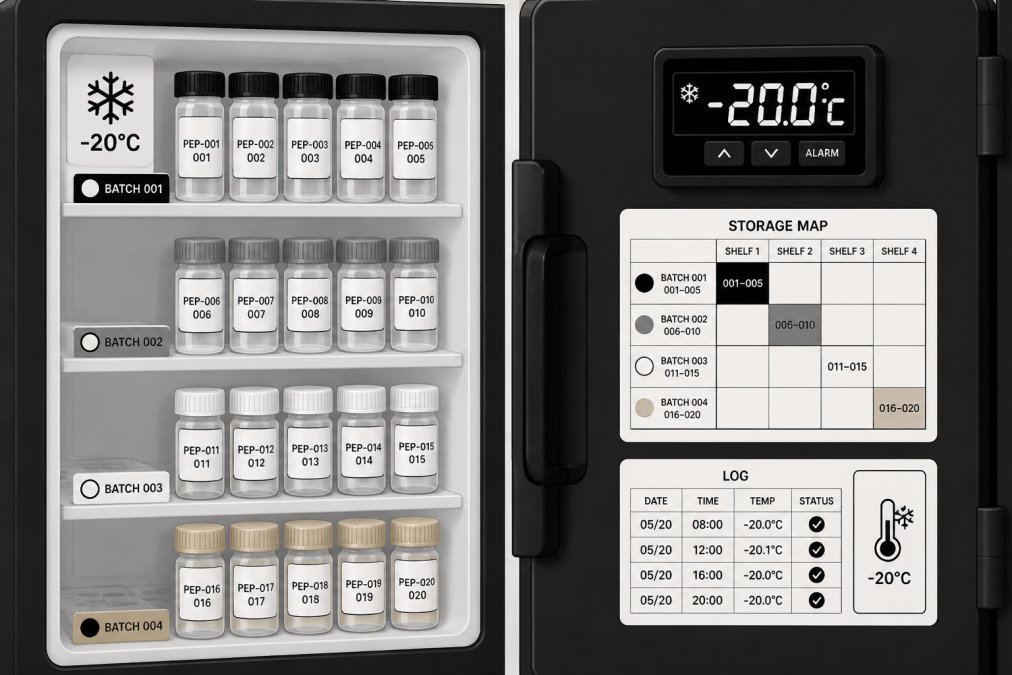
Freezer storage at -20°C is the standard for long-term peptide stability. At this temperature, chemical reactions slow dramatically, and peptides can remain stable for years. Ultra-low freezers at -80°C are even better for very long-term storage (5+ years).
The second consideration is the buffer or solvent. Peptides dissolved in water alone are more prone to degradation than those in buffered solutions. A buffer maintains pH stability, preventing hydrolysis of peptide bonds. Common storage buffers include phosphate-buffered saline (PBS) or acetate buffers at pH 4-7.
Some peptides are hydrophobic and don't dissolve well in purely aqueous buffers. These may be stored in organic solvents like DMSO or acetonitrile, or in buffers supplemented with organic co-solvents. The key is matching the storage condition to the peptide's chemical properties.
Documentation and Standard Operating Procedures
Reproducibility requires documentation. Every vial should have a label recording the storage temperature, receipt date, buffer or solvent, and any known stability data. When you run an experiment and get unexpected results, the first diagnostic question is: how old is this peptide, and how has it been stored?
A proper standard operating procedure (SOP) for peptide handling should specify storage temperature and container type, acceptable storage duration, thawing protocol (slow thaw on ice, not at room temperature), how to verify peptide integrity before use, and how to document each use and remaining quantity.
When troubleshooting an assay that worked last month and doesn't work now, the difference between a peptide stored at -20°C for two months versus one stored at 4°C for six months becomes critical. Documentation tells you which scenario you're in.
LC-MS Peptide Quantification for Accurate Assay Performance
Quantification, knowing the actual concentration of peptide in your solution, is where many experiments fail silently. A peptide vial labelled as 10 mg/mL but actually containing 9.2 mg/mL will cause every assay using that peptide to be systematically off by 8%. If you're running multiple batches with different actual concentrations, your assay will show artificial batch-to-batch variation.
Standardisation of Quantification Methods Across Batches
LC-MS peptide quantification uses isotopically labelled internal standards to measure concentration with high accuracy. You add a known amount of a peptide identical to your target except for stable isotope labelling (usually heavy carbon or nitrogen). The labelled peptide behaves identically to the unlabelled version during analysis, but the mass spectrometer distinguishes them by their mass difference.
When you run the sample through LC-MS, you get two peaks: one for your unlabelled peptide and one for the labelled standard. The ratio of their peak areas tells you exactly how much unlabelled peptide is present, because you know precisely how much labelled peptide you added. This method is far more accurate than UV absorbance methods, which rely on extinction coefficients that can vary with peptide sequence.
For reproducibility across batches, standardised quantification is essential. If batch A is quantified by amino acid analysis and batch B by LC-MS, you're comparing results from two different methods with different accuracy profiles. High-quality suppliers use the same quantification method for every batch they produce, ensuring consistency.
Common Pitfalls in Peptide Quantification
The most common pitfall is assuming the supplier's reported concentration is accurate without independent verification. Suppliers vary in their quality standards.
A second pitfall is failing to account for water or solvent content in the reported concentration. A peptide solution labelled as "10 mg/mL in PBS" might actually be "10 mg/mL peptide plus PBS," meaning the actual peptide concentration is lower.
The third pitfall is not accounting for counter-ions or salt associated with the peptide. Peptides synthesised as acetate salts or with trifluoroacetic acid (TFA) counter-ions carry additional mass. Reputable suppliers specify the form (free base, acetate salt, TFA salt) explicitly.
The fourth pitfall is storing quantified solutions without accounting for evaporation or degradation. A peptide solution quantified on day one and used on day 90 without re-verification may have lost water through evaporation or lost peptide through degradation. For critical assays, re-quantify after extended storage.
Batch-to-Batch Consistency and Quality Control
Batch-to-batch consistency is the hallmark of a reliable peptide supplier. It's the difference between an assay that works reliably and one that works sometimes. Consistency requires rigorous quality control at every step of synthesis, purification, and characterisation.
A strong quality control programme includes in-process checks during synthesis, final purity assessment by multiple methods (HPLC and mass spectrometry), sequence verification, quantification, and stability testing. Each batch is compared against reference standards and previous batches to detect drift.
When you receive a peptide from a supplier, you should receive a certificate of analysis (COA) documenting the results of quality control testing. A good COA includes purity (by HPLC and/or LC-MS), molecular weight confirmation (by mass spectrometry), quantification method and result, storage conditions and stability data, batch identification and synthesis date, and relevant analytical chromatograms or spectra.
A minimal COA that just lists "purity: 95%" without supporting data is a red flag. You can't verify it, and you can't troubleshoot if something goes wrong.
Everform Research provides third-party testing verification for all compounds, ensuring that the data you receive comes from an independent laboratory, not just the manufacturer's internal testing.
Building a Reproducible Peptide Research Protocol
Reproducibility at the protocol level starts with the peptide itself but extends to how you use it. A high-quality peptide in a poorly designed assay will still fail to produce reproducible results.
A reproducible protocol requires standardised peptide sourcing (use the same supplier and batch whenever possible; run bridging experiments when switching batches), documented handling procedures (write down exactly how you prepare working solutions, how long they're stable, and how you store them), internal controls in every run (include a positive control and negative control), quantification checks (verify the concentration of your working peptide solution periodically), batch-specific validation (run a small validation experiment before committing new batches to critical work), and statistical monitoring (track assay results over time to detect drift).
Ensuring reproducible results with peptides is fundamentally about control: controlling the quality of your starting material, controlling how you store and handle it, and controlling how you use it in your assay. This requires investment in analytical characterisation upfront and rigorous documentation throughout. The payoff is assays you can trust, results you can publish, and experiments that other labs can actually replicate.
At Everform Research, we've built our reputation on this principle. Every peptide we supply is backed by third-party testing, detailed documentation, and the commitment to consistency that makes your research reproducible. When you're ready to upgrade your peptide sourcing, our team is here to help you transition smoothly. Use code EVER15 for 15% off your first order and experience the difference that genuine quality control makes.
Frequently Asked Questions
How does peptide purity impact experimental results?
Peptide purity directly determines the reliability of your assay data. Lower purity introduces variability across experiments, meaning identical protocols may yield different results batch to batch. Even small deviations, such as 98% versus 96% purity, can shift quantification, alter binding kinetics, and compromise statistical power. High-purity peptides (typically >95%) reduce inter-experimental deviation and ensure your findings remain reproducible across multiple trials and laboratories.
What analytical methods verify peptide quality most reliably?
Mass spectrometry (particularly LC-MS/MS) and high-performance liquid chromatography (HPLC) are the gold standards for peptide verification. LC-MS/MS confirms molecular weight and sequence identity, whilst HPLC measures purity and detects degradation pathways. Combined with amino acid analysis and counter-ion quantification, these methods provide comprehensive quality assurance. Third-party analytical validation, independent of the manufacturer, offers the strongest evidence of actual peptide composition and stability.
Why is batch-to-batch consistency critical in peptide research?
Batch-to-batch variability is the primary source of experimental failure in peptide-dependent assays. If your first batch is 97% pure and your second is 94%, your quantification, binding assays, and proteomics results will shift unpredictably. Consistency ensures that when you repeat an experiment months or years later, you get comparable data. This is essential for publication, regulatory compliance, and replication by other laboratories. Suppliers with rigorous quality control and documented COAs (Certificates of Analysis) minimise this risk.
How should peptides be stored to maintain stability and reproducibility?
Store lyophilised peptides at -20°C or below in a freezer dedicated to research materials, away from light and moisture. Once reconstituted, maintain buffer compatibility and pH stability, most peptides are stable in phosphate-buffered saline or acetate buffers. Always document storage conditions, reconstitution dates, and freeze-thaw cycles in your standard operating procedures. Degradation pathways accelerate at room temperature, so avoid prolonged thawing. Proper storage protocols are as critical as initial purity for maintaining reproducible results across your research timeline.
This article was written using GrandRanker