 listicle
High Purity Peptides for Academic Research: A 2026 Guide
Table of Contents
- What Are High Purity Peptides and Why They Matter for Research
- Peptide Purity Standards and HPLC Verification Methods
- Custom Peptide Synthesis Services: Comparing Your Options
- Quality Control and Certificate of Analysis Standards
- Best Practices for Peptide Storage and Stability
- Applications in Scientific and Academic Research
- Troubleshooting Common Synthesis Failures
- Conclusion: Finding the Right High Purity Peptide Supplier
Last Updated: August 11, 2026
What Are High Purity Peptides and Why They Matter for Research
High purity peptides are synthesised amino acid chains manufactured to exacting standards for use in scientific, academic, and research applications. The difference between 95% pure and 98% pure peptides isn't academic, that 3% gap represents impurities that can skew assay results, interfere with binding studies, or introduce noise into your biochemical data. For principal investigators managing grant timelines and publication deadlines, purity directly determines whether your experiments succeed on the first attempt or require costly replication.
Research-grade peptides undergo rigorous analytical testing including high-performance liquid chromatography, mass spectrometry, and endotoxin screening to verify that what you receive matches the Certificate of Analysis. This transparency is the foundation of scientific integrity.
At Everform Research, we understand that academic labs operate under budget constraints and procurement rules that don't exist in commercial settings. You need peptides that meet institutional compliance requirements, come with verifiable third-party testing, and arrive on schedule. That's why we've built our service around three commitments: rigorous quality verification, transparent documentation, and accessible pricing for premium compounds.
Below, we'll walk you through the standards that define high purity peptides, how to evaluate synthesis services, and the practical steps to integrate new suppliers into your research workflow without compromising data integrity.
Peptide Purity Standards and HPLC Verification Methods
Peptide purity thresholds vary by application, but research-grade standards typically fall into three categories: crude (70-80% pure), standard (90-95% pure), and high purity (95-99%+ pure). If you're running a binding assay where micromolar concentrations suffice, 90% purity may work. For quantitative mass spectrometry or cellular uptake studies, anything below 98% introduces systematic error.
Understanding Purity Thresholds
The term "purity" refers to the percentage of your desired peptide sequence relative to all other compounds in the vial. Impurities arise from incomplete coupling during synthesis, deletion sequences, and side reactions. A Certificate of Analysis should document these impurities quantitatively, not just a percentage, but a breakdown of what else is present.
A 99% pure peptide with unknown impurities is less useful than a 95% pure peptide where every impurity is identified and quantified. Academic labs should demand CoA documents that include: exact peptide identity verified by mass spectrometry, impurity profile with named compounds, water content, endotoxin levels (especially for cell-based assays), and heavy metal screening. If a supplier provides only a single purity percentage without this detail, move on.
Mass Spectrometry and Analytical Testing
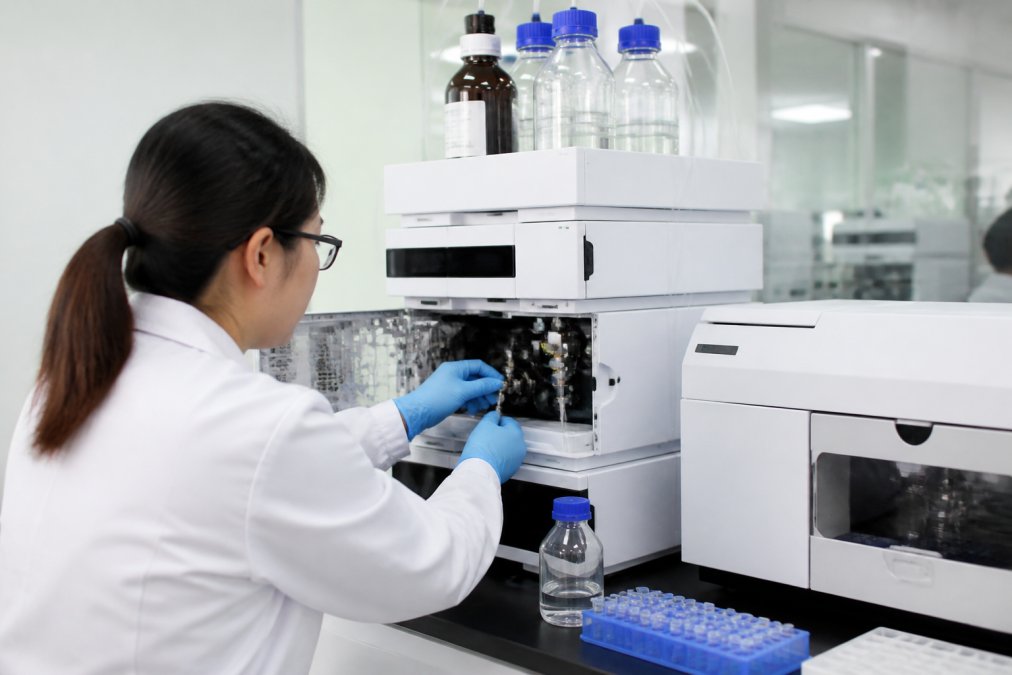
Mass spectrometry confirms peptide identity by measuring molecular weight with extraordinary precision. HPLC combined with MS provides both purity (chromatographic separation) and identity (mass confirmation) in a single analytical workflow.
Many contract manufacturers use HPLC alone for purity assessment. That's acceptable for simple peptides, but it misses structural variants. A peptide with a scrambled sequence might elute at the same retention time as the correct sequence; MS would catch this, HPLC alone would not. For research applications where sequence integrity is non-negotiable, insist on HPLC-MS or equivalent analytical methods.
Analytical testing adds cost and turnaround time. Budget accordingly and communicate timelines with your research team before placing orders.
Custom Peptide Synthesis Services: Comparing Your Options
The peptide synthesis market divides into three operational tiers, each with distinct strengths and constraints.
High-Volume Commercial Platforms vs. Boutique Synthesis Providers
Large manufacturers like GenScript and Thermo Fisher operate automated, high-throughput facilities optimised for speed and standardisation. GenScript's proprietary microwave-assisted synthesis allows them to deliver standard peptides (up to 30 amino acids, no complex modifications) within 5-7 business days at per-amino-acid pricing that scales favourably for simple sequences.
Boutique contract research organisations like AnaSpec and Biomatik prioritise customisation and complex modifications. They excel at phosphorylated peptides, stapled peptides, FRET pairs, and post-translational modifications. For labs synthesising modified peptides regularly, this specialisation justifies the cost and delay.
Mid-tier providers like Biomatik occupy a middle ground: faster than pure boutiques, cheaper than GenScript for bulk orders, and willing to negotiate on complex modifications.
In-House Synthesis: Economics and Control
Automated peptide synthesisers shift the cost structure entirely. The upfront capital investment eliminates per-peptide synthesis fees and gives you complete control over purity levels, modifications, and batch consistency.
If you synthesise 20-30 peptides annually at standard purity, in-house synthesis can be a cost-effective option. Beyond that threshold, the economics may favor internal capability. You also gain intellectual property control, your sequences remain confidential, and you can iterate rapidly without waiting for external turnaround times.
The hidden cost is training and maintenance. Automated synthesisers require operator certification, reagent inventory management, and annual service contracts.
Scale of Synthesis and Turnaround Times
Most academic labs work in the 5-50 mg range, sufficient for multiple experiments without the cost of gram-scale production. Turnaround time correlates inversely with scale and purity:
- 5 mg, 90% purity: 5-7 business days
- 25 mg, 95% purity: 7-10 business days
- 50 mg, 98% purity: 10-14 business days
- 100 mg, 98%+ purity: 3-4 weeks
- 500 mg-1 g, 95%+ purity: 4-8 weeks
If your research timeline is compressed, order early and specify your purity threshold clearly. Requesting 98% purity when 95% would suffice adds 3-5 days and 20-30% cost without improving your assay results.
Modification Options and Customisation
Standard peptide synthesis produces linear chains with free N-terminal and C-terminal ends. Real research often demands modifications:
- Phosphorylation (serine, threonine, tyrosine residues): adds to cost and turnaround time
- Fluorescent labelling (FITC, Alexa Fluor, TMR): adds to cost and turnaround time
- Biotin conjugation: adds to cost and turnaround time
- Cyclisation (head-to-tail or disulphide bond): adds to cost and turnaround time
- Stapled peptides: adds to cost and turnaround time
- PEGylation: adds to cost and turnaround time
AnaSpec specialises in complex modifications and maintains a library of pre-synthesised modified peptides available off-the-shelf, reducing lead time from weeks to days. Before ordering, clarify whether your modification is standard (phosphorylation, common dyes) or custom (novel dye pairs, unusual crosslinks). Standard modifications have predictable pricing and timelines; custom modifications require quotes and may extend timelines by 2-3 weeks.
Vendor Selection Checklist
When comparing synthesis providers, evaluate these criteria:
- Purity guarantee: Does the provider guarantee the stated purity?
- Analytical transparency: Are HPLC and MS data included in the CoA?
- Modification expertise: Does the provider have published examples of similar work?
- Batch consistency: Do they provide CoA data across multiple batches?
- Turnaround flexibility: Can they expedite orders?
- Pricing structure: Is pricing per-amino-acid, per-peptide, or tiered by scale?
- Quality certifications: Are they cGMP-compliant? ISO 9001 certified?
Request samples or small orders from 2-3 providers before committing to a primary supplier.
Quality Control and Certificate of Analysis Standards
A Certificate of Analysis (CoA) is your proof of quality and your documentation for institutional compliance. Many researchers treat it as a checkbox rather than a technical record they should actively interpret and validate.
The CoA Standardisation Problem
The peptide industry lacks universal CoA standards. One supplier's "purity" might mean HPLC area percent; another's might mean mass balance. A third might report purity by UV absorbance at 280 nm, which is unreliable for peptides without aromatic residues. These inconsistencies make it impossible to compare suppliers fairly.
Many commercial CoAs omit critical information: they state "95% pure" without identifying what the other 5% is. Knowing that 3% is a deletion sequence is very different from knowing that 3% is residual trifluoroacetic acid from the synthesis solvent. The first affects your experimental results; the second affects solubility and storage stability.
Academic procurement offices increasingly demand standardised CoA documentation before authorising payment. If your supplier's CoA doesn't match your institution's template, payment can be delayed by weeks.
Interpreting HPLC Purity Data
High-performance liquid chromatography separates peptide molecules by size and charge, producing a chromatogram with multiple peaks. Purity is calculated as:
Purity (%) = (Area of desired peptide peak / Sum of all peak areas) × 100
A CoA stating "97% purity by HPLC" means the desired peptide peak represents 97% of the total area. However, HPLC has a critical limitation: it measures separation, not identity. Two peptides with different sequences but similar size and charge may co-elute, inflating apparent purity. This is why mass spectrometry is essential for confirmation.
When reviewing a CoA, ask: Is the HPLC method documented? What detection method was used? Are impurity peaks identified? Is the chromatogram included?
Mass Spectrometry Confirmation
Mass spectrometry measures molecular weight with extraordinary precision (typically ±0.01 Da for peptides under 5 kDa). A peptide with 15 amino acids has a specific calculated molecular weight. If your MS reading matches the calculated value within 0.05 Da, you have the correct sequence.
MS also reveals structural variants that HPLC misses. A peptide with a scrambled sequence or unexpected modification will have a different molecular weight than expected.
When reviewing MS data, look for: observed vs. calculated molecular weight (should match within 0.05 Da), ionisation method (ESI is standard), mass accuracy, and multiple charge states.
For research applications where sequence integrity is non-negotiable, insist on HPLC-MS or equivalent analytical methods. HPLC alone is acceptable for preliminary screening.
Endotoxin and Heavy Metal Testing
Endotoxins are bacterial lipopolysaccharides that trigger immune responses in cell-based assays. Even trace amounts (>0.1 EU/mL) can confound results. If you're running cell proliferation assays, cytokine release studies, or immune activation experiments, endotoxin screening is mandatory.
Endotoxin testing uses the Limulus Amebocyte Lysate (LAL) assay, which detects endotoxin concentrations as low as 0.01 EU/mL. A CoA should specify endotoxin level in EU/mg, LAL method used, and detection limit.
For cell-based work, acceptable endotoxin levels are typically <0.1 EU/mg. Heavy metal contamination (cadmium, lead, mercury, arsenic) arises from synthesis reagents or equipment. Most manufacturers test for these, but standards vary. Academic labs should specify maximum acceptable levels (typically <10 ppm) and request testing results on every CoA.
Water Content and Lyophilisation Quality
Most research-grade peptides are supplied as lyophilised (freeze-dried) powder. Water content is critical because residual moisture affects peptide stability and introduces uncertainty into concentration calculations.
A CoA should report water content as a percentage by mass (typically determined by Karl Fischer titration). Acceptable water content for lyophilised peptides is usually <5%, with <2% being ideal. If a CoA omits water content data, ask your supplier to provide it.
Building a Standardised CoA Template for Your Lab
Develop a standardised CoA template that your lab requires from all suppliers. This template should include:
- Peptide identification: Sequence, molecular weight (calculated and observed), lot number, synthesis date
- Purity data: HPLC purity (% area), chromatogram, impurity identification
- Identity confirmation: MS molecular weight (observed vs. calculated), ionisation method, mass accuracy
- Biological safety: Endotoxin level (EU/mg), heavy metals screening (ppm), sterility testing (if applicable)
- Physical properties: Water content (%), appearance, storage instructions, expiry date
- Supplier information: Manufacturer name, facility certifications (cGMP, ISO 9001), contact person
Provide this template to your supplier before ordering. Most reputable suppliers can accommodate standardised CoA formats.
Regulatory Compliance for Academic Labs
Institutional biosafety committees and compliance offices increasingly scrutinise peptide sourcing. cGMP (current Good Manufacturing Practice) certification is the gold standard, it means the manufacturer's facility, processes, and documentation meet FDA expectations for pharmaceutical manufacturing.
Not all academic research requires cGMP peptides. Small-scale basic research typically doesn't. But if your work involves human subjects, translational research, or potential commercialisation, cGMP becomes relevant. When submitting peptide CoAs to your IBC or compliance office, include supplier quality certifications, complete analytical data, Material Safety Data Sheets, and supplier contact information.
Best Practices for Peptide Storage and Stability
Peptides are fragile molecules. Moisture, heat, light, and oxidation degrade them. Proper storage extends shelf life from months to years and maintains purity between synthesis and use.
Storage Conditions and Shelf Life
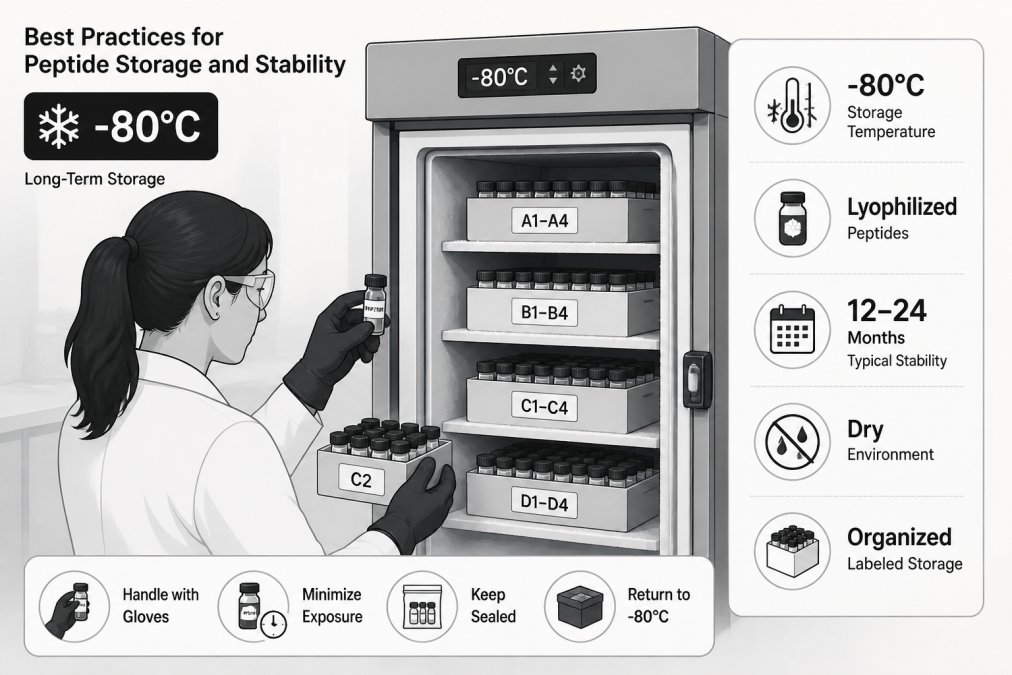
Lyophilised peptides are shipped as white powder in sealed vials. Storage at -20°C extends shelf life to 2-3 years; storage at -80°C extends it to 5+ years. Room temperature storage degrades peptides within weeks. Never store peptides in a standard refrigerator (4°C), as repeated freeze-thaw cycles accelerate degradation.
Once reconstituted in solution, peptide stability depends on the solvent and storage temperature. Aqueous solutions at 4°C remain stable for 1-4 weeks. Solutions in 30% acetonitrile or dimethyl sulfoxide (DMSO) last longer, up to 3 months at 4°C. For long-term storage of reconstituted peptides, aliquot into small volumes, freeze at -80°C, and thaw only what you need.
Hydrophobic peptides require organic solvents (acetonitrile, DMSO, methanol) or detergent-containing buffers. Some manufacturers offer TFA removal services to improve solubility.
Handling Lyophilised Powder and Reconstitution
A lyophilised peptide vial contains exactly the mass stated on the label, but dissolved peptide concentration depends on your solvent choice and final volume. Measure carefully.
Use deionised water or PBS for aqueous peptides. For hydrophobic peptides, start with 50% acetonitrile or DMSO, then dilute with water if needed. Add a small volume of solvent (100-200 µL), vortex gently for 30 seconds, then add the remainder. Don't shake vigorously, as this introduces bubbles and oxidises the peptide.
Record the reconstitution date and solvent on your vial. Store aliquots at -80°C if you won't use the entire stock within a week. Before use, confirm visual clarity; cloudiness indicates precipitation.
Applications in Scientific and Academic Research
High purity peptides enable reproducible research across multiple disciplines: immunology, cell biology, drug discovery, and biomarker validation.
Biochemical Assays and Bioavailability Studies
Peptide binding assays (ELISA, SPR, fluorescence polarisation) require known peptide concentration and purity. A 95% pure peptide introduces 5% uncertainty into your concentration calculation; this propagates through your entire assay. Using 98%+ pure peptides reduces this source of error and improves assay sensitivity.
Bioavailability studies in animal models demand peptides of consistent purity across batches. Suppliers who guarantee batch consistency, backed by CoA documentation, are essential for this work.
Cell-based assays using synthetic peptides require endotoxin-free peptides. Bacterial contamination triggers non-specific immune activation, masking your true results. Always specify endotoxin screening for cell work.
Troubleshooting Common Synthesis Failures
Synthesis doesn't always succeed. Peptides fail for predictable reasons, and knowing them helps you recover quickly.
Incomplete coupling is the most common failure. A single amino acid doesn't attach properly, leaving a deletion sequence. This shows up as a secondary peak in HPLC and a lower-than-expected molecular weight in MS. Ask your supplier to re-synthesise with extended coupling times.
Hydrophobic peptides precipitating during synthesis is the second major issue. Long stretches of hydrophobic amino acids cluster together and fall out of solution. Some manufacturers offer specialised synthesis or use different solvents to prevent this.
Oxidation of methionine residues occurs during storage or synthesis. Methionine has a reactive sulfur atom that oxidises to methionine sulfoxide, changing the peptide's properties. Request inclusion of antioxidants (ascorbic acid, DTT) in your storage buffer if your peptide contains methionine.
Aggregation upon reconstitution happens with hydrophobic peptides. Warming the vial, adding detergent (0.1% Tween-20), or using organic solvents often resolves this.
If synthesis fails, communicate clearly with your supplier: share your HPLC and MS data, specify your application, and ask for root-cause analysis. Reputable suppliers investigate failures and adjust their process.
Conclusion: Finding the Right High Purity Peptide Supplier
Selecting a peptide supplier is a decision that affects your research timeline, data quality, and institutional compliance. The lowest price rarely delivers the best value. Instead, prioritise suppliers who provide transparent CoA documentation, third-party analytical testing, and consistent batch quality.
Everform Research combines rigorous third-party testing with cGMP-compliant manufacturing and accessible pricing for premium compounds. Our commitment to transparency and batch consistency means your experiments run smoothly the first time. We provide detailed documentation that satisfies institutional compliance requirements, responsive support when questions arise, and a growing selection of peptide products backed by quality you can trust.
Ready to experience the difference that verified quality makes? Explore our peptide selection and place your first order today. Use discount code EVER15 for 15% off your initial purchase.
| Purity Level | Typical Application | Analytical Methods | Turnaround Time | Best For |
|---|---|---|---|---|
| 70-80% (Crude) | Preliminary screening | HPLC only | 3-5 days | Budget-conscious pilot work |
| 90-95% (Standard) | Most biochemical assays | HPLC + MS | 7-10 days | Routine research applications |
| 95-99% (High Purity) | Quantitative assays, cell work | HPLC-MS + endotoxin testing | 10-14 days | Sensitive assays, regulatory work |
| 99%+ (Ultra-High) | Bioavailability studies, publications | Full analytical panel + stability data | 14-21 days | Clinical translation, high-stakes research |
Frequently Asked Questions
What is the standard purity level for high purity peptides in academic research?
High purity peptides for academic research typically range from 85% to >98% purity, depending on the application. Most biochemical assays require at least 95% purity, whilst more sensitive applications like quantitative mass spectrometry studies demand >98% purity. The exact threshold depends on your experimental design and whether minor impurities could interfere with results. Always verify the purity specification against your research protocol before ordering.
How do I verify that high purity peptides meet quality standards?
Verification relies on the Certificate of Analysis (CoA) accompanying each batch, which should include high-performance liquid chromatography (HPLC) results, mass spectrometry data, and amino acid sequence confirmation. Independent third-party testing provides the most reliable verification. Check that the CoA clearly states purity percentage, molecular weight, and any detected impurities. Reputable suppliers like Everform Research provide transparent documentation and third-party verification to ensure batch consistency and research-grade quality.
What are the main differences between crude and high-purity synthetic peptides?
Crude peptides (typically 50-70% purity) contain significant synthesis byproducts and impurities, making them unsuitable for most research applications. High purity peptides (>95%) undergo additional purification steps using HPLC and other analytical methods, removing trifluoroacetic acid residues and synthesis intermediates. This purification increases cost but ensures batch consistency, reproducibility, and reliability in experiments. For academic research requiring quantitative results, high purity peptides are essential.
What storage conditions do high purity peptides require?
High purity peptides are typically supplied as lyophilised powder and should be stored at -20°C or below to maintain stability and prevent degradation. Keep vials in a sealed, dry environment away from moisture and light. When reconstituted, peptide solutions should be stored at 4°C for short-term use (days to weeks) or frozen at -20°C or -80°C for longer storage. Always follow the supplier's specific storage recommendations, as stability varies by peptide sequence and composition.
Why should I choose a supplier with cGMP-compliant manufacturing?
cGMP (current Good Manufacturing Practice) compliance ensures consistent, documented manufacturing processes that meet regulatory standards for quality and safety. This matters for academic research because it guarantees batch consistency across multiple experiments. Suppliers like Everform Research maintain cGMP standards, which means rigorous quality control, validated testing methods, and transparent documentation. For researchers managing multiple projects or publishing results, cGMP compliance reduces variability and strengthens the credibility of your findings.
This article was written using GrandRanker