 how-to
How to Choose a Reliable Peptide Testing Lab in 2026
Table of Contents
- Why the Importance of Third Party Testing Cannot Be Overstated
- Step 1: Confirm the Lab Uses Validated Analytical Methods
- Step 2: How to Read a Peptide Certificate of Analysis
- Step 3: Check for ISO 17025 Laboratory Certification
- Step 4: Evaluate Turnaround Time, Logistics, and Chain of Custody
- Step 5: Compare Testing Tiers and Regulatory Submission Support
- Common Mistakes When Selecting a Peptide Testing Lab
- Frequently Asked Questions
Last Updated: September 17, 2026
Why the Importance of Third Party Testing Cannot Be Overstated
If you're sourcing research compounds, knowing how to choose a reliable peptide testing lab is the difference between clean data and a ruined experiment. Research-grade peptides should hit at least 98% HPLC purity, and premium vendors push past 99%, according to PeptaLabs' 2026 vendor guide. That gap sounds small. It isn't.
A 2% impurity can wreck a binding assay or skew a dose-response curve. And you can't spot it by looking at the vial.
This guide from Everform Research walks through a five-step framework for vetting any peptide testing lab.
Internal Quality Control vs. Independent Verification
In-house testing is a conflict of interest. The vendor grades its own homework.
If the answer is "our internal team," walk away.
Step 1: Confirm the Lab Uses Validated Analytical Methods
A legitimate peptide testing lab runs two tests, not one. Purity alone tells you nothing about whether the compound is what the label claims.
The two pillars are:
- HPLC (High-Performance Liquid Chromatography) measures purity and flags impurities
- Mass Spectrometry confirms molecular identity and mass accuracy
HPLC and Mass Spectrometry: The Two Pillars of Peptide Analysis
HPLC separates compounds by how they travel through a column. The result is a chromatographic purity reading, usually shown as a percentage.
Step 2: How to Read a Peptide Certificate of Analysis
A Certificate of Analysis (CoA) is a document that reports the test results for a specific batch of peptides. It should show purity, identity, and the lab that ran the tests.
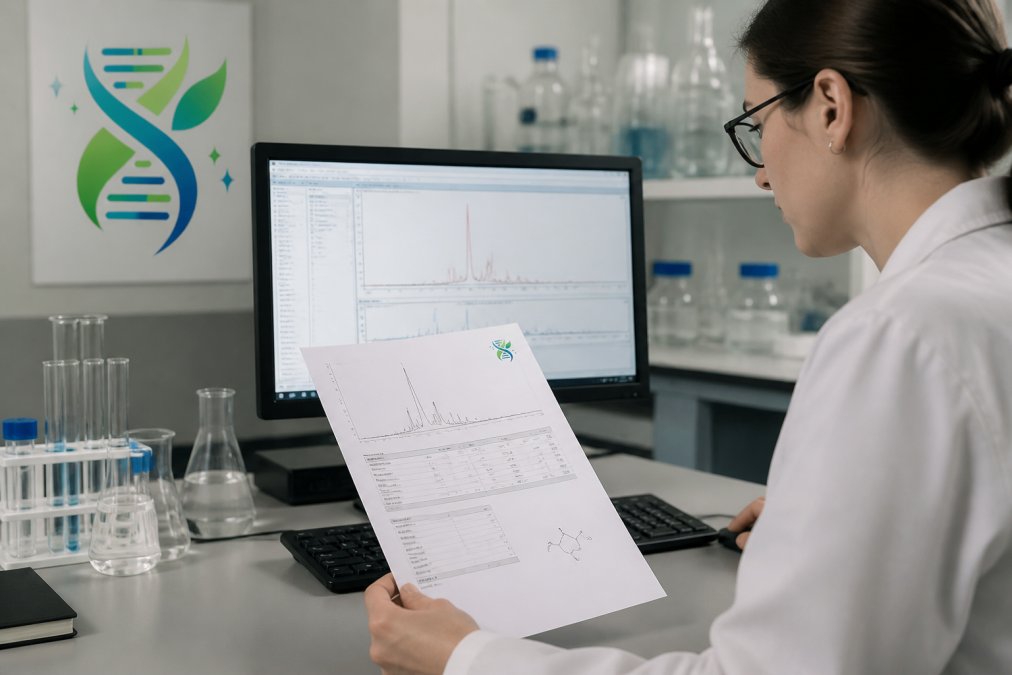
Check these fields every time:
- Batch or lot number that matches your vial
- Purity percentage from HPLC
- Identity confirmation from mass spectrometry
- Name of the issuing lab
- Date of testing
If any field is missing, the document is decorative.
Red Flags in Lab Reports
Most fake or recycled CoAs give themselves away fast. Watch for these:
- No batch number. A generic CoA covers nothing.
- Purity only, no identity. Purity without identity is half a test.
- Unnamed lab. "Third-party tested" means nothing without a name.
- Blurry scans or edited PDFs. Real labs send clean digital files.
- Identical results across batches. Real testing shows natural variance.
Step 3: Check for ISO 17025 Laboratory Certification
ISO/IEC 17025 is the international standard for testing and calibration laboratories. It is not a badge a lab buys. It is an audit of whether the lab can produce valid, traceable, repeatable results, and whether it knows when its own methods are failing.
- Method validation. The lab must prove each assay performs as claimed, accuracy, precision, linearity, limit of detection, and robustness.
- Traceability. Every measurement must link back to a recognized reference standard, so a purity figure means the same thing in one lab as another.
- Documented standard operating procedures. Written protocols for sample handling, instrument calibration, and data review.
- Competency records. Analysts must be trained and assessed, not just employed.
- Proficiency testing. The lab must periodically test blind samples against peer labs and show it stays within acceptable limits.
Accreditation Bodies and How to Verify a Claim
In the United States, labs are typically accredited by bodies such as A2LA (American Association for Laboratory Accreditation) or recognized signatories of the International Laboratory Accreditation Cooperation (ILAC) mutual recognition arrangement. The accreditation is scoped, a lab may be accredited for HPLC purity but not for mass spectrometry identity, or for one matrix but not another.
Ask for three things:
- The accreditation body's name
- The certificate number
- The specific scope of accreditation
How Accreditation Connects to GLP and Regulatory Submission
Good Laboratory Practice (GLP) is a separate quality system, codified under 21 CFR Part 58. GLP governs how nonclinical laboratory studies are planned, performed, monitored, recorded, and archived. ISO 17025 governs the competence of the testing lab itself. They overlap but are not interchangeable.
| Framework | What It Governs | When It Matters |
|---|---|---|
| ISO/IEC 17025 | Lab competence, method validation, traceability | Routine purity and identity verification |
| GLP (21 CFR Part 58) | Study conduct, record retention, QA oversight | Data intended for regulatory submission |
| Neither | Nothing auditable | Never acceptable for research use |
The Verification Checklist
- Confirm the accreditation body and certificate number
- Confirm the scope includes HPLC and mass spectrometry for peptides
- Confirm the certificate is current, not expired
- Confirm the lab can name the reference standards it uses
- Confirm the lab retains raw data and can re-issue a report if challenged
A lab that cannot answer these five questions is a lab you cannot cite in a regulatory submission, and, more practically, a lab whose results you cannot defend if a batch fails.
Step 4: Evaluate Turnaround Time, Logistics, and Chain of Custody
Fast results mean nothing if the sample was compromised in transit. Chain of custody tracks who handled the sample, when, and under what conditions.
Ask any peptide testing lab these questions:
| Factor | What to Ask | Why It Matters |
|---|---|---|
| Turnaround time | Standard vs. rush options | Delays stall your project timeline |
| Shipping method | Temperature-controlled? | Heat degrades peptides |
| Chain of custody | Documented at each step? | Proves sample integrity |
| Sample retention | Kept for re-testing? | Lets you verify disputed results |
Skipping chain of custody documentation means you can't prove your sample wasn't mishandled. If a result gets challenged, you have no defense.
Step 5: Compare Testing Tiers and Regulatory Submission Support
Most guides list testing tiers without telling you how to choose one. The decision is not about budget alone. It is about what happens if the result is challenged.
Tier 1: Basic Purity and Identity
What you get: an HPLC purity percentage and a mass spectrometry identity confirmation for a specific batch.
Tier 2: Standard with Impurity Profiling
What you get: everything in Tier 1, plus identification and quantification of major impurities, batch traceability documentation, and a retained sample for re-testing.
Tier 3: Advanced with Stability and Regulatory-Ready Documentation
What you get: everything in Tier 2, plus stability testing under defined storage conditions, potency assessment over time, and reports formatted for regulatory submission under GLP.
The Cost-Benefit Math
The temptation is to buy the cheapest CoA that satisfies a vendor checklist. That math breaks down in three places:
- Re-testing. If a basic result is challenged, you pay for a second round of testing plus the delay. The premium tier often costs less than the re-test.
- Failed batches. Impurity profiling catches problems before they reach a study. A single failed in vivo run can cost more than a year of advanced testing.
- Regulatory rejection. A report that lacks GLP documentation, raw data, or traceable standards cannot be filed. The work behind it has to be repeated.
Questions to Ask Before Choosing a Tier
- Does the quote include raw data, or only a summary?
- Is the retained sample stored under conditions that preserve it for re-testing?
- Are impurity standards traceable to a recognized reference?
- Is the report format acceptable to the regulator you are targeting?
- What is the lab's policy if a batch fails, re-test, refund, or nothing?
A lab that answers all five clearly is a lab you can build a program around. A lab that hedges on any of them is a lab you will eventually re-test.
Common Mistakes When Selecting a Peptide Testing Lab
The biggest mistake is treating a CoA as proof. It's a claim until you verify the lab behind it.
Other frequent errors:
- Choosing on price alone, then re-testing everything yourself
- Ignoring batch-specific documentation
- Accepting internal QC as independent verification
- Skipping accreditation checks
- Never asking about chain of custody
Frequently Asked Questions
What specific analytical methods should a reliable peptide testing lab use?
A reliable peptide testing lab should use High-Performance Liquid Chromatography (HPLC) for purity analysis and mass spectrometry for identity verification. Research-grade peptides should meet a minimum of 98% HPLC purity, with premium vendors achieving 99% or higher. The lab should also perform impurity profiling, contaminant screening, and stability testing. Independent third-party testing that uses both methods provides unbiased confirmation of both purity and molecular identity.
How can you verify the authenticity of a Certificate of Analysis?
Check that the CoA is batch-specific and accessible on the product page before purchase. A legitimate document should include both purity and identity verification results, clearly identify the issuing laboratory, and provide lot or run traceability. Look for raw data references, standard operating procedures, and the lab's contact information. If the document is generic, undated, or lacks a named lab, treat it as a red flag and request verification directly from the testing facility.
Why is third party testing critical for peptide quality assurance?
Third party testing removes the conflict of interest that exists when a vendor tests its own products. Independent laboratories provide unbiased verification of purity, identity, and potency. Industry consensus confirms that independent testing is the only way to ensure objective results. Researchers are increasingly prioritizing suppliers that use named, independent labs rather than relying solely on internal quality control, because independent verification catches issues that in-house testing may overlook or suppress.
What certifications should a reputable analytical laboratory hold?
A reputable analytical laboratory should hold ISO 17025 certification, which confirms it meets international standards for testing and calibration competence. GLP compliance is also important for studies intended to support regulatory submissions. Ask whether the lab participates in proficiency testing programs and whether its methods have been validated. These credentials demonstrate that the facility follows documented standard operating procedures and maintains quality assurance systems that produce traceable, defensible results.