 ultimate-guide
Mass Spectrometry Standards for Peptide Synthesis
Table of Contents
- Why Mass Spectrometry Standards Matter for Peptide Synthesis
- Peptide Purity Verification Methods: HPLC, MS, and Beyond
- Peptide Synthesis Quality Control: Building Reproducible Batches
- Troubleshooting Peptide Synthesis via Mass Spec: Common Failures and Fixes
- Types of Mass Spectrometry Standards and Their Applications
- Calibration Mixtures for MALDI-TOF and ESI: Practical Selection
- Storage, Stability, and Regulatory Documentation
- Custom vs. Catalog Standards: The Cost Question
- Frequently Asked Questions
Last Updated: September 16, 2026
Why Mass Spectrometry Standards Matter for Peptide Synthesis
Mass spectrometry standards for peptide synthesis are the reference materials and calibration tools that confirm a peptide's molecular identity, purity, and sequence before it ever reaches your bench. In 2026, that verification step is no longer optional: the aggregate stockout rate for research-grade peptides hit 12.2 percent, and specific compounds like BPC-157 reached 44.8 percent, according to Essential Acids' 2026 technical guide to laboratory standards. When supply is that unstable, you need to know exactly what's in the vial.
This guide breaks down how standards work, where runs fail, and how to document everything for a compliance review.
The stakes are straightforward. A single misidentified residue can compromise an entire study, and purity percentages quoted without context tell you almost nothing about whether a peptide survived shipping and storage.
Peptide Purity Verification Methods: HPLC, MS, and Beyond
The established industry benchmark for high-purity research peptides is greater than 99 percent, and reaching it requires both mass spectrometry for identity and High-Performance Liquid Chromatography for purity assessment, per Axis Biotech's 2026 quality and testing standards guide.
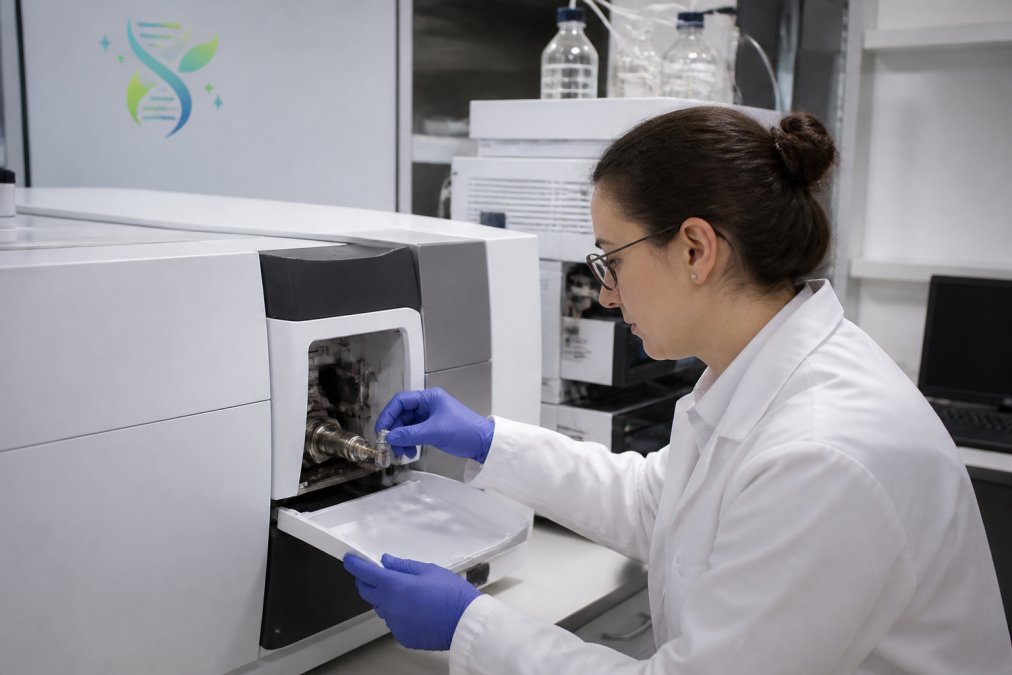
Each method answers a different question:
- HPLC measures how much of the sample is your target peptide versus related impurities
- ESI-MS confirms molecular weight and flags sequence errors
- MALDI-TOF offers fast identity checks with minimal sample prep
- Amino acid analysis validates composition independently of the mass readout
What most guides miss is that these methods fail in different ways. HPLC can report 99 percent purity on a degraded sample if the degradation products co-elute with the main peak. Mass accuracy alone won't catch that.
Peptide Synthesis Quality Control: Building Reproducible Batches
Reproducible batches start with documented synthesis parameters and end with raw analytical data, not a summary certificate. Automated synthesizers typically run at 0.1 to 1 mmol scale, and that scale determines how much material you have for verification, per PMC's recommendations for peptide generation and handling.
A Molecular & Cellular Proteomics study of 5,000 synthetic peptides catalogued post-translational modifications across a large sample set, showing how often sequence-level variation appears in practice. The lesson: batch-to-batch consistency depends on testing every batch, not sampling a few.
| QC Stage | What to Check | Why It Matters |
|---|---|---|
| Crude synthesis | Synthetic yield, mass confirmation | Catches failed couplings early |
| Purification | Chromatographic separation profile | Confirms impurity removal |
| Final release | MS identity plus HPLC purity | Verifies label claims |
| Stability | Re-test at defined intervals | Detects post-analysis degradation |
Troubleshooting Peptide Synthesis via Mass Spec: Common Failures and Fixes
Failed runs usually trace to four causes: contamination, ion suppression, calibration drift, or a genuinely wrong peptide. Start by running your calibration standard again. If it passes, the problem is in the sample.
Common fixes:
- No signal at all, check sample concentration and matrix; crude peptide mixtures often need dilution or cleanup
- Mass shift of 16 or 32 Da, oxidation of methionine or tryptophan residues; add reducing agent during prep
- Mass shift of 57 Da, incomplete deprotection or an extra glycine; re-examine the synthesis record
- Broad, unresolved peaks, salt contamination; desalt before re-running
- Unexplained extra peaks, possible deletion or truncation sequence; request fragmentation data
Types of Mass Spectrometry Standards and Their Applications
Standards fall into four practical categories, and most labs need at least two of them. Choosing correctly comes down to what you're trying to prove.
- Calibration standards set mass scale accuracy across the instrument's range
- Internal standards correct for variability during sample prep and ionization
- Reference materials provide a known identity benchmark for comparison
- Stable isotope-labeled standards enable precise quantification in targeted workflows
The United States Pharmacopeia's work on reference standards for synthetic peptide therapeutics outlines value assignment methods that underpin how reference materials are characterized. Meanwhile, NIST's peptide mass spectral library program builds reference data specifically for biomarker discovery work.
Halogenated peptides have also been introduced as internal standards for quality control, with 10 such compounds developed in one early study reported by ScienceDirect.
Calibration Mixtures for MALDI-TOF and ESI: Practical Selection
Calibration mixture selection depends on your mass range and ionization method, not on brand preference. MALDI-TOF and ESI-MS need different calibrant chemistries, and using the wrong one produces mass accuracy errors that look like sample problems.
For MALDI-TOF, peptide calibration mixtures covering roughly 700 to 3,500 Da handle most synthetic peptide work. For ESI-MS, infusion-based calibrants give tighter mass accuracy across a narrower window.
What most reviews skip: calibration frequency matters more than calibrant choice. Instruments drift with temperature and source contamination. A lab running 50 samples a day should calibrate at the start of each session, not weekly.
Targeted MS isotope analysis is increasingly replacing traditional antibody-based assays, according to Cambridge Isotope Laboratories' 2026 analysis, which changes how calibration standards get selected for SRM and MRM workflows.
Storage, Stability, and Regulatory Documentation
High purity percentages can mislead if the peptide is not stored or transported correctly, because degradation happens after the analysis is complete, as Tide Labs' 2026 quality guide notes. A 99 percent pure peptide stored badly is a 90 percent pure peptide by the time you use it. The same logic applies to your standards: a calibration standard that has degraded gives you a false sense of accuracy across every sample in the run.
Storage basics that actually matter:
- Lyophilized peptides keep best at -20°C, sealed with desiccant
- Reconstituted peptides degrade faster; aliquot before freezing
- Avoid repeated freeze-thaw cycles entirely
- Protect methionine- and cysteine-containing sequences from oxidation
- Keep standards in a separate, labeled box from samples to prevent cross-contamination
- Log every freeze-thaw cycle on the vial, not in your head
For standards specifically, stability is a calibration issue, not just a sample issue.
Documentation for Regulated and GMP-Grade Work
This is where most guides go quiet, and it is where the real risk sits. If your peptide work feeds into a clinical assay, a GMP-grade synthesis, or an institutional review, the standard you used is part of the evidence chain. Reviewers increasingly want raw spectra, not just a purity percentage, and they want to see how the standard was characterized, stored, and re-verified over time.
A documentation package that survives review typically includes:
- Certificate of analysis with the characterization methods named, not just the results
- Raw mass spectra and chromatograms for the standard itself
- Value assignment method, including how the standard's concentration or purity was established
- Storage and handling records, including re-test dates and outcomes
- Chain of custody from supplier to bench
- A statement of intended use, so the reviewer can see the standard was fit for purpose
Custom vs. Catalog Standards: The Cost Question
Most guides tell you to 'pick the standard that fits your workflow' and stop there. That is not a decision. The real question is whether a catalog standard can carry your assay's accuracy requirement, or whether you need a sequence-specific standard synthesized to match your target. The answer usually comes down to four variables: sequence match, quantification level, timeline, and documentation burden.
A practical decision rule:
- One or two routine targets, identity-only work: catalog standard plus a calibration mixture
- Multiple targets, quantification required: custom stable isotope-labeled standard per target
- Regulated or clinical context: custom standard with full raw data package, regardless of target count
- Exploratory screening: catalog standard first, upgrade to custom once a target is confirmed
Frequently Asked Questions
Why are mass spectrometry standards necessary for peptide synthesis?
Mass spectrometry standards provide reference points for mass accuracy and identity confirmation. Without them, you cannot reliably distinguish your target peptide from deletion sequences, truncated products, or contaminants. The 2026 industry benchmark for high-purity research peptides is >99% purity, verified through HPLC for purity assessment and MS for identity confirmation. Even a single misidentified residue can compromise study results, making standards essential for reproducible research.
How do you verify peptide purity using mass spectrometry?
Verification requires two complementary techniques: HPLC separates components by chromatographic retention, while MS confirms molecular identity through mass-to-charge ratio analysis. According to 2026 guidance from Axis Biotech, achieving >99% purity requires both methods working together. You should also examine raw analytical data rather than relying on summary purity percentages, as high purity claims can be misleading if the peptide degrades after analysis due to improper storage.
What role does NIST play in peptide mass spectral libraries?
NIST develops peptide mass spectral libraries that serve as reference data for biomarker discovery and proteomic workflows. These libraries enable researchers to match fragmentation patterns against validated spectra, improving confidence in peptide identification. The National Institute of Standards and Technology continues expanding these resources in 2026, supporting targeted proteomics applications including SRM and MRM analysis where reproducible reference data is critical for quantification.
How often should mass spectrometry equipment be calibrated for peptide analysis?
Calibration frequency depends on your instrument type and throughput. MALDI-TOF systems typically require daily calibration with peptide calibration mixtures before sample runs. ESI-MS instruments benefit from calibration at the start of each analytical session. Always verify mass accuracy against known standards before committing expensive peptide samples to analysis.