 how-to
How to Verify a Peptide Certificate of Analysis
Table of Contents
- What Is a Peptide Certificate of Analysis?
- Why Certificate of Analysis Verification Matters for Research
- Key Components of a Peptide CoA You Should Examine
- How to Read HPLC and MS Reports on Your CoA
- Identifying Fake Peptide CoAs: Red Flags and Warning Signs
- Peptide Purity Testing Standards and Third-Party Verification
- Step-by-Step Process for Verifying a CoA's Authenticity
- Conclusion
Last Updated: August 12, 2026
What Is a Peptide Certificate of Analysis?
A peptide certificate of analysis is a formal laboratory document that certifies the identity, purity, and composition of a peptide compound. It serves as proof that a batch of peptides has undergone rigorous analytical testing and meets specified quality standards. Think of it as a quality passport for your research materials, without it, you're essentially working blind.
The certificate typically includes test results from multiple analytical methods, batch-specific information, and the issuing laboratory's credentials. For researchers, this document is non-negotiable. It bridges the gap between what a supplier claims and what you can actually verify about the product you're purchasing.
At Everform Research, we understand that peptide sourcing demands absolute transparency. A comprehensive certificate of analysis isn't just paperwork, it's your assurance that the compound you're using matches the specifications required for reproducible, reliable research.
Why Certificate of Analysis Verification Matters for Research
Verifying a peptide certificate of analysis verification is essential because peptide quality directly impacts your experimental outcomes. A batch that appears pure but contains unidentified impurities can invalidate months of research, waste reagents, and compromise your credibility when results don't replicate.
The stakes are particularly high in academic and clinical research. Principal investigators depend on consistent, documented quality to satisfy institutional review boards and maintain funding. A single batch with undocumented contamination can trigger protocol reviews, delay publications, and raise questions about data integrity. For independent biotech labs, inconsistent peptide quality means wasted time troubleshooting whether problems stem from the compound or your experimental design.
Beyond the laboratory, researchers in fitness and performance optimisation rely on peptide quality for safety and efficacy. Impurities or mislabelled compounds introduce unknown variables into your biohacking protocols. Verification protects you from compounds that don't match their documentation, protecting both your research validity and your wellbeing.
The verification process itself is straightforward once you know what to look for. Most researchers skip this step because they assume suppliers are trustworthy or because the process seems technical. That assumption has cost many labs months of wasted effort and compromised data.
Key Components of a Peptide CoA You Should Examine
A comprehensive peptide certificate of analysis contains several critical sections. Understanding what each section means and why it matters transforms verification from intimidating to straightforward.
Batch number and manufacturing date
Every legitimate peptide certificate of analysis must display a unique batch number and manufacturing date. These identifiers allow you to trace exactly which production run you're working with and when it was synthesised. Batch numbers aren't random, they follow the manufacturer's internal tracking system and connect your vial directly to the laboratory records.
The manufacturing date matters because peptides degrade over time, particularly if stored improperly. A certificate showing a manufacturing date from two years ago raises questions about storage conditions and stability. Most peptides maintain acceptable purity for 12-24 months under proper conditions, but older batches require additional scrutiny.
Cross-reference the batch number against any documentation from your supplier. If the batch number on your vial doesn't match the certificate, you've found your first red flag. Legitimate suppliers maintain meticulous records linking batch numbers to certificates, storage logs, and chain-of-custody documentation.

Molecular weight and peptide sequence
The molecular weight and peptide sequence represent the fundamental identity of your compound. These aren't approximate values, they're precise, calculated figures based on the amino acid composition of your specific peptide.
The peptide sequence should list every amino acid in order, using standard three-letter or single-letter notation. For example, a simple tripeptide might be listed as Ala-Gly-Ser or AGS. Longer sequences are typically broken into groups of ten for readability. This sequence must match exactly what you ordered, no substitutions, no variations.
Molecular weight calculations flow directly from the sequence. If the sequence is correct, the molecular weight follows mathematically. Conversely, if the stated molecular weight doesn't align with the sequence provided, something is wrong. This mismatch is often the first sign of a fraudulent or poorly prepared certificate.
Pay attention to modifications listed on the certificate. Peptides are often synthesised with N-terminal or C-terminal modifications, acetate additions, or other chemical groups that affect the final molecular weight. These modifications must be explicitly documented and reflected in the final weight calculation.
Purity percentage and impurity profile
The purity percentage is perhaps the most scrutinised value on any certificate. It represents the proportion of your target peptide within the sample, expressed as a percentage. A purity of 95% means 95% of your sample is the desired peptide; the remaining 5% consists of related compounds, synthesis byproducts, or contaminants.
The impurity profile lists what those other compounds are. A detailed profile names specific impurities and their percentages. For example, a certificate might show: target peptide 96%, des-methyl impurity 2%, truncated peptide 1%, other impurities <1%. This level of detail is what separates legitimate certificates from generic templates.
Purity standards vary by application. Research-grade peptides typically range from 85-99% purity. Anything below 85% raises questions about synthesis quality. Anything claiming 99%+ purity requires verification through mass spectrometry and HPLC analysis, those numbers are achievable but demand rigorous purification.
How to Read HPLC and MS Reports on Your CoA
Two analytical methods dominate peptide characterisation: high-performance liquid chromatography (HPLC) and mass spectrometry (MS). Understanding what these reports show transforms a confusing certificate into actionable quality information. Most competitors explain these methods in isolation; the real skill is learning to read them together and spot when results don't align.
Understanding HPLC purity results and retention time
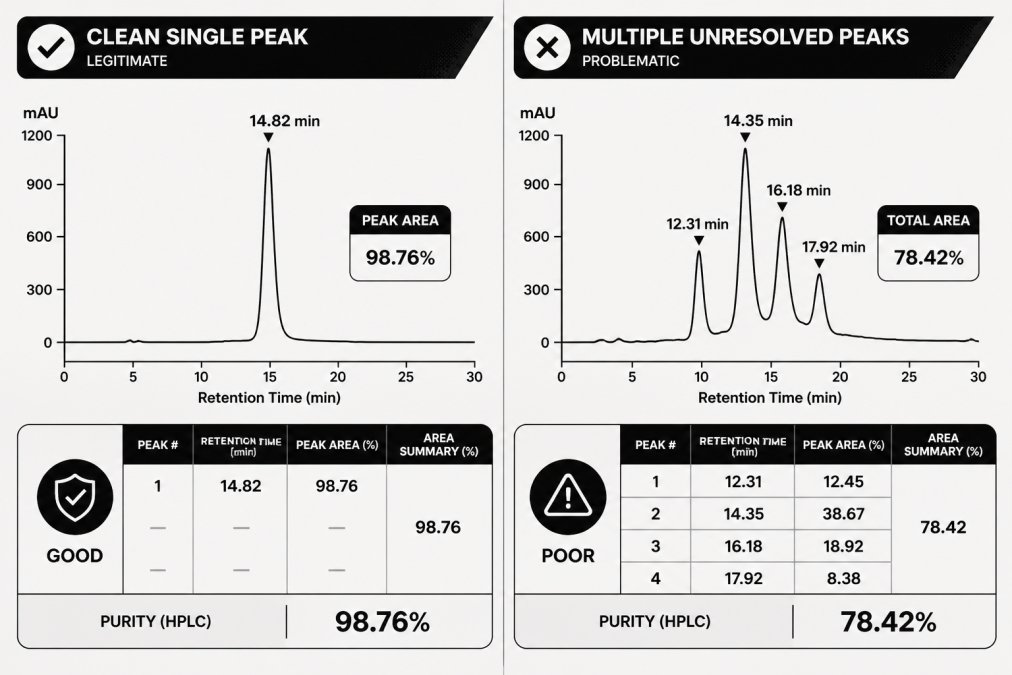
HPLC separates peptide molecules based on their chemical properties as they travel through a column. The resulting chromatogram, a graph showing peaks over time, visually represents what's in your sample. Each peak represents a different compound. The largest peak should be your target peptide, typically accounting for 85-99% of the total peak area depending on your application.
The retention time is when that peak appears on the chromatogram, measured in minutes. Your target peptide always elutes at the same retention time under consistent conditions. If a certificate shows retention time of 12.5 minutes for your peptide, that value should remain consistent across batches tested under the same HPLC method. A variance of more than ±0.2 minutes between batches using identical methods suggests either a problem with the peptide or inconsistent laboratory procedures.
Purity percentage from HPLC is calculated by dividing the area under your target peptide's peak by the total area under all peaks, then multiplying by 100. A chromatogram with one dominant peak at 96% of total area indicates 96% purity. Multiple peaks suggest impurities or degradation products. Here's what to look for in a legitimate HPLC report:
Peak shape and baseline: Your target peptide peak should be symmetrical and well-resolved from other peaks. A peak that's split, tailing (dragging to the right), or fronting (sharp leading edge) indicates either a problem with the peptide or a poorly maintained instrument. The baseline, the flat line between peaks, should be stable and close to zero. Noisy or drifting baselines suggest instrument calibration issues.
Impurity peaks: Legitimate certificates show what those other peaks are. A detailed report might display: target peptide 96.2%, des-methyl impurity 2.1%, truncated peptide 0.8%, unknown impurity 0.9%. This specificity is critical. If a certificate lists "other impurities <1%" without identifying them, you're missing essential quality information. Unidentified impurities could be synthesis byproducts, degradation products, or contaminants, you need to know which.
Detection wavelength and method details: Look for the HPLC method details on your certificate. The method should specify the column type (e.g., C18 reversed-phase, 5 µm particle size), mobile phase composition (e.g., 0.1% trifluoroacetic acid in water and acetonitrile), flow rate (typically 1 mL/min for analytical columns), and detection wavelength. These parameters matter because different methods can produce different results. A peptide tested at 214 nm (a standard wavelength for peptide detection via peptide bond absorbance) will show different peak heights and resolution than one tested at 280 nm (which detects aromatic amino acids like tryptophan and tyrosine). A legitimate certificate specifies which wavelength was used and why. If the method details are missing, you cannot independently verify whether the testing was rigorous.
Integration method: The certificate should explain how peak areas were calculated. Modern HPLC software uses automated integration, but the baseline definition and peak detection parameters vary. A report stating "peaks integrated using tangent baseline with 5 µV threshold" is more credible than one with no integration details. Vague integration descriptions suggest the laboratory didn't document their procedure, a quality control red flag.
Legitimate certificates include the actual chromatogram image or at minimum a detailed table showing retention time, peak area, and percentage for each detected compound. If a certificate states "purity 95%" without showing the chromatogram or explaining how that percentage was calculated, you're missing critical verification data. Request the full chromatogram image before accepting the certificate.
Interpreting mass spectrometry identity data
Mass spectrometry measures the mass-to-charge ratio of peptide molecules, providing definitive proof of molecular identity. Unlike HPLC, which separates compounds based on behaviour, MS directly weighs them. This makes MS the gold standard for confirming you have the right compound, not just a pure compound.
The MS report shows peaks at specific mass-to-charge (m/z) ratios. Your target peptide appears at a calculated m/z value based on its molecular weight and charge state. For a peptide with molecular weight 1500 Da carrying a +1 charge, you'd expect a peak at m/z 1500. The same peptide with a +2 charge appears at m/z 750. Multiple peaks at predictable intervals indicate a peptide with multiple charge states, this is normal and actually confirms the presence of your target compound. If you see random peaks that don't align with expected charge states, you've discovered unexpected compounds in your sample.
Interpreting charge state patterns: A typical electrospray ionisation (ESI) mass spectrum of a peptide shows a series of peaks, each representing the same molecule with a different number of charges. For a 2000 Da peptide, you might see peaks at m/z 2000 (+1), 1000 (+2), 667 (+3), and 500 (+4). The spacing between these peaks follows a predictable mathematical relationship. If your certificate shows only a single peak with no charge-state series, either the peptide is unusually small (under 500 Da) or the MS method wasn't optimised properly. A well-optimised MS method produces a characteristic "envelope" of peaks showing multiple charge states.
Resolution and accuracy: The MS report should specify the ionisation method used, typically electrospray ionisation (ESI) for peptides. The resolution of the instrument matters significantly. High-resolution MS (often called "accurate mass" instruments) can distinguish compounds differing by 0.01 Da or less; lower-resolution instruments might miss subtle differences. A certificate from a high-resolution instrument (e.g., Orbitrap or time-of-flight mass spectrometer) carries more weight than one from a benchtop quadrupole unit. The report should state the mass accuracy achieved, typically ±5 ppm (parts per million) for high-resolution instruments.
Calculated versus measured molecular weight: Look for both the calculated molecular weight (based on the peptide sequence) and the measured value from the mass spectrum. These should match within 0.1% for high-resolution instruments, or within 0.5% for lower-resolution units. Larger discrepancies suggest either calculation errors or contamination with a different compound. For example, if your peptide sequence calculates to 1234.56 Da but the MS shows a peak at 1250 Da, something is wrong. That 15 Da difference could indicate a missing amino acid, an unexpected modification, or a completely different compound.
Isotope patterns: High-resolution MS reports often show isotope patterns, multiple peaks very close together representing the same molecule with different isotope compositions (e.g., carbon-12 versus carbon-13). A legitimate high-resolution report will show these isotope patterns and confirm they match the theoretical pattern for your peptide. If isotope patterns are missing or don't match theory, the instrument resolution may be insufficient or the compound may not be what's claimed.
Combining HPLC and MS for complete verification: Here's where most researchers miss a critical step. HPLC tells you purity (how much of your sample is one compound), but MS tells you identity (whether that compound is the right one). A sample can be 99% pure by HPLC but still be the wrong peptide if MS shows an unexpected molecular weight. Conversely, a sample can show the correct molecular weight by MS but contain multiple forms of that peptide (e.g., oxidised and non-oxidised versions) visible only on HPLC. A comprehensive certificate includes both methods because they answer different questions. If your certificate includes only HPLC or only MS, request the missing analysis before accepting the batch.
Red flags in analytical data presentation
Beyond the numbers themselves, pay attention to how the data is presented. Legitimate laboratories format analytical reports consistently and include all supporting information. Watch for these warning signs:
Rounded or approximate values: Analytical instruments produce precise measurements. A report stating "purity approximately 95%" or "molecular weight ~1500 Da" suggests either lazy data recording or intentional vagueness. Legitimate reports state "purity 95.3%" and "molecular weight 1499.87 Da." The precision reflects the instrument's capability.
Missing method parameters: If the HPLC method section doesn't specify column dimensions, particle size, mobile phase pH, or flow rate, the laboratory either didn't document their procedure or is hiding something. Reproducible analytical work requires detailed method documentation.
No reference standards mentioned: Legitimate HPLC and MS instruments are calibrated against known reference standards. A certificate should mention what standards were used for calibration and when calibration was last verified. If this information is absent, you don't know whether the instrument was properly calibrated when your sample was tested.
Identifying Fake Peptide CoAs: Red Flags and Warning Signs
Fraudulent certificates are more common than many researchers realise. Suppliers operating without proper laboratory infrastructure sometimes fabricate certificates, use templates from legitimate labs, or commission testing from unaccredited facilities and misrepresent the results. Recognising these fakes protects you from wasting resources on substandard compounds. The good news: fraudulent certificates follow predictable patterns. Once you know what to look for, spotting a fake takes minutes.
Visual inconsistencies and document authenticity markers
Start with the physical or digital document itself. Legitimate laboratory certificates follow consistent formatting and include specific visual elements that are difficult to forge convincingly.
Logo and letterhead quality: Legitimate laboratories invest in professional document templates. Their logos should be crisp, properly scaled, and consistent across all certificates. Look for these specific markers:
- Logo clarity: Blurry, pixelated, or stretched logos indicate a hastily prepared document or a scanned image of a scanned image. Legitimate labs use vector-based logos that remain sharp at any size.
- Letterhead alignment: Text and logos should align perfectly to the page. Misaligned elements, inconsistent margins, or text that doesn't line up with the grid suggest a template cobbled together from multiple sources.
- Font consistency: All text should use the same font family throughout (typically a professional serif or sans-serif font like Times New Roman or Arial). If you see multiple different fonts, especially decorative or unusual fonts, that's a red flag. Legitimate laboratories maintain strict formatting standards.
- Colour accuracy: If the certificate is digital, colours should be consistent. A logo that appears in different shades of blue on different pages suggests the document was assembled from different sources.
Signature and authorisation markers: Examine the signature line carefully. Legitimate laboratories use one of three approaches:
-
Digital signatures with timestamp: Modern laboratories use digital signature technology that embeds a timestamp and verification code. These signatures cannot be forged without breaking the digital signature chain. If a certificate includes a digital signature, you can often verify it by opening the PDF in Adobe Reader or similar software, which will display the signer's name, timestamp, and validity status.
-
Printed signatures with consistent ink: If the signature is printed (not handwritten), it should be identical across all certificates from that laboratory. Handwritten signatures vary naturally, but printed signatures should be pixel-perfect identical. If you have multiple certificates from the same laboratory and the signatures differ, something is wrong.
-
Signature blocks with title and credentials: Legitimate certificates include not just a signature but the signer's printed name, title, and sometimes credentials (e.g., "Dr. Sarah Chen, Director of Quality Assurance, Ph.D. Chemistry"). This information allows you to verify the person actually works at the laboratory. Vague signatures like "Lab Manager" or unsigned certificates are red flags.
Certification numbers and verification codes: Many accredited laboratories include a unique certificate number and QR code that links to a verification database. This is a powerful authenticity marker because it's nearly impossible to forge convincingly. To verify:
- Note the certificate number (typically formatted like "CERT-2024-001234")
- Visit the laboratory's official website and look for a "Verify Certificate" or "Certificate Database" link
- Enter the certificate number and batch number into the verification tool
- Confirm the returned data matches your certificate exactly
If the QR code doesn't scan, the verification database returns no results, or the returned data differs from your certificate, you've caught a fake. Legitimate laboratories maintain these databases as a core part of their quality assurance.
Contact information verification: The certificate should list a phone number, email address, and physical mailing address for the issuing laboratory. This is your opportunity to verify independently:
- Do not use contact information from the certificate itself. Instead, visit the laboratory's official website directly (search for the lab name in a search engine, don't click links from the supplier).
- Compare contact details: Does the phone number on the certificate match the number on the laboratory's official website? Does the address match?
- Call the laboratory: Use the number from their official website and ask to verify the certificate. A legitimate laboratory can pull up your batch number and confirm they issued that certificate within seconds.
- Check the address: If the certificate lists a physical address, verify it's a real location. Use Google Maps to confirm the address exists and is actually a laboratory facility, not a residential address or mailbox service.
Mismatched or unverifiable contact information is a major red flag. Fraudulent certificates often use slightly altered versions of real laboratory names or addresses to create confusion.
Temporal inconsistencies and dating anomalies
Fraudulent certificates often contain impossible or suspicious date sequences. Check these carefully:
Manufacturing date after testing date: This is logically impossible. A peptide cannot be tested before it's made. If your certificate shows a manufacturing date of January 15 but a testing date of January 10, the certificate is fabricated. Legitimate certificates always show testing dates after manufacturing dates, typically within 1-7 days for standard testing.
Testing date far after manufacturing date: If the certificate shows a manufacturing date of January 2023 but a testing date of August 2024, question why testing was delayed 19 months. Peptides degrade over time, and delayed testing suggests either poor record-keeping or intentional delay to hide degradation. A legitimate explanation might be that the batch was stored frozen and tested only when the customer requested verification, but this should be explicitly documented on the certificate.
Certificate issue date inconsistencies: The date the certificate was issued (printed or signed) should be the same as or shortly after the testing date. If the certificate was issued in January but the testing date is in December of the previous year, that's reasonable. If the certificate was issued in January but the testing date is in March, something is wrong.
Expiration or validity dates: Some certificates include an expiration date or statement like "Valid for 12 months from issue date." This is a quality marker because it shows the laboratory stands behind their results for a defined period. Certificates with no expiration date or vague validity statements are less credible.
Batch number date encoding: Many laboratories encode the manufacturing date into the batch number itself. For example, a batch number like "PEP-2024-01-001" might indicate January 2024 manufacturing. If the batch number date doesn't match the stated manufacturing date, that's a red flag. You can sometimes decode batch numbers by asking the laboratory for their batch numbering system.
Missing or vague analytical data
Vague certificates are the most common type of fraud. Instead of detailed analytical results, they provide generic statements that sound professional but mean nothing without supporting data.
Generic purity statements: Compare these two examples:
- Vague: "Purity >95%, suitable for research applications"
- Legitimate: "Purity 95.3% by HPLC (method: C18 reversed-phase, 214 nm detection, integrated using tangent baseline)"
The vague statement tells you almost nothing. The actual purity could be 95.1% (barely acceptable) or 89% (substandard). The legitimate statement gives you exact numbers, the method used, and enough detail to understand how the result was obtained.
Missing chromatograms and spectra: A comprehensive certificate includes:
- The actual HPLC chromatogram image showing all peaks with retention times and areas
- The mass spectrum showing the molecular ion peak and charge-state pattern
- Peak integration tables with numerical values
- Or, at minimum, detailed written descriptions of what was observed
If a certificate provides only summary numbers without supporting analytical traces, demand the full report before proceeding. Legitimate laboratories include these images as standard because they're the actual evidence of testing. If a supplier says "the full report is too large to email" or "we only provide summary certificates," that's a red flag. Modern PDF files easily accommodate chromatograms and spectra.
Incomplete certificate sections: A complete certificate includes all of these sections:
- Batch number and unique certificate number
- Manufacturing date and testing date
- Molecular weight and peptide sequence confirmation
- HPLC purity with chromatogram and method details
- Mass spectrometry identity data with m/z values
- Specific impurity identification (not just "other impurities <1%")
- Storage recommendations and stability information
- Laboratory accreditation details (ISO/IEC 17025 or equivalent)
- Signature or digital authorisation from a named individual
If your certificate is missing any of these sections, it's incomplete. Incomplete certificates suggest either lazy preparation or intentional omission to hide problems. Request a complete certificate before accepting the batch.
Impurity profiles that lack specificity: A detailed impurity profile names specific compounds and their percentages. For example:
- Vague: "Purity 96%, other impurities 4%"
- Legitimate: "Target peptide 96.2%, des-methyl impurity 2.1%, truncated peptide (missing C-terminal residue) 1.1%, unidentified impurity <0.6%"
The legitimate profile tells you exactly what's in your sample. The vague profile hides information. If a supplier can't tell you what that remaining 4% actually is, they either haven't tested properly or they're hiding something.
Third-party lab accreditation verification
Before accepting any certificate, independently verify that the issuing laboratory is accredited and that the specific tests performed fall within their accredited scope. This is the single most effective way to eliminate fraudulent certificates.
ISO/IEC 17025 accreditation: This is the international standard for testing and calibration laboratories. An ISO/IEC 17025-accredited laboratory has undergone rigorous audits, maintains documented procedures, and participates in proficiency testing. To verify accreditation:
- Note the laboratory name and accreditation number from the certificate
- Visit the ILAC (International Laboratory Accreditation Cooperation) website or your regional accreditation body (in the United States, this is typically ANAB, American National Accreditation Board)
- Search for the laboratory in the accreditation database
- Confirm the laboratory name, address, and accreditation number match exactly
- Most importantly: Check the "scope of accreditation." This document lists exactly which tests the laboratory is accredited to perform. If HPLC analysis is listed but mass spectrometry is not, then an MS result on their certificate falls outside their accreditation scope, a red flag.
Accreditation status changes. A laboratory might have been accredited in 2022 but lost accreditation in 2024. The accreditation database shows current status, so always verify against the live database, not a printed certificate that might be outdated.
cGMP compliance for pharmaceutical-grade peptides: If you're sourcing pharmaceutical-grade or clinical-grade peptides, look for cGMP (current Good Manufacturing Practice) compliance. This is a regulatory standard enforced by the FDA for facilities producing compounds intended for human use. cGMP compliance is more rigorous than ISO/IEC 17025 accreditation and includes manufacturing controls, not just analytical testing. To verify cGMP status:
- Ask the supplier for their FDA establishment number
- Visit the FDA's Establishment Inspection Reports (EIR) database
- Search for the facility and review their inspection history
- Look for any warning letters or citations related to analytical testing or certificate of analysis procedures
A facility with a clean inspection history and no warning letters is more trustworthy than one with documented violations.
Other relevant certifications: Depending on your application, look for:
- ISO 9001: Quality management system accreditation (indicates general quality processes)
- ISO 13485: Medical device quality management (relevant for clinical-grade peptides)
- GLP (Good Laboratory Practice): Standard for non-clinical safety testing, often required for research peptides
Each certification indicates a different level of rigor. A laboratory with multiple relevant certifications has invested more in quality systems than one with none.
Visual comparison: Legitimate versus fraudulent certificates
Here's what to look for when comparing a suspicious certificate against a known legitimate one from the same laboratory:
Legitimate certificate characteristics:
- Professional, consistent formatting with proper alignment
- Clear, sharp logo and letterhead
- Specific analytical data with numbers and units
- HPLC chromatogram image showing clear peak separation
- MS data with multiple charge-state peaks
- Named individual signature with title
- Unique certificate number and batch number
- Accreditation statement with specific scope
- Contact information that matches the laboratory's official website
- Dates that follow logical sequence (manufacturing before testing)
- Impurity profiles that name specific compounds
Fraudulent certificate red flags:
- Inconsistent formatting, misaligned text or logos
- Blurry or pixelated logo
- Generic statements like "purity >95%" without specific numbers
- No chromatogram or spectrum images
- Single MS peak or no charge-state pattern
- Unsigned or illegibly signed
- Missing or generic certificate number
- No accreditation statement or unverifiable accreditation claim
- Contact information that doesn't match the laboratory's official website
- Impossible date sequences (testing before manufacturing)
- Vague impurity descriptions like "other impurities <1%"
Peptide Purity Testing Standards and Third-Party Verification
Understanding the standards that govern peptide testing helps you evaluate whether a laboratory's methods are legitimate and rigorous.
What third-party lab accreditation means
Third-party accreditation means an independent organisation has audited the laboratory's procedures, equipment, and quality systems. The most relevant accreditation for peptide analysis is ISO/IEC 17025, which certifies that a laboratory meets international standards for testing and calibration.
An ISO/IEC 17025-accredited laboratory undergoes regular audits, maintains detailed quality documentation, and participates in proficiency testing. This accreditation doesn't guarantee perfect results, but it does mean the laboratory operates under documented procedures with external oversight.
Other relevant accreditations include cGMP (current Good Manufacturing Practice) compliance for facilities producing pharmaceutical-grade compounds, and specific certifications from organisations like the Association of Commercial Analytical Laboratories. Look for these credentials on the certificate or on the supplier's website.
Verify accreditation independently. Most accredited laboratories maintain searchable databases where you can confirm their status. If a supplier claims accreditation but you can't verify it, that's a red flag. Legitimate laboratories are transparent about their credentials because those credentials differentiate them from competitors.
Be aware that accreditation applies to specific testing methods and scopes. A laboratory might be accredited for HPLC analysis but not for mass spectrometry. Check the certificate of accreditation to confirm the specific tests performed on your peptide fall within the laboratory's accredited scope.
Batch-specific versus generic CoAs
A batch-specific certificate of analysis contains data unique to your particular batch. The batch number, manufacturing date, and analytical results all correspond to the specific vial you received. This is what you should always receive.
Generic certificates are templates filled with representative data. They might show "typical purity 95%" or "standard impurity profile" without reference to your actual batch. Some unscrupulous suppliers use the same generic certificate for every batch they ship, regardless of actual test results.
The difference is critical. A batch-specific certificate proves your particular batch was tested. A generic certificate proves nothing about your batch, it only shows what the supplier claims is typical.
Demand batch-specific certificates for every purchase. If a supplier provides only a generic or "representative" certificate, request the actual testing data for your batch number. If they can't provide it, they haven't actually tested your batch.
Everform Research provides batch-specific certificates of analysis for every peptide compound, with complete analytical data tied to your specific batch number. This commitment to transparency ensures you know exactly what you're using in your research.
Step-by-Step Process for Verifying a CoA's Authenticity
Follow this systematic approach to verify any peptide certificate of analysis you receive.
Step 1: Confirm the laboratory's accreditation
Before examining the certificate data, verify the issuing laboratory is legitimate and accredited.
- Note the laboratory name from the certificate
- Visit the laboratory's official website independently (don't use links from the supplier)
- Look for accreditation statements and certificate numbers
- Search for the laboratory in the ISO/IEC 17025 database or relevant accreditation body registry
- Verify the specific testing methods (HPLC, MS) fall within their accredited scope
- Contact the laboratory directly using contact information from their official website to confirm they issued the certificate
This step alone eliminates most fraudulent certificates. Fake laboratories often use names similar to real ones or claim accreditation they don't possess. A five-minute verification call can save you from purchasing counterfeit compounds.
Step 2: Cross-reference batch number and manufacturing date
Verify the batch number and manufacturing date match your physical vial and your supplier's records.
- Compare the batch number on the certificate against the label on your vial
- Check your supplier's records to confirm the batch number matches what was shipped to you
- Verify the manufacturing date falls within acceptable timeframes (typically within the last 12-24 months)
- If storage conditions are unclear, request documentation of how the peptide was stored between manufacturing and delivery
- Calculate the age of the batch, older batches require additional scrutiny about storage conditions
Mismatched batch numbers are a clear sign of fraud. Even if everything else looks legitimate, a batch number discrepancy means the certificate doesn't correspond to your actual product.
Step 3: Verify analytical data completeness
Examine the actual analytical results reported on the certificate.
- Confirm HPLC data includes retention time, chromatogram image or peak integration details, and purity percentage
- Verify mass spectrometry data shows the calculated molecular weight and measured m/z ratios
- Check that impurity profiles list specific compounds, not just generic "other impurities"
- Look for the HPLC method details: column type, mobile phase, flow rate, detection wavelength
- Confirm the MS method: ionisation type, resolution, mass range
- Verify all dates on analytical reports are consistent and reasonable (testing should occur shortly after manufacturing)
Missing or vague analytical data is the most common indicator of a fabricated or poorly prepared certificate. Legitimate laboratories provide complete, specific analytical information because that's what differentiates them from competitors.
Step 4: Contact the issuing laboratory directly
The final verification step is direct contact with the laboratory.
- Use contact information from the laboratory's official website, not from the certificate
- Provide the batch number and ask the laboratory to confirm they issued that certificate
- Ask for clarification on any analytical results you don't understand
- Request the full analytical report if only a summary was provided
- Ask about their quality control procedures and storage recommendations
- Inquire about their turnaround time for testing, this helps identify whether the certificate timeline is realistic
Most legitimate laboratories are happy to discuss their testing procedures and confirm certificates. If a laboratory is evasive, defensive, or unwilling to discuss their methods, that's a significant red flag.
Conclusion
Verifying a peptide certificate of analysis is the difference between confident, reproducible research and expensive, frustrating failures. The process isn't complicated, it's systematic. Check accreditation, cross-reference batch numbers, examine analytical data, and contact the laboratory directly.
Fraudulent certificates exist because suppliers know many researchers skip verification. Don't be that researcher. Five minutes of verification upfront prevents months of wasted effort downstream.
When you're ready to source peptides backed by rigorous third-party testing and transparent documentation, Everform Research delivers batch-specific certificates of analysis with complete analytical data. Every compound includes verified HPLC purity results, mass spectrometry identity confirmation, and cGMP-compliant manufacturing documentation. Use code EVER15 for 15% off your first order and experience the difference that genuine quality transparency makes.
Frequently Asked Questions
What's the difference between HPLC and mass spectrometry testing?
HPLC separates peptides based on their chemical properties and measures purity by comparing peak areas. Mass spectrometry directly weighs peptide molecules and confirms molecular identity. Both are complementary, HPLC tells you how pure your sample is, MS confirms you have the right compound.
How old can a peptide be and still be reliable?
Most peptides remain stable for 12-24 months under proper storage (typically -20°C or freeze-dried at room temperature). Beyond 24 months, degradation increases. Always check the manufacturing date and ask about storage conditions. A one-year-old peptide stored at room temperature is less reliable than a three-year-old peptide stored frozen.
Can I trust a certificate that shows 99% purity?
Ninety-nine percent purity is achievable but expensive. If the price is significantly lower than competitors, the 99% claim is likely fabricated. Request the detailed analytical data and contact the laboratory directly to verify. Legitimate 99%+ purity certificates include comprehensive HPLC chromatograms showing minimal impurities.
What should I do if my peptide doesn't perform as the certificate suggests?
First, verify your storage conditions and handling procedures, improper storage degrades peptides quickly. Then contact the supplier and request re-testing of the batch. Ask for the original analytical report and compare it against new testing. If results don't match, you have grounds to request a replacement or refund.
Is batch-specific testing really necessary?
Yes. Batch-specific testing is the only way to verify your particular batch meets specifications. Generic certificates prove nothing about what you actually received. Legitimate suppliers provide batch-specific certificates because quality control demands it.
ISO/IEC 17025 accreditation standards
FDA guidance on peptide testing and validation
Analytical Chemistry best practices for peptide characterisation
Frequently Asked Questions
How can I tell if a peptide certificate of analysis is authentic?
Authentic peptide CoAs contain specific markers: accredited laboratory contact information, batch-specific data (not generic templates), clear HPLC chromatograms with retention times, mass spectrometry identity data showing molecular weight, and a professional layout with consistent formatting. Verify the issuing laboratory's accreditation directly by contacting them. Fake CoAs often lack detailed analytical data, contain vague purity claims, or use generic templates. Always request batch-specific documentation rather than generic certificates.
What should I look for when reading HPLC and MS reports on a peptide CoA?
On HPLC reports, examine the chromatogram for a single dominant peak (your peptide) and smaller peaks (impurities). The retention time should be consistent across batches of the same peptide. Purity percentage should be clearly stated with standard deviation noted. On mass spectrometry data, verify the mass-to-charge ratio matches your peptide's molecular weight. The MS report should show the isotopic pattern and confirm peptide sequence identity. Both reports must include the testing date, analyst name, and laboratory accreditation details.
Why is third-party testing important for peptide verification?
Third-party testing removes bias and ensures independent quality control. When a supplier tests their own products, conflicts of interest can affect results. Independent laboratories with proper accreditation follow strict analytical protocols and maintain chain of custody documentation. Third-party verification protects your research by confirming purity, identity, and stability data. For reproducible experiments, batch-specific third-party CoAs provide traceability and accountability that generic or in-house testing cannot guarantee.
What's the difference between a batch-specific CoA and a generic one?
A batch-specific CoA documents the exact analytical results for your particular peptide batch, including the batch number, manufacturing date, and unique analytical data from HPLC and mass spectrometry testing. A generic CoA is a template showing typical results for a peptide product without referencing your actual batch. For research requiring reproducibility, batch-specific CoAs are essential because they prove your exact vial meets purity and identity standards. Generic CoAs offer no traceability and are a common red flag for fraudulent documentation.
This article was written using GrandRanker