 how-to
Peptide Quality Assurance in Labs: A Step-by-Step Guide
Table of Contents
- Why Peptide Quality Assurance Matters for Research Integrity
- Understanding Peptide Purity and Identity Verification
- HPLC Peptide Purity Analysis: Method and Interpretation
- Mass Spectrometry and Complementary Analytical Methods
- Peptide Certificate of Analysis Interpretation
- Third-Party Peptide Testing Standards and Independence
- Building Your Internal Quality Assurance Protocol
- Common Peptide Impurities and Contaminants to Screen For
Last Updated: August 25, 2026
Why Peptide Quality Assurance Matters for Research Integrity
The research peptide market has a serious problem that most labs don't know about until it's too late. According to Kylo Peptides' verification gap analysis, close to 30% of peptide vials analysed in 2026 were mislabelled, incorrectly quantified, or contaminated. A peer-reviewed analysis of products from five manufacturers found that two-thirds fell below research-grade purity standards, and one product was an entirely different peptide than its documentation claimed.
This isn't a niche issue. At Everform Research, we track quality failures across the industry because they directly undermine research reproducibility. When your peptide isn't what the label says it is, your experiments fail. Your data becomes unreliable. Months of work evaporate.
Peptide quality assurance in labs isn't optional, it's foundational. Without rigorous verification of purity, identity, and contamination status, you're essentially running blind. Below, we'll walk you through every step of building a strong quality assurance programme, from understanding what purity percentages actually mean to reading analytical documentation like a professional.
Understanding Peptide Purity and Identity Verification
Peptide purity sounds straightforward until you realise what it doesn't measure. A 99% purity result from high-performance liquid chromatography tells you about one thing: the ratio of your target peptide to detectable impurities in that specific test. It tells you nothing about counterions, residual water content, or undeclared fillers that can make up 15-30% of the vial's actual mass.
This is why identity verification matters as much as purity. You need to confirm two separate things: that the peptide is present in the vial, and that it's the right peptide.
The Hidden Problem: What Purity Percentages Don't Tell You
Standard purity testing by HPLC measures only the chromatographic profile, which compounds elute from the column and in what proportion. It's a powerful technique, but it has blind spots. Salt content, water, and structural isomers can all hide in a "pure" sample.
Consider this: ultra-high purity peptides (≥98%) dominated the market in 2025 with a USD 2.888 billion share, reflecting stringent quality requirements across pharmaceutical and biotechnology applications. Yet that same year, independent testing found that purity percentages alone were insufficient. A vial could measure 99% pure and still contain only 70-85% actual peptide by weight because HPLC doesn't detect counterions or residual trifluoroacetic acid (TFA).
The fix is straightforward: demand batch-specific documentation that includes quantitative analysis beyond purity percentage. Your certificate of analysis must state the actual peptide content by weight, not just the HPLC purity figure.
Sequence Verification and Molecular Weight Confirmation
Identity verification answers a different question: is this actually the peptide you ordered? Sequence errors happen. Manufacturing mistakes happen. The only way to know is through molecular weight confirmation.
Mass spectrometry is the gold standard here. It measures the exact mass of your peptide molecule and compares it to the theoretical mass of the intended sequence. If they match, you have the right peptide. If they don't, you've caught a critical error before it ruins your experiment.
Amino acid analysis provides a secondary check. This technique hydrolyses your peptide into individual amino acids, then quantifies each one. If your peptide is supposed to contain 15 leucine residues and the analysis shows 12, you've got a sequence problem.
HPLC Peptide Purity Analysis: Method and Interpretation
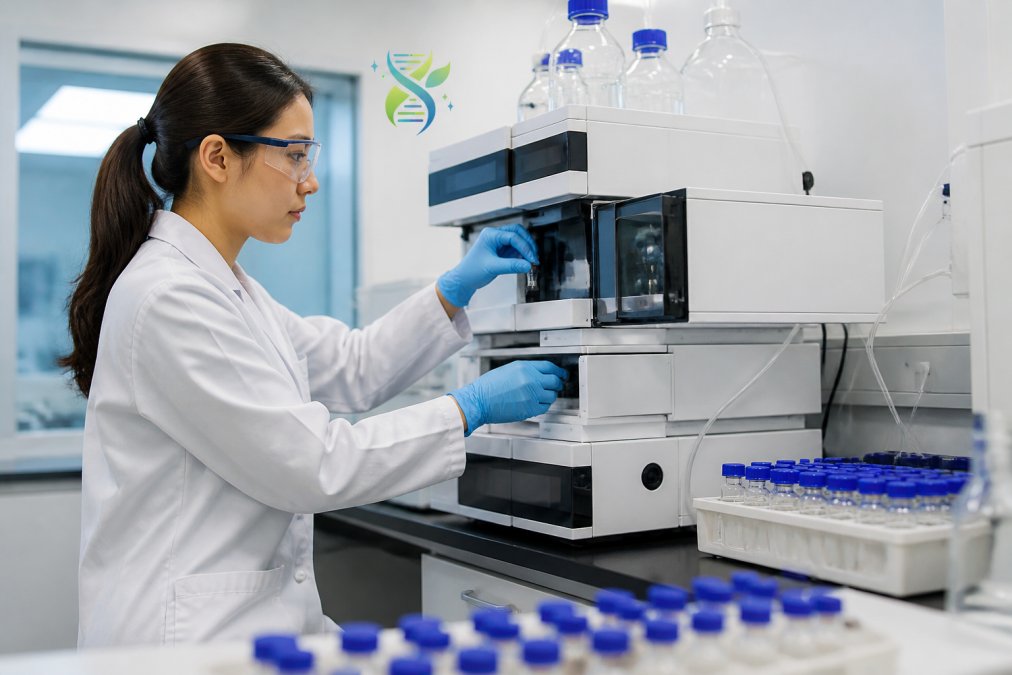
High-performance liquid chromatography separates molecules based on their chemical properties as they move through a column. For peptides, reverse-phase HPLC is the standard method. Your peptide binds to a hydrophobic resin, then elutes as the solvent becomes increasingly organic. The detector measures absorbance at 214 nm (peptide bond) or 280 nm (aromatic amino acids).
The result is a chromatogram, a graph showing peaks over time. Each peak represents a different compound in your vial.
How HPLC Detects Impurities and Degradation Products
Impurities in peptide vials come from several sources: incomplete synthesis (truncated sequences), oxidised methionine or tryptophan, dimerisation, and contamination from the manufacturing environment. HPLC separates these from your target peptide because they have different chemical properties.
A clean chromatogram shows one dominant peak (your peptide) with minor peaks below 1-2% of the total area. A messy chromatogram shows multiple significant peaks, which indicates either poor synthesis or degradation during storage.
Degradation products accumulate over time, especially if the peptide is stored incorrectly. Freeze-thaw cycles, exposure to light, and humidity all accelerate breakdown. This is why stability monitoring, repeated HPLC testing at intervals, matters for long-term storage.
Reading Your HPLC Chromatogram
The chromatogram is your peptide's fingerprint. Here's how to read it like a professional.
The x-axis shows retention time (minutes). The y-axis shows detector response (milliabsorption units). Your target peptide appears as a single peak at a specific retention time, this is reproducible and unique to that sequence.
The peak area under the curve represents the amount of that compound. If your target peptide peak is 98% of total area and all other peaks combined are 2%, you have 98% purity by HPLC. Simple.
But here's the critical detail: that 2% of other peaks might include degradation products, synthesis impurities, or unknown contaminants. A complete quality assurance programme requires you to identify what those peaks are, not just quantify them. This is where mass spectrometry comes in.
Also watch for baseline noise. If the baseline is jagged or elevated, the sample may contain salt, residual TFA, or other non-peptide material that doesn't elute cleanly.
Mass Spectrometry and Complementary Analytical Methods
Mass spectrometry measures the mass-to-charge ratio of ionised molecules. For peptides, this means measuring the exact molecular weight. It's the most definitive proof that you have the right compound.
LC-MS for Molecular Weight Verification
Liquid chromatography coupled to mass spectrometry (LC-MS) combines the separation power of HPLC with the identification power of mass spectrometry. Your peptide exits the HPLC column and enters the mass spectrometer, which measures its exact mass.
The theoretical mass of a peptide is calculated from its amino acid sequence. If your 20-amino-acid peptide should weigh 2,347.32 Da (daltons) and the mass spectrometer reads 2,347.31 Da, you have confirmation. The tiny difference is normal analytical variation.
If the measured mass is 2,200 Da or 2,500 Da, you have a problem. Either the sequence is wrong, or the vial contains a different peptide entirely.
This is why BioLongevity Labs' 2026 industry analysis identified batch-specific Certificates of Analysis with HPLC chromatograms and mass spectrometry confirmation as the minimum documentation standard for research-grade compounds. Without MS data, you're missing proof of identity.
Amino Acid Analysis and Quantitative Assessment
Amino acid analysis (AAA) hydrolyses your peptide into individual amino acids, then measures each one using high-performance liquid chromatography or mass spectrometry. This technique serves two purposes: it confirms the amino acid composition, and it provides an independent measure of actual peptide content by weight.
Here's why this matters: HPLC purity tells you about chromatographic purity. AAA tells you how much actual peptide is in the vial. A sample marked 99% pure by HPLC might show 82% peptide by AAA if the remaining mass is salt, water, or counterions.
The global market for amino acid derivatives used in peptide drug synthesis was projected to grow from USD 414 million in 2024 to USD 727 million by 2032, reflecting rising demand for high-quality sourcing with rigorous analytical backing. This growth is driven partly by stricter quality requirements in research and therapeutic applications.
Quantitative amino acid analysis is labour-intensive and expensive, which is why it's not routine for every batch. But for critical experiments or when you suspect a quality issue, it's worth the investment.
Peptide Certificate of Analysis Interpretation
A Certificate of Analysis (CoA) is your proof of quality. It's also where most labs get fooled. Many CoAs are incomplete, outdated, or unverifiable.
What a Complete CoA Must Include
A complete, trustworthy CoA includes these elements:
- Batch number and manufacturing date. This ties the document to a specific vial. Reused CoAs (the same document for multiple batches) are a major red flag.
- HPLC chromatogram with peak integration. You should see the actual chromatogram, not just a purity percentage. The chromatogram shows peak areas and retention times.
- Mass spectrometry data. For peptides, this means the observed mass and the theoretical mass. They should match within 0.1%.
- Amino acid analysis results. Ideally showing both composition and quantitative content by weight.
- Endotoxin testing results. Measured in endotoxin units per milligram (EU/mg). For research-grade peptides, <1 EU/mg is acceptable; for therapeutic-grade, <0.1 EU/mg.
- Sterility and microbial testing. Especially if the peptide will contact cells or animals.
- Water content (Karl Fischer titration). Typically <5% for lyophilised peptides.
- Naming of the testing laboratory. The lab that performed each test should be identified. "Third-party tested" means nothing without a name.
A CoA from the manufacturer's own lab is in-house testing. A CoA from an independent, named laboratory is third-party testing. These are not equivalent.
Red Flags in Documentation and Verification
Watch for these warning signs that a CoA is incomplete or fabricated:
- Generic CoA used for multiple batches. If the document has no batch number or the batch number matches multiple vials, it's reused. This is common in low-quality suppliers.
- Missing chromatogram. If the CoA states "98% purity" but shows no HPLC chromatogram, you have no way to verify the claim.
- No mass spectrometry data. For peptides, MS confirmation is essential. Without it, identity is unconfirmed.
- Testing lab not named. "Third-party tested" without specifying which lab is meaningless. Bad actors use this vague language intentionally.
- Inconsistent or impossible results. If HPLC shows 99% purity but amino acid analysis shows 70% peptide content, something is wrong. Request clarification.
- Post-purchase documentation. Some suppliers provide CoAs only after you've paid. This prevents you from verifying quality before committing funds.
According to PeptideTrust's vendor transparency analysis, only 30% of active research-peptide vendors publish a Certificate of Analysis that can be independently verified at the testing laboratory itself. This verification gap is a major source of quality failures.
Third-Party Peptide Testing Standards and Independence
The difference between in-house and third-party testing is not subtle. It's the difference between a supplier grading its own homework and an independent auditor checking the work.
Why In-House Testing Falls Short
A manufacturer's own laboratory has a financial incentive to report good results. This doesn't mean they fabricate data, most don't, but it creates a conflict of interest. If a batch fails in-house testing, the manufacturer loses money. If it passes, they sell it. The pressure is always toward passing.
Third-party testing removes this conflict. An independent laboratory has no financial stake in whether your peptide passes or fails. They're paid the same whether the result is "pass" or "fail."
The research is clear on this point. Between 41.6% to 71.1% of 6,441 peptide samples across fourteen compounds failed to meet basic quality criteria when applying models approximating regulatory standards, according to Scilit's peer-reviewed evaluation. Measurable endotoxin contamination was present in 15% of samples. These failures would likely have been caught earlier if third-party testing had been routine.
Triple Third-Party Verification: The Highest Standard
The highest standard in the industry is triple third-party verification: testing across three independent certified laboratories. This approach eliminates the possibility of a single lab making an error or having a blind spot.
Each lab performs the same tests independently, HPLC, mass spectrometry, amino acid analysis, endotoxin screening. If all three agree, you have confidence. If one disagrees, you know there's a problem worth investigating.
This level of verification is rare because it's expensive. Most suppliers use single in-house or single third-party testing. But for critical research or when batch consistency is essential, triple verification is worth the cost.
Everform Research provides rigorous third-party testing for every batch, with full analytical documentation available before purchase. This transparency is what separates suppliers committed to quality from those cutting corners.
Building Your Internal Quality Assurance Protocol
You cannot rely entirely on supplier documentation. You need your own quality assurance programme to verify incoming batches and monitor stability over time. The difference between labs that catch quality failures and those that don't is the presence of a documented, repeatable process.
Creating a Standard Operating Procedure for Batch Acceptance
A Standard Operating Procedure (SOP) for batch acceptance is a written protocol that defines exactly what you test, how you test it, and what results you accept. This removes guesswork and ensures consistency across your lab. Without an SOP, quality decisions become ad hoc, and critical batches can slip through.
Your SOP should include these core elements:
1. Pre-Purchase Documentation Review
- Request the Certificate of Analysis before committing funds
- Verify the testing laboratory is named (not vague: "third-party tested")
- Confirm batch number is unique to this vial (not reused across multiple batches)
- Check that HPLC chromatogram, mass spectrometry data, and amino acid analysis are all present
- Document the manufacturing date; reject batches older than 12 months unless stability data justifies longer shelf life
2. Acceptance Criteria (Define Your Thresholds)
Example criteria for a typical research peptide:
- HPLC purity ≥98% (or your protocol's specific requirement)
- Mass spectrometry observed mass within ±0.1% of theoretical mass
- Endotoxin <1 EU/mg (adjust to <0.1 EU/mg for cell-based work)
- Water content ≤5% (Karl Fischer titration)
- Counterion identity and quantity documented
- No single impurity peak >2% of total area
Document these thresholds in writing. Different experiments may have different thresholds; create separate criteria for routine screening versus therapeutic-intent work.
3. In-House Confirmatory Testing Decision Tree (Source: ultra-high purity peptides (≥98%) dominated the market in 2025 with a USD 2.888 billion share)
Not every batch requires full in-house retesting. Use this logic:
- New supplier, first batch: Run HPLC in-house. Compare your result to supplier's HPLC. If they match within 1%, supplier is reliable. If they diverge by >2%, investigate or switch suppliers.
- Established supplier, routine batch: Accept supplier's documentation if CoA is complete and lab is named. Spot-check every 5th batch with HPLC.
- Critical experiment (e.g., in vivo work, publication-intent data): Run both HPLC and mass spectrometry in-house, even if supplier provided both. The cost of in-house testing can vary, but the insurance is worth it.
- Batch fails acceptance criteria: Do not use. Request replacement or refund immediately.
4. Failure Protocol
If a batch fails your acceptance criteria, follow this sequence:
- Repeat the test. Single failures are often instrument drift or operator error. If retest passes, document the anomaly and accept the batch. If it fails again, proceed.
- Contact the supplier. Request the raw chromatogram, the name of the testing laboratory, and the batch manufacturing date. Ask if they can provide a replacement batch or retesting by an independent lab.
- Evaluate partial acceptance. If HPLC shows 97% purity (below your 98% threshold) but mass spectrometry and amino acid analysis confirm identity and content, consider accepting for non-critical applications. Document this decision in writing.
- Escalate if necessary. If the supplier refuses to replace or refund, and the batch is defective, escalate to your procurement or quality officer. Do not use the batch in published research.
5. Documentation and Traceability
Maintain a centralised batch log with these fields:
- Vial ID and supplier name
- Batch number and manufacturing date
- Supplier's CoA date and testing laboratory name
- Your acceptance criteria and results
- Date accepted or rejected
- Storage location and temperature
- Any in-house testing performed
Use a spreadsheet or laboratory information management system (LIMS) to make this searchable. If an experiment fails months later, you need to trace which batch was used and what its quality status was at receipt.

Storage Conditions and Stability Monitoring
Peptides degrade over time. Temperature, humidity, light exposure, and freeze-thaw cycles all accelerate breakdown. Your quality assurance programme must include stability monitoring, periodic retesting to track degradation and confirm that your storage conditions are adequate.
Standard storage conditions:
- Temperature: −20 °C in a dedicated freezer, protected from light
- Some peptides require −80 °C, especially if prone to aggregation or if long-term storage (>2 years) is planned
- Always check the supplier's storage recommendations; follow them exactly
- Use opaque, airtight vials; avoid repeated opening of the same vial
- Store away from volatile solvents and reactive chemicals
Stability testing protocol:
Run HPLC at these intervals:
- Time zero: Upon receipt, before use
- 3 months: Retest one vial from the batch
- 6 months: Retest another vial
- 12 months: Final retest
Plot the results on a simple graph: purity (y-axis) versus time (x-axis). A stable peptide should show <2% loss of purity over 12 months at −20 °C. If purity drops from 99% to 92% in three months, your storage conditions are inadequate, move to −80 °C or investigate freezer temperature stability.
Document everything in your batch log. If you need to troubleshoot a failed experiment months later, stability data tells you whether the peptide degraded in your hands or arrived compromised.
Troubleshooting Failed Quality Tests: A Systematic Diagnostic Approach
When a batch fails your acceptance criteria, systematic investigation prevents both false rejections and acceptance of genuinely defective material.
Step 1: Confirm the failure is real
- Repeat the test using the same instrument, method, and operator if possible
- If the batch passes on retest, the first result was likely instrument error or operator mistake. Document the anomaly and accept the batch
- If it fails again, proceed to root-cause investigation
Step 2: Gather supplier data
- Request the supplier's raw chromatogram (not just the summary purity percentage)
- Ask which laboratory performed the testing and request their accreditation status
- Ask for the batch manufacturing date and synthesis method (if available)
- Request the supplier's stability data for this batch, if available
- Ask whether other batches from the same synthesis run passed or failed
Step 3: Classify the failure type
Different failure modes have different solutions:
| Failure Type | Typical Cause | Investigation | Resolution |
|---|---|---|---|
| HPLC purity low (e.g., 94% instead of ≥98%) | Incomplete synthesis, degradation during storage, or contamination | Check manufacturing date (old batches degrade). Request supplier's stability data. Run amino acid analysis to confirm actual peptide content. | If manufacturing date is recent, request replacement. If batch is old, reject. If AAA confirms content, may accept for non-critical use. |
| Mass spectrometry mass off by >0.5% | Wrong sequence synthesised, post-translational modification, or MS calibration error | Request supplier's MS data. Confirm theoretical mass calculation. Ask if MS was run on the same batch you received. | If MS error is likely, request retesting by independent lab. If sequence is wrong, reject and request correct peptide. |
| Endotoxin high (>1 EU/mg) | Bacterial contamination during synthesis or storage | Check storage conditions (temperature, humidity, seal integrity). Ask supplier about manufacturing environment controls. | If storage was poor, reject. If supplier's manufacturing controls are questionable, switch suppliers. For critical work, request endotoxin removal (depyrogenation) and retesting. |
| Water content high (>5%) | Incomplete lyophilisation or moisture absorption during storage | Check vial seal integrity. Ask supplier about lyophilisation parameters. | If seal is compromised, reject. If lyophilisation was incomplete, request re-lyophilisation or accept with lower effective peptide concentration. |
| Single impurity peak >2% | Synthesis impurity, oxidation, or dimer formation | Request supplier's peak identification (what is that peak?). Run mass spectrometry on the impurity to identify it. | If impurity is known and harmless (e.g., oxidised methionine), may accept. If impurity is unknown or harmful, reject. |
Step 4: Make a documented decision
- Full acceptance: Batch meets all criteria. Use normally. Document date and criteria met.
- Conditional acceptance: Batch fails one criterion but passes others, and the failure is non-critical for your application. Example: 97% purity (below 98% threshold) but identity confirmed by MS and AAA. Document the exception and the reason it was accepted.
- Rejection: Batch fails critical criteria (e.g., wrong sequence, high endotoxin, unknown contaminant). Request replacement or refund. Do not use in experiments.
- Escalation: If the supplier refuses to replace or refund a defective batch, escalate to your procurement or quality officer. Do not use the batch in published research.
Step 5: Update your supplier assessment
Keep a running record of supplier performance:
- How often do batches fail your acceptance criteria?
- How quickly does the supplier respond to quality complaints?
- Do they provide complete documentation and raw data?
- Are their testing laboratories accredited (ISO 17025 or equivalent)?
If a supplier's failure rate exceeds 5% or their response to complaints is poor, reduce orders or switch suppliers. Quality is a supplier relationship metric, not a one-time transaction.
Common Peptide Impurities and Contaminants to Screen For
Not all impurities are equal. Some are harmless. Others will invalidate your experiment or introduce confounding variables that you won't notice until your results fail to replicate. Understanding what impurities to screen for, how they form, and how to detect them is essential for quality assurance.
Synthesis-Related Impurities: Truncated Sequences and Incomplete Coupling
During peptide synthesis, amino acids are added one at a time to a growing chain. If any coupling step is incomplete, you end up with truncated sequences, peptides missing one or more amino acids from the intended sequence.
A 20-amino-acid peptide with 98% coupling efficiency at each step will yield only 67% full-length product (0.98^20). The remaining 33% is a mixture of 19-mer, 18-mer, 17-mer, and shorter fragments. This is why HPLC purity alone is insufficient; a chromatogram showing 98% purity might include multiple truncated sequences that HPLC cannot distinguish from the target.
Detection: Mass spectrometry is the only reliable method. Each truncated sequence has a different molecular weight. A 20-amino-acid peptide might weigh 2,347 Da; a 19-mer would weigh ~2,234 Da. If your mass spectrometry result shows multiple peaks at different masses, you have truncation.
Amino acid analysis also reveals truncation indirectly. If your peptide should contain 15 leucine residues but analysis shows 14, you likely have a mix of full-length and truncated sequences.
Impact on experiments: Truncated sequences can have completely different biological activity. A truncated peptide might not bind its target receptor, or it might bind weakly and act as a competitive inhibitor. In cell-based assays, this creates confounding variables. In binding studies, it inflates IC50 values. In vivo, it may have unexpected toxicity or clearance kinetics.
Mitigation: Demand mass spectrometry confirmation from your supplier. If truncation is present, request re-synthesis or accept the batch only for non-critical applications. For therapeutic-intent work, truncation must be <1% of total peptide mass.
Oxidation: Methionine and Tryptophan Degradation
Methionine and tryptophan are easily oxidised by atmospheric oxygen, especially during synthesis, purification, and storage. Oxidised methionine (methionine sulfoxide) and oxidised tryptophan have different chemical properties than their native forms, affecting peptide solubility, stability, and biological activity.
Oxidation is particularly problematic if your peptide contains methionine or tryptophan residues in functionally critical positions (e.g., at a binding interface). A single oxidised methionine can reduce binding affinity by 10-fold or more.
Detection: HPLC can detect oxidised forms as separate peaks if they are present in significant amounts (>2-3%). Mass spectrometry shows oxidation as a mass shift: methionine sulfoxide is 16 Da heavier than native methionine. If you see multiple peaks in the mass spectrum separated by 16 Da, you have oxidation.
Impact on experiments: Oxidation introduces batch-to-batch variability. One batch might be 99% native; another from the same supplier might be 85% native and 15% oxidised. This variability causes irreproducible results, especially in sensitive assays like surface plasmon resonance (SPR) or isothermal titration calorimetry (ITC).
Mitigation: Request that your supplier synthesise peptides under inert atmosphere (nitrogen or argon) to minimise oxidation. Store your peptides at −80 °C in the dark, in sealed vials under nitrogen if possible. If oxidation is detected, request re-synthesis. For non-critical applications, you may accept oxidised peptides if the oxidation level is documented and consistent across batches.
Dimerisation and Aggregation
Some peptides, especially hydrophobic ones or those prone to forming disulphide bonds, spontaneously dimerise or aggregate during synthesis, purification, or storage. Dimers are two peptide molecules covalently linked (usually via disulphide bond) or non-covalently associated. Aggregates are larger, insoluble clusters.
Dimers and aggregates have different molecular weights and biological properties than monomers. A dimer weighs twice as much as a monomer, so it may not be detected as a separate peak in HPLC if it co-elutes with the monomer. But in mass spectrometry, a dimer appears as a distinct peak at 2× the monomer mass.
Detection: Mass spectrometry is definitive. A monomer at 2,347 Da and a dimer at 4,694 Da are clearly distinguished. HPLC may or may not resolve them, depending on the column and method.
Size-exclusion chromatography (SEC) is another method. Dimers and aggregates elute earlier (larger molecules elute first) than monomers. SEC is often used for stability monitoring.
Impact on experiments: Dimers and aggregates can completely change the peptide's behaviour. A dimeric peptide might have different binding kinetics, cellular uptake, or in vivo clearance than the monomer. In cell-based assays, aggregates can trigger non-specific immune responses or cell toxicity unrelated to the peptide's intended function.
Mitigation: Request that your supplier provide mass spectrometry data showing monomer percentage. For peptides prone to dimerisation (especially those with cysteine residues), request that they be synthesised with capping groups or reduced disulphide bonds. Store at −80 °C to slow aggregation. Before use, confirm solubility and run a quick SEC or dynamic light scattering (DLS) to verify monomeric state.
Endotoxin Contamination and Sterility
Endotoxins are lipopolysaccharides from gram-negative bacterial cell walls. They are pyrogenic, they trigger fever and inflammation in living systems. Even in research settings, endotoxin contamination can invalidate cell-based experiments by triggering non-specific inflammatory responses.
Endotoxin is measured in endotoxin units (EU). One EU is approximately 0.1 nanograms of endotoxin. The threshold depends on application:
- In vitro cell culture: <1 EU/mg is acceptable for most assays
- In vivo injection (mouse, rat): <0.1 EU/mg is safer; <0.01 EU/mg is preferred
- Therapeutic peptides: <0.01 EU/mg is required by regulatory standards
Detection: The limulus amebocyte lysate (LAL) assay is the gold standard. It uses lysate from horseshoe crab blood cells, which react to endotoxin at extremely low concentrations (as low as 0.005 EU/mL). The reaction causes gelation, which is detected colorimetrically or kinetically.
Sterility testing checks for bacterial and fungal contamination by incubating the peptide in growth media (thioglycollate broth for bacteria, Sabouraud dextrose broth for fungi) and observing for turbidity or growth over 14 days. This test is essential if your peptide will contact cells or be injected.
Impact on experiments: Endotoxin triggers toll-like receptor 4 (TLR4) signalling in immune cells, causing cytokine release (TNF-α, IL-6, IL-1β). In cell-based assays, this confounds results. A peptide that appears to have no effect on cells might actually be masked by endotoxin-induced inflammation. Conversely, a peptide's true effect might be obscured by endotoxin toxicity.
Mitigation: Always request endotoxin testing results on the Certificate of Analysis. For cell-based work, demand <1 EU/mg. For in vivo work, demand <0.1 EU/mg. If endotoxin is high, request depyrogenation (heating to 250 °C for 30 minutes) and retesting. Some suppliers offer endotoxin-free synthesis protocols; these cost more but are worth it for critical experiments.
Trifluoroacetic Acid Residue and Counterion Analysis
Trifluoroacetic acid (TFA) is used during peptide synthesis and purification as a volatile solvent and counterion. Most TFA is removed by lyophilisation, but residual TFA can remain in the final product, especially if the peptide is hydrophobic or poorly soluble.
High TFA content affects peptide solubility (TFA is hydrophilic; excess TFA can make hydrophobic peptides insoluble), stability (TFA is acidic and can promote hydrolysis), and biological activity (TFA can interfere with binding or cellular uptake).
Counterions are the salts that balance the peptide's charge. Common counterions are acetate, chloride, and TFA. The type and amount of counterion affects solubility and storage stability. A peptide with acetate counterion is typically more stable than one with TFA.
Detection: TFA residue is measured by nuclear magnetic resonance (NMR) spectroscopy or by high-performance liquid chromatography with evaporative light-scattering detection (HPLC-ELSD). Acceptable levels are typically <2% for most applications, though some protocols require <0.5%.
Counterion type and quantity should be specified on the Certificate of Analysis. If not, request this information.
Impact on experiments: High TFA content can cause peptides to precipitate or aggregate in aqueous solution, making them unusable. It can also lower pH, which affects peptide stability and biological activity. In binding assays, TFA can compete for binding sites or alter the ionic strength, affecting kinetics.
Mitigation: Request that your supplier specify TFA content on the CoA. Demand <2% for routine work, <0.5% for sensitive applications. If TFA is high, request re-lyophilisation or counter-ion exchange (converting TFA salt to acetate salt). For long-term storage, acetate counterion is preferable to TFA.
Unknown Impurities and Peak Identification
HPLC chromatograms often show minor peaks that are not identified. A complete quality assurance programme requires you to identify these peaks, not just quantify them.
If your HPLC shows 98% purity with 2% unidentified impurities, you don't know if those impurities are harmless (e.g., salt, residual solvent) or harmful (e.g., a toxic degradation product, a different peptide, a heavy metal). This uncertainty is unacceptable for critical research.
Detection: Mass spectrometry coupled to HPLC (LC-MS) identifies unknown peaks by measuring their mass. If a peak has a mass that doesn't match any expected impurity, you know you have an unknown compound. Further investigation (tandem MS, NMR) may be needed to identify it.
Mitigation: For new suppliers or critical batches, request that all peaks >0.5% of total area be identified by LC-MS. This adds cost but provides certainty. For routine batches from trusted suppliers, you may accept unidentified peaks if they are <1% and consistent across batches.
In conclusion, ensuring peptide quality is paramount for reproducible research. Everform Research is committed to providing premium-quality peptide products backed by rigorous quality standards, transparency, and exceptional customer service. Our mission is to make high-quality peptides more accessible through reliable sourcing, third-party quality testing, and a customer-first experience. Shop compounds today and use discount code EVER15 for 15% off your order.
Frequently Asked Questions
What is the most accurate lab test for peptides?
High-performance liquid chromatography (HPLC) combined with mass spectrometry (LC-MS) provides the most comprehensive peptide assessment. HPLC determines purity by separating compounds and identifying impurities; LC-MS confirms molecular weight and sequence. A complete analytical profile also includes amino acid analysis and endotoxin screening. According to 2026 industry standards, HPLC purity of 98% or higher, confirmed by an independent third-party lab, is the minimum credibility threshold for research peptides.
How do I know if peptides are high quality?
High-quality peptides require three key indicators: (1) a batch-specific Certificate of Analysis with HPLC chromatograms and mass spectrometry confirmation from a named independent lab, (2) verifiable third-party testing that you can confirm directly with the testing facility, and (3) documented purity of 98% or higher with a complete impurity profile. Red flags include reused COAs across batches, missing mass spectrometry data, and CoAs provided only after purchase. In 2026, only 30% of active research peptide vendors publish a CoA that can be independently verified at the testing lab itself.
How does third-party testing improve peptide quality assurance?
Third-party testing removes conflicts of interest inherent in supplier self-testing. An independent certified laboratory has no financial incentive to inflate purity claims. Triple third-party verification, testing across three independent certified labs, sets the highest available standard for purity confidence. This approach catches mislabelling, incorrect quantification, and contamination that in-house methods might miss. Studies show that close to 30% of peptide vials analysed in 2026 were mislabelled, incorrectly quantified, or contaminated, highlighting why external verification is critical.
What should I do if a batch fails quality testing?
First, verify the test results by reviewing the full analytical report and confirming the testing lab's credentials. Request a retest from the same independent facility to rule out procedural error. Document the failure with photographs of the vial, batch number, and all analytical data. Contact your supplier immediately with the complete test report and request either a replacement batch with new third-party testing or a full refund. Establish a written protocol in your lab's Standard Operating Procedure for batch rejection so all researchers follow the same process. Do not use the failed batch in any experiments.
This article was written using GrandRanker