 listicle
Protide Health Alternatives for CROs: 2026 Guide
Table of Contents
- Why CROs Are Seeking Protide Health Alternatives
- Peptide Supplier Quality Standards: What You Need to Know
- How to Vet Peptide Vendors: A Procurement Framework
- Key Differences Between Peptide Suppliers
- HPLC Verification and Analytical Testing Standards
- Risk Mitigation When Switching Peptide Vendors
- Everform Research: A Transparent Alternative
- Conclusion
Last Updated: August 13, 2026
Why CROs Are Seeking Protide Health Alternatives
Contract Research Organisations managing peptide procurement face a critical decision: stick with established suppliers or explore alternatives that might offer better quality assurance, transparency, and batch consistency. The shift toward Protide Health alternatives for CROs reflects a broader industry trend where research institutions demand more than just competitive pricing, they want documented proof of purity, independent testing, and reliable supply chains.
At Everform Research, we've observed that many CROs switching vendors cite three recurring frustrations: inconsistent batch documentation, unclear third-party testing protocols, and difficulty verifying actual manufacturing compliance. When a batch fails to meet specifications mid-project, the cost isn't just financial, it's lost research time, invalidated protocols, and damaged credibility with sponsors.
This guide explores what separates a reliable peptide supplier from one that merely looks credible on paper. We'll walk through the vendor evaluation framework that leading research labs use, the analytical standards that matter most, and how to assess whether a supplier genuinely delivers what their documentation promises.
Peptide Supplier Quality Standards: What You Need to Know
Research-grade peptides demand a different standard than consumer-grade compounds. The difference lies not in marketing language but in measurable, documented processes: how raw materials are sourced, how synthesis is monitored, and how purity is verified before a vial ships.
A reliable supplier operates within established quality frameworks. cGMP (current Good Manufacturing Practice) compliance means the facility follows FDA-regulated protocols for equipment calibration, environmental controls, staff training, and batch documentation. This isn't optional for serious research, it's the baseline expectation.
Batch consistency is where many suppliers falter. One batch at 98.5% purity and the next at 96.2% might both technically pass a loose specification, but they'll produce different experimental outcomes. Labs running parallel studies need identical peptide purity across all samples. This requires tight process controls and real-time monitoring during synthesis, not just end-point testing.
Third-Party Testing and COA Verification
A Certificate of Analysis (COA) is only as credible as the lab that issued it. When a supplier tests their own products in-house, you're reading a self-reported grade. Independent third-party testing removes that conflict of interest.
The most rigorous suppliers send samples to accredited external laboratories for verification. These labs use HPLC (High-Performance Liquid Chromatography) to measure purity, mass spectrometry to confirm molecular weight, and endotoxin assays to verify sterility. The resulting COA includes the testing lab's credentials, methodology, and date, information you can verify independently.
What to look for in a COA:
- Testing laboratory name and accreditation status
- Specific analytical methods used (HPLC, MS, endotoxin assay)
- Lot-specific date and batch number
- Purity percentage with acceptable range
- Any detected impurities listed by name
If a supplier refuses to disclose which lab performed testing or claims their internal testing is "equivalent" to third-party verification, that's a red flag. Legitimate suppliers have nothing to hide.
cGMP Manufacturing Compliance
cGMP compliance means the facility has been audited and certified to meet FDA standards for sterile manufacturing, environmental controls, and documentation. This isn't a marketing claim, it's a verifiable credential.
Request proof: ask for the facility's cGMP certification or FDA inspection records if they're publicly available. Some suppliers will provide a summary letter from their quality assurance team; others can point to published inspection results. If they deflect or claim compliance without documentation, move on.
The practical benefit of cGMP compliance is repeatability. A cGMP-certified facility maintains strict protocols for equipment maintenance, calibration records, and batch traceability. When you order the same peptide six months later, the manufacturing process is identical, same equipment, same environmental controls, same staff training. This is how batch consistency becomes predictable.

How to Vet Peptide Vendors: A Procurement Framework
Switching peptide suppliers carries real risk. Your protocols are validated against a specific product. A new supplier's batch might meet the same purity spec but exhibit different behaviour in your assay, different solubility, different cell uptake, different stability profile. Before committing, you need a structured evaluation process.
Audit Vendor Credentials and Certifications
Start with documented proof, not promises. Request the following:
- cGMP certification or FDA inspection records - Verifiable, dated proof of compliance
- Third-party testing lab accreditation - The external lab's credentials and scope of accreditation
- ISO 9001 or equivalent quality management certification - Shows systematic quality controls
- Batch-specific COAs for at least three previous lots - Demonstrates consistency over time
- Stability data - How purity changes over storage time under defined conditions
A credible supplier will provide these within days. If they claim these don't exist or are "proprietary," that's a sign they're not operating at research-grade standards.
Evaluate Supply Chain Transparency
Where do the raw materials originate? How are they stored between synthesis and shipment? What's the shelf life after receipt?
Transparency means the supplier can trace each component back to its source. They document storage temperatures, humidity controls, and handling procedures. They publish shelf life data with supporting stability studies. They can explain why a peptide stored at 4°C remains stable for 24 months but only 6 months at room temperature.
Request a supply chain audit: ask the vendor to walk you through the journey of a specific lot from raw material receipt through final packaging. A transparent supplier will provide this detail. A vague response suggests they don't actually know or don't track it carefully.
Assess Technical Documentation and Support
Beyond the COA, how much technical support does the vendor provide?
Reliable suppliers offer:
- Solubility data and reconstitution protocols specific to each peptide
- Stability curves showing purity retention over time
- Troubleshooting guides for common issues (precipitation, aggregation, cell uptake)
- Direct access to a technical team for protocol questions
- Batch-specific analytical raw data (not just summary results)
This matters because every research group's application is slightly different. A supplier who can discuss your specific protocol and offer guidance based on their experience is worth more than one who just ships a vial with a COA.
Key Differences Between Peptide Suppliers
Not all suppliers operate at the same standard. The differences are measurable and consequential.
| Supplier Type | Testing Approach | Documentation | Batch Consistency | Support Level |
|---|---|---|---|---|
| Budget suppliers | In-house only | Basic COA | Variable | Minimal |
| Mid-tier suppliers | Mixed (in-house + occasional third-party) | Detailed COA | Moderate | Responsive |
| Research-grade suppliers | Independent third-party standard | Lot-specific with raw data | Tight (±1-2%) | Technical team available |
| Everform Research | Independent third-party verified | Complete with analytical methodology | Documented across batches | Direct technical support |
Budget suppliers prioritise volume and cost. Their testing is in-house, their documentation is minimal, and batch consistency is inconsistent. This might work for exploratory research where variability is acceptable, but not for reproducible studies or clinical applications.
Mid-tier suppliers offer better documentation and occasional third-party testing, but it's not systematic. You might get one batch verified independently and the next tested only internally. This creates uncertainty.
Research-grade suppliers, including Everform Research, make third-party testing standard practice, not optional. Every batch is independently verified. Documentation includes the analytical methodology, not just the results. Batch consistency is tracked and published. Technical support is available to discuss your specific application.
HPLC Verification and Analytical Testing Standards
HPLC (High-Performance Liquid Chromatography) is the gold standard for peptide purity verification. It separates peptide components by size and charge, allowing precise measurement of the target compound versus impurities.
A credible HPLC report shows:
- Retention time - The time the target peptide appears on the chromatogram (should be consistent across batches)
- Peak area percentage - The purity reading (e.g., 98.3% of total peaks)
- Impurity identification - What else is present (related peptides, truncated sequences, synthesis byproducts)
- Detection wavelength - Usually 214 nm or 280 nm, depending on the peptide
- Calibration standards used - How the instrument was validated before testing
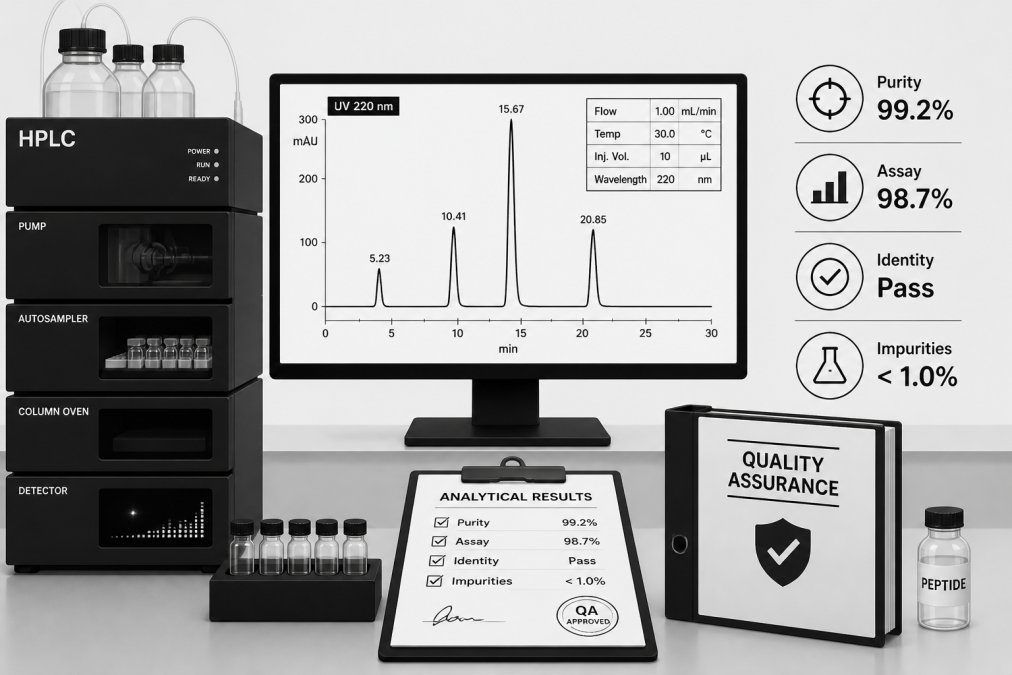
Mass spectrometry complements HPLC by confirming molecular weight. A peptide might appear pure by HPLC but have a different mass than expected, indicating a synthesis error or contamination. Mass spec catches this.
Endotoxin testing (LAL assay) measures bacterial contamination. This matters for any peptide used in cell culture or in vivo work. A pure peptide contaminated with endotoxin will trigger immune responses that confound your results.
When reviewing analytical data, look for consistency. If one batch shows 98.5% purity by HPLC and the next shows 95.8%, ask why. A credible supplier will explain the variation or acknowledge it's outside acceptable range and re-synthesise the batch. Inconsistent responses suggest they're not actively managing quality.
Risk Mitigation When Switching Peptide Vendors
Switching suppliers mid-project is risky. The new batch might meet specifications but behave differently in your assay. Here's how to minimise that risk.
Run a validation study first. Order a small batch from the new supplier. Test it alongside your current batch in parallel experiments. Document any differences in solubility, cell uptake, stability, or assay readout. If the new batch performs identically, you've validated the switch. If not, you've identified the issue before committing to a larger order.
Request matched batches during transition. Ask both suppliers for material from the same synthesis period, tested by the same third-party lab. Run side-by-side comparisons. This isolates supplier differences from batch-to-batch natural variation.
Document your protocol against the original batch. Before switching, publish or file your validated protocol with the original supplier's lot number and COA. This creates a reference point. If results drift after switching, you'll have evidence of what changed.
Stagger your transition. Don't order six months' supply from a new vendor immediately. Start with a one-month supply. Validate it. Then order three months. Only after successful use do you commit to larger quantities.
Maintain a backup supplier. For critical research, keep a second qualified vendor on standby. If your primary supplier has a manufacturing issue, you can pivot without derailing your timeline.
Everform Research: A Transparent Alternative
Everform Research operates at the research-grade standard. Every peptide batch is tested by an independent third-party laboratory. COAs include the full analytical methodology, not just a summary result. Manufacturing is cGMP-compliant with documented facility audits.
What sets Everform Research apart is transparency about batch consistency. We publish stability data showing how purity changes over time under defined storage conditions. We provide raw HPLC chromatograms alongside the COA, not just the final purity percentage. Technical support is available to discuss your specific protocol and troubleshoot issues.
For CROs evaluating alternatives to established suppliers, Everform Research offers a documented commitment to quality and consistency. Pricing for premium compounds depends on quantity, dates, and delivery. Visit the Everform Research website for current prices or a quote.
When you're ready to evaluate Everform Research, request a sample batch and validation COA. Run it through your standard assay. Compare it directly to your current supplier. The data will tell you whether the switch makes sense for your work.
Switching peptide suppliers is a calculated decision, not an impulse. The framework above, auditing credentials, evaluating supply chain transparency, assessing technical support, gives you the tools to make that decision with confidence.
The best vendor isn't always the most established or the cheapest. It's the one whose documented processes, third-party verification, and batch consistency match your research standards. Everform Research has built its reputation on exactly that: rigorous quality standards, transparent documentation, and dependable consistency.
Use code EVER15 for 15% off your first order. Visit Everform Research to explore our peptide selection and request a validation COA for your protocol.
Frequently Asked Questions
What documentation should a peptide supplier provide to a CRO?
A credible peptide supplier should provide a comprehensive Certificate of Analysis (COA) that includes HPLC purity data, molecular weight confirmation via mass spectrometry, amino acid sequence verification, batch-specific lot numbers, and stability testing results. Additionally, request documentation of cGMP compliance, third-party testing verification, endotoxin levels, and supply chain transparency records. This documentation allows your team to validate quality independently and meet institutional compliance requirements.
How do I verify the quality of research-grade peptides?
Verify quality through multiple channels: request independent third-party COAs rather than relying solely on supplier-generated documents, cross-reference HPLC purity percentages (research-grade should consistently exceed 95%), confirm mass spectrometry data matches the expected molecular weight, and ask for lot-specific stability testing results. Request references from other CROs using the same supplier, and establish a validation protocol where you test initial batches in-house before committing to larger orders. Protide Health alternatives like Everform Research provide transparent analytical data to support this verification process.
What are the industry standards for peptide purity in clinical research?
Clinical research typically requires peptide purity of 95% or higher, with some applications demanding 98%+ purity for reproducible results. The standard analytical method is HPLC, which provides a quantitative purity profile. Additionally, mass spectrometry confirms molecular weight accuracy, and peptide mapping ensures correct amino acid sequence. These standards align with research-grade material specifications outlined in scientific literature and regulatory guidance for preclinical and clinical work. Documentation of these metrics through independent testing is essential for protocol validation.
Are there reliable alternatives to Protide Health for bulk peptide orders?
Yes, several suppliers offer transparent quality standards and third-party testing for bulk orders. When evaluating Protide Health alternatives, prioritise vendors offering cGMP-compliant manufacturing, independent COA verification, batch-specific documentation, and clear supply chain transparency. Everform Research exemplifies this approach with rigorous third-party testing, cGMP compliance, and accessible pricing for premium compounds. Assess each supplier's track record with batch consistency, responsiveness to technical questions, and willingness to provide institutional compliance documentation required by your CRO.
This article was written using GrandRanker