 blog
blog
Protide Health vs Ion Peptide: 2026 Supplier Comparison
Table of Contents
- Protide Health vs Ion Peptide: Quick Comparison Table
- Purity and Potency Standards for High-Purity Peptides
- Third-Party Testing for Research Peptides: What Actually Matters
- How to Verify Peptide Purity: A Step-by-Step Checklist
- Certificate of Analysis Transparency and Documentation Standards
- Storage, Stability, and Handling Protocols for Lyophilized Powder
- Regulatory Compliance and Research-Use-Only Requirements
- Conclusion: Choosing the Right Supplier for Your Lab
- Frequently Asked Questions
Last Updated: September 10, 2026
Protide Health vs Ion Peptide: Quick Comparison Table
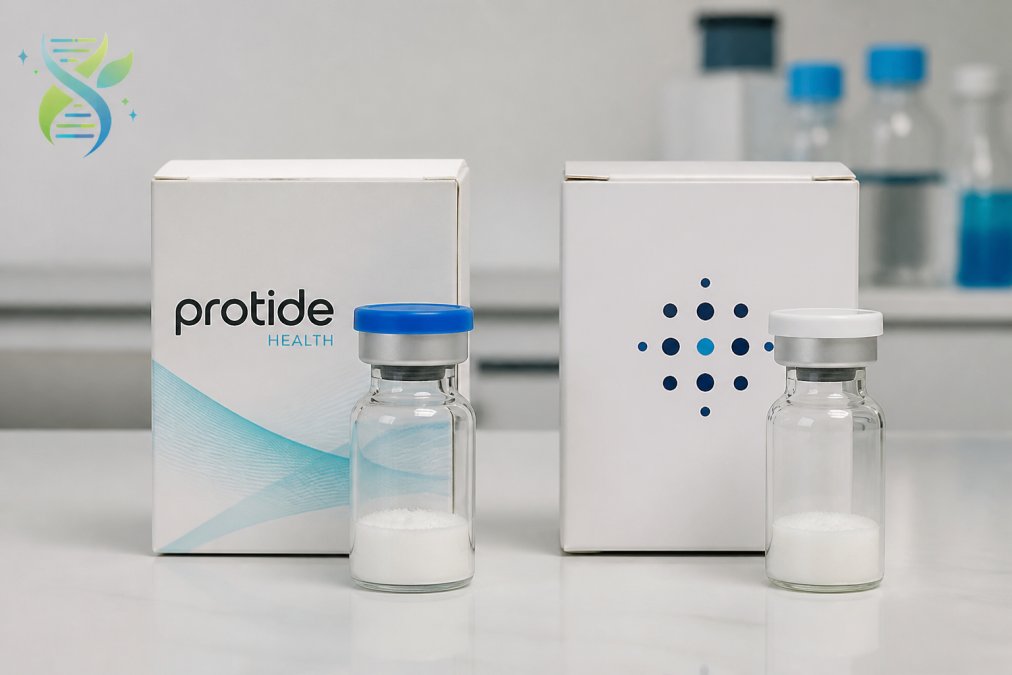
The Protide Health vs Ion Peptide question comes down to one thing: which supplier gives your lab documentation you can actually defend in a grant review. The peptide therapeutics market hit roughly $52.6 billion in 2026, according to PeptidesExplorer's 2026 peptide statistics, and with 1 in 8 adults now using GLP-1 receptor agonists, procurement scrutiny has never been tighter. At Everform Research, we watch labs get burned by vendors whose certificates of analysis (COAs) look polished but don't survive a second look.
Here's the honest starting point: neither vendor publishes a head-to-head independent audit, so you're comparing process transparency, not brand names.
| Criteria | Protide Health | Ion Peptide | What to Check |
|---|---|---|---|
| Reported batch purity | 99.53% average | Not publicly stated | Request raw HPLC data |
| Third-party testing | Independent HPLC and mass spec | Not documented publicly | Ask for lab name |
| COA availability | Published per batch | On request | Verify lot numbers match |
| Operating history | Founded 2025 | Longer track record | Weigh experience vs transparency |
| Documentation depth | Full analytical panel | Limited public detail | Compare impurity profiles |
A word of caution before you read further: Protide Health was only founded in 2025, which PSPeptides' vendor analysis flags as the shortest track record among prominent suppliers. That's not disqualifying, but it means batch consistency data is thin. Ion Peptide's longer history cuts the other way: familiarity isn't proof of purity.
Purity and Potency Standards for High-Purity Peptides
Purity is the percentage of your target peptide relative to all other material in the vial, measured by high-performance liquid chromatography (HPLC). The industry benchmark sits at 99.5%, though most suppliers treat anything above 98% as a baseline. Potency is separate, and conflating the two is the most common analytical error we see.
A COA reporting a single purity figure without underlying data tells you very little, so read the two techniques properly.
Reading an HPLC chromatogram
HPLC separates compounds by how they interact with a stationary phase inside a column. The detector records each compound as a peak, and the area under each peak is proportional to how much is present. The main peak is your target peptide; every smaller peak is an impurity, truncation error, deletion sequence, or synthesis byproduct.
When you look at a chromatogram, check four things:
- Retention time of the main peak, it should match the reference standard for that peptide. A shifted peak suggests a different compound or a degraded sample.
- Peak shape, a symmetric, narrow peak indicates a clean product. Tailing or fronting suggests column issues or co-eluting impurities.
- Number and size of impurity peaks, a single large impurity peak above 1% is more concerning than several small peaks below 0.5%.
- Baseline stability, a drifting baseline makes area integration unreliable, which means the reported percentage itself is suspect.
Purity percentage is the main peak area divided by the total area of all peaks. If a COA reports 99.5% purity but the chromatogram shows an unintegrated shoulder on the main peak, the real number is lower.
What mass spectrometry actually confirms
Mass spectrometry (MS) measures the mass-to-charge ratio of ionized molecules. For peptides, it confirms the molecular weight of the dominant species matches the expected value for your target sequence. This is a structural identity check, not a purity check.
A COA showing both 99% HPLC purity and a correct MS molecular weight suggests the main component is the right peptide. But MS alone cannot tell you how much peptide is in the vial: a vial can be 99% pure and still under-dosed if the powder was weighed incorrectly before filling. That is a potency problem, requiring quantitative assays such as amino acid analysis or quantitative NMR.
Batch-to-batch variance: the number that actually matters
For high-throughput screening, a 2% purity drift between batches is enough to skew your data. If you run the same assay across 50 or more experiments, a supplier's best-ever result is meaningless. Ask for batch-to-batch variance figures across at least the last ten lots.
A practical way to assess this without trusting the vendor's summary:
- Request raw chromatograms for three separate lots of the same product.
- Compare the main peak areas and impurity profiles side by side.
- Note whether impurity peaks appear in the same positions across lots, consistent patterns suggest a controlled process, random patterns suggest inconsistent synthesis.
- Ask whether the same analytical method was used for every lot. If the method changed, the numbers are not directly comparable.
Potency testing beyond purity
If your application depends on accurate dosing, purity and identity are not enough. Ask whether the supplier performs quantitative content testing, which measures how much peptide is present per vial rather than what fraction of the powder is the target molecule. This is the difference between a vial that is 99% pure and correctly filled and one that is 99% pure but contains 80% of the labelled mass.
For most research applications, the practical standard is: HPLC purity above 98%, MS confirmation of molecular weight, a named testing laboratory, and batch-to-batch variance data you can review. Anything less is analytical risk you cannot quantify.
Third-Party Testing for Research Peptides: What Actually Matters
Third-party testing for research peptides only counts when the laboratory is genuinely independent of the vendor. The critical detail is whether the testing lab's name appears on the COA, and whether you can contact them directly to verify a lot number.
The National Center for Biotechnology Information's review of peptide production standards makes the case plainly: rigorous quality standards are not optional in research applications, because synthesis byproducts and truncation errors change how a compound behaves in assay. Independent testing is how you catch those problems before they reach your bench.
How to verify a testing laboratory is actually independent
A named lab on a COA is a starting point, not proof. Work through these checks:
- Search the lab's registration and accreditation status. Many analytical labs publish their scope of accreditation, telling you which methods they are certified to run. If a lab is not accredited for HPLC or LC-MS, its results carry less weight.
- Contact the lab directly. Ask them to confirm they tested a specific lot number for a specific vendor. A genuinely independent lab will confirm or deny; one that will not respond is a red flag.
- Check whether the lab also sells peptides or is owned by a peptide vendor. A testing lab with a commercial interest in the result is not independent, whatever the COA says.
- Look for method details on the COA. A credible report names the instrument, column, mobile phase, detection wavelength, and reference standard used. A COA reporting only a percentage is a summary, not a test report.
What separates real testing from theater
- The analytical lab is named and reachable, and will confirm lot numbers on request
- Lot numbers on the COA match the vial label exactly, character for character
- Raw chromatogram data is supplied, not just a summary figure
- Testing happens per batch, not once per product line
- The COA states the analytical method and the instrument used
- Impurity peaks are reported individually, not lumped into a single "other" figure
If a vendor will not name their lab, assume the testing is not independent. That is the fastest filter in vendor vetting, and it eliminates most of the market in one step.
The failure modes most buyers miss
Three patterns show up repeatedly when labs audit incoming COAs:
Shared COAs across products. A vendor lists the same purity figure and chromatogram for multiple different peptides, usually meaning the COA was copied from a template rather than generated per lot. Compare retention times across products, they should differ.
Stale testing dates. A COA dated more than 12 months before the batch ship date suggests the material was tested once and the documentation reused. For lyophilized peptides stored correctly this is not automatically disqualifying, but it means you have no data on the specific lot in front of you.
Summary-only reporting. The COA reports a purity percentage and a molecular weight but no chromatogram, impurity profile, or method details. This is the most common pattern and the hardest to challenge, because the numbers look correct. Without raw data, you cannot verify them.
Building this into your procurement process
For lab managers vetting a new supplier, treat independent testing as a documented requirement rather than a preference. Ask for the testing lab's name, the method used, and a sample raw chromatogram before you place a first order, then verify one lot directly with the lab. If the supplier passes, you have a repeatable standard for every future order.
That verification step is also where most labs discover whether their current supplier's documentation holds up. Run the same check on the vendor you already use, the answer is often more informative than the comparison that started the search.
How to Verify Peptide Purity: A Step-by-Step Checklist
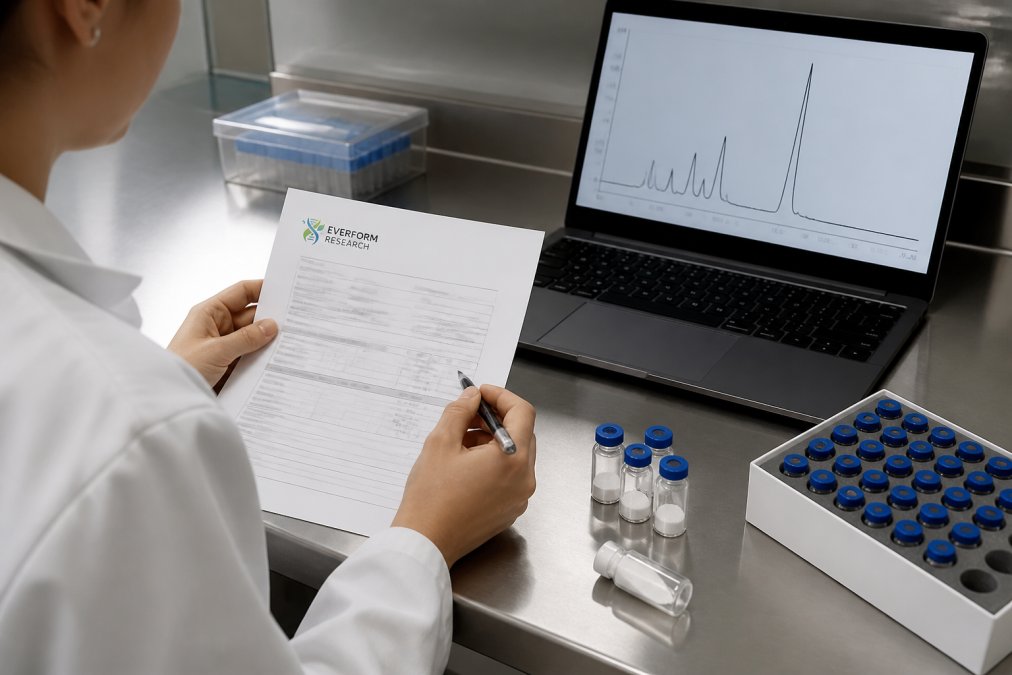
Verifying peptide purity means matching the physical vial to an unbroken documentation trail. Here's the process our team at Everform Research recommends for any new supplier, including us.
- Confirm the lot number on the vial matches the COA exactly
- Check the COA is dated within the last 12 months
- Verify the testing laboratory is named and independent
- Request the raw HPLC chromatogram, not just a percentage
- Cross-check the reported molecular weight against the expected value
- Ask for the impurity profile and confirm no unexplained peaks
- Request endotoxin testing results if your application requires it
- Confirm shipping used appropriate cold-chain or desiccant packaging
Run this checklist on your current supplier before you run it on a new one. Most labs find at least one gap, and that gap is usually the raw chromatogram.
Certificate of Analysis Transparency and Documentation Standards
A certificate of analysis is a batch-specific document reporting the analytical results for one production lot, including purity, molecular weight, and testing method. Search volume for peptide quality verification jumped 652% in 2026, per PeptidesExplorer's market data, which tells you researchers are already suspicious of vague paperwork.
Transparency has a hierarchy. At the bottom sits a generic PDF with a purity number and no lab name. In the middle, a batch-specific COA with a named lab. At the top, a COA plus raw chromatogram, impurity profile, and a lot number you can verify with the testing lab directly.
Ask for chain of custody documentation too. It's rare, but it's the difference between a supplier who tracks material from synthesis to shipment and one who doesn't.
Storage, Stability, and Handling Protocols for Lyophilized Powder
Lyophilized powder is the freeze-dried form most research peptides ship in, more stable than reconstituted solution but not indestructible. Store it at -20°C for long-term stability, or 2-8°C for short-term use, away from light.
Reconstitution is where most labs introduce error. Use bacteriostatic water or the supplier-specified solvent, add it slowly down the vial wall rather than onto the powder, and avoid vigorous shaking, which damages peptide integrity through shear stress.
Once reconstituted, chemical stability drops sharply. Most reconstituted peptides hold up for weeks refrigerated, not months, and freeze-thaw cycling degrades them faster than steady cold storage. Aliquot before freezing if you plan to use a vial across multiple experiments.
Regulatory Compliance and Research-Use-Only Requirements
Research-use-only (RUO) designation means a compound is sold for laboratory investigation and is not approved for human or veterinary use. The American Medical Association's guidance on unregulated peptides notes that some injectable peptides are unregulated and may carry significant health risks, and that patients should consult medical professionals rather than relying on vendor claims.
For lab managers, RUO compliance means three things: labeling that clearly states the restriction, documentation supporting the material's research purpose, and a supplier who doesn't market the same compound for human consumption.
Here's your compliance checklist for procurement:
- Supplier labels every product as research use only
- Marketing makes no therapeutic or dosing claims
- COA and safety documentation are available before purchase
- Material is packaged for laboratory handling, not consumer use
- Supplier can provide documentation your compliance team can file
If a vendor's website blurs the line between research reagent and consumer product, that's a documentation risk you inherit.
Conclusion: Choosing the Right Supplier for Your Lab
The Protide Health vs Ion Peptide comparison ultimately isn't about which name is bigger. It's about which supplier hands you a COA you can verify independently, batch after batch, without chasing them for the raw data.
That's the standard we built Everform Research around: rigorous third-party testing, cGMP-compliant manufacturing, and clearer documentation and quality signals on every lot, so your results hold up when someone else checks your work.
New to Everform Research? Use code EVER15 at checkout for 15% off your first order, and see what properly documented peptides look like. Shop Compounds today.
Frequently Asked Questions
What criteria should laboratories use to evaluate peptide suppliers?
Focus on four areas: documented purity above 98%, independent third-party testing with accessible Certificates of Analysis, cGMP-compliant manufacturing, and batch-to-batch consistency data. Ask for HPLC analysis and mass spectrometry results for each lot. Verify that the testing lab is genuinely independent, not affiliated with the supplier. Check whether the vendor provides molecular weight verification and impurity profiles. Supply chain reliability and shipping standards also matter, especially for temperature-sensitive compounds.
How does third-party testing for research peptides affect experimental reliability?
Independent testing catches what in-house quality checks miss. A supplier claiming 99% purity without external verification may ship batches with impurities that skew results. Third-party testing for research peptides provides an unbiased purity figure, confirms molecular weight, and screens for contaminants. When every batch is tested by an independent lab, you get consistent starting material across experiments. This reduces variables in your data and makes results reproducible across different research groups.
How can researchers verify the authenticity of a Certificate of Analysis?
Cross-reference the CoA batch number against the vial label. Contact the named testing laboratory directly to confirm the report exists and matches. Look for HPLC analysis and mass spectrometry data with specific retention times and molecular weights, not just a pass/fail stamp. Check the testing date against the manufacturing date. A legitimate CoA includes the lab's contact information and a unique report identifier. If the document lacks these details, request a replacement from the supplier or source elsewhere.
Are Protide Health and Ion Peptide compliant with FDA research standards?
Research-use-only peptides are not FDA-approved drugs. Suppliers operate under RUO labeling, which means the compounds are for laboratory research and not for human consumption. Compliance depends on whether the vendor follows cGMP manufacturing practices and provides proper documentation. The FDA does not certify individual peptide vendors. Check whether the supplier labels products as research use only, provides full analytical documentation, and follows standard operating procedures for handling and shipping.