 ultimate-guide
Research Peptide Procurement Compliance Guide
Table of Contents
- Understanding Research Peptide Procurement Compliance
- Regulatory Frameworks and FDA Oversight for Research Peptides
- Building a Peptide Vendor Vetting Checklist
- COA Verification for Research Peptides: What to Examine
- Quality Standards: HPLC Purity, Mass Spectrometry, and GMP Compliance
- Documentation, Chain of Custody, and Standard Operating Procedures
- International Supply Chain Compliance and Adverse Event Reporting
- Conclusion
Last Updated: August 5, 2026
Understanding Research Peptide Procurement Compliance
Research peptide procurement compliance is the systematic process of sourcing high-purity peptides whilst ensuring regulatory adherence, quality verification, and proper documentation throughout the supply chain. For principal investigators, biotech researchers, and fitness professionals working with research compounds, compliance is foundational to reproducible results and institutional credibility.
The challenge isn't just finding a supplier, it's finding one who can prove their products meet rigorous standards, maintain transparent records, and align with institutional and regulatory requirements. At Everform Research, we help researchers navigate this landscape by providing third-party tested peptides backed by comprehensive documentation and cGMP-compliant manufacturing.
This guide covers the critical pillars of research peptide procurement compliance: regulatory frameworks, vendor vetting, certificate of analysis verification, quality standards, documentation, international supply chains, and adverse event reporting. By the end, you'll have a practical framework for procurement decisions that protect your research integrity and institutional standing.
Regulatory Frameworks and FDA Oversight for Research Peptides
The FDA distinguishes between research-use-only (RUO) compounds and therapeutic peptides intended for human consumption. This distinction determines which compliance pathways apply to your procurement.
Research peptides marketed explicitly as "research use only" fall under different regulatory scrutiny than peptides marketed for therapeutic use. The FDA has issued warning letters to suppliers misrepresenting research compounds as therapeutic agents or failing to maintain proper manufacturing documentation, underscoring the agency's commitment to preventing unapproved claims and ensuring supply chain integrity.
For institutional researchers, your supplier must clearly label products as research-use-only and maintain documentation proving they follow Good Manufacturing Practice (GMP) standards. Whilst research peptides don't require FDA pre-approval like pharmaceuticals, suppliers must comply with Current Good Manufacturing Practice (cGMP) regulations under 21 CFR Part 211 if manufacturing for commercial distribution.
Your institution's compliance office will likely require:
- Certificate of GMP compliance or third-party manufacturing audits
- Batch-specific documentation showing quality control testing
- Chain of custody records from manufacture through delivery
- Clear RUO labelling on all products and documentation
Some states have implemented additional restrictions on peptide sourcing or possession, so verify your state's specific requirements before procurement. The FDA's official guidance on research-use-only products provides clarity on labelling requirements and marketing restrictions.
FDA guidance on research-use-only products
Building a Peptide Vendor Vetting Checklist
Vendor selection is where procurement compliance begins. A poor choice cascades through your entire research programme, potentially invalidating months of work if batch consistency or quality becomes questionable.

Establish a formal vendor vetting framework rather than relying on reputation alone. Your framework should include:
Manufacturing and Compliance Documentation Request evidence of cGMP compliance, including third-party manufacturing audits, ISO certifications (particularly ISO 9001), or direct GMP compliance statements. Ask for the specific facility location and manufacturing date for any batch. Suppliers who hesitate to provide this information are a red flag.
Third-Party Testing and Independence Verify that quality testing is genuinely independent. Ask which third-party laboratories perform testing and request their accreditation credentials. A certificate of analysis signed by the supplier themselves isn't third-party verification, you need testing from an accredited laboratory with no financial relationship to the supplier.
Batch Traceability and Documentation Every batch should have a unique lot number, manufacturing date, and expiration date. Request the supplier's standard operating procedures for batch tracking and storage. You should be able to trace any batch back to its manufacturing run and access all associated quality data.
Product Stability and Storage Requirements Ask for stability data showing how purity degrades over time under specified storage conditions. Request written guidance on optimal storage conditions and shelf life to prevent receiving batches that degrade rapidly regardless of storage.
Regulatory Compliance History Search the FDA's warning letters database for any enforcement actions against your potential supplier. Check for failed inspections or unapproved therapeutic claims. This public record is invaluable and often overlooked by researchers relying solely on supplier reputation.
Pricing and Volume Flexibility Document the supplier's pricing structure and minimum order quantities. Understand whether bulk purchasing offers discounts and whether pricing is stable. This matters for budgeting and for identifying suppliers who might be cutting corners to maintain artificially low prices.
Create a scoring matrix where each vendor is evaluated across these criteria. Weight the criteria based on your institution's priorities, a high-throughput screening lab may prioritise batch consistency, whilst a small research group might prioritise accessibility and support.
COA Verification for Research Peptides: What to Examine
A Certificate of Analysis (COA) is your primary tool for verifying that a specific batch meets quality standards. Many researchers treat COAs as rubber stamps rather than detailed technical documents requiring careful interpretation.
A legitimate COA should include:
Batch Identification and Traceability The COA must clearly state the lot number, manufacturing date, and expiration date. Cross-reference this against your purchase order to ensure you've received the correct batch. Some suppliers recycle lot numbers or provide generic COAs that don't tie to specific batches, this is a significant compliance gap.
Testing Parameters and Results The COA should specify which analytical methods were used (HPLC for purity, mass spectrometry for identity, endotoxin testing for sterility, microbial analysis for contamination). Results should include actual measured values, not just "pass/fail" statements. For example, a HPLC purity result should show "98.2% purity" with the detection method and reference standard used.
Third-Party Laboratory Credentials The COA should be signed by an accredited third-party laboratory, not by the supplier. Look for the laboratory's name, location, and accreditation status (ISO 17025 accreditation is the standard for analytical laboratories). If the COA is signed by someone at the supplier's facility, it's internal quality control, which is necessary but insufficient for procurement compliance.
Specification Limits and Acceptance Criteria The COA should state the specification for each test (e.g., "purity ≥97%") and confirm that results fall within those limits. If a COA shows results without stated specifications, you cannot determine whether the batch is acceptable.
Impurity Profiling For high-purity peptides, the COA should detail identified impurities, not just total purity. A peptide that's 98% pure might be 1.5% related peptides and 0.5% residual solvent, or 1.9% of a single unknown contaminant. Request COAs that include this level of detail.
When you receive a COA, compare it against previous batches from the same supplier. Significant batch-to-batch variation suggests inconsistent manufacturing or quality control.
Quality Standards: HPLC Purity, Mass Spectrometry, and GMP Compliance
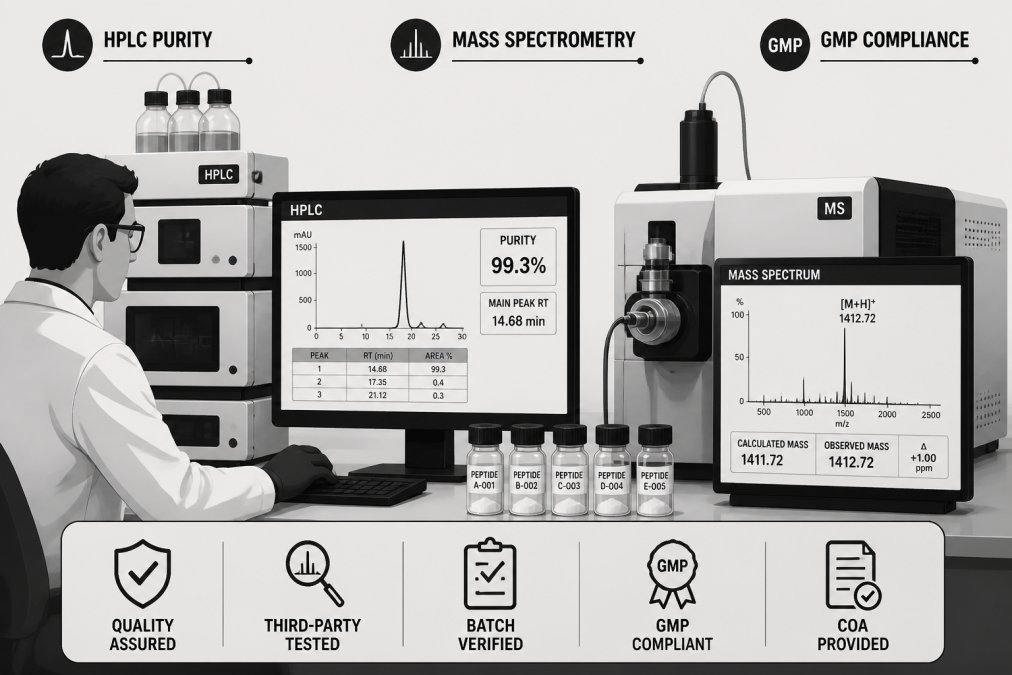
Quality standards for research peptides centre on three technical pillars: purity verification through HPLC, identity confirmation through mass spectrometry, and manufacturing consistency through GMP compliance.
HPLC Purity Standards
High-Performance Liquid Chromatography (HPLC) is the gold standard for measuring peptide purity. It separates peptide components based on their chemical properties and quantifies each as a percentage of the total.
Industry standards for research peptides generally specify minimum purity levels of 95-98%, depending on the application. High-throughput screening and structural studies often require 98% or higher. Your research protocol should define your minimum acceptable purity threshold before procurement.
HPLC results should specify the detection wavelength used (typically 214 nm or 280 nm for peptides), the reference standard or comparison method, and the gradient and solvent system used. Suppliers who provide only a purity percentage without these methodological details are hiding important information.
Mass Spectrometry Verification
Mass spectrometry (MS) confirms the identity of your peptide by measuring its molecular weight. A peptide that appears pure by HPLC but has the wrong molecular weight isn't the compound you ordered.
Most research peptide suppliers use either MALDI-TOF (Matrix-Assisted Laser Desorption/Ionisation Time-of-Flight) or ESI-MS (Electrospray Ionisation Mass Spectrometry) for identity verification. The COA should state which method was used and provide the measured molecular weight alongside the theoretical value. For complex peptides or those with post-translational modifications, MS becomes critical because HPLC alone cannot confirm identity.
GMP Compliance and Manufacturing Standards
Good Manufacturing Practice (GMP) ensures consistent product quality through standardised manufacturing processes, documentation, and quality control. For research peptides, GMP compliance means documented standard operating procedures for every manufacturing step, validated equipment and analytical methods, environmental monitoring, batch records showing all manufacturing parameters and quality tests, personnel training records, and change control procedures.
GMP compliance doesn't guarantee perfect products, but it ensures that any variation is documented and understood. Suppliers should provide evidence of GMP compliance through third-party audits, ISO certifications, or direct compliance statements. Ask whether their facility has been inspected by regulatory agencies and whether any findings or corrective actions were issued.
Documentation, Chain of Custody, and Standard Operating Procedures
Institutional compliance requires meticulous documentation. This is the evidence trail that protects your research integrity and allows you to troubleshoot quality issues if they arise.
Your procurement documentation should include:
Purchase Orders and Specifications Create a standard purchase order template that specifies the peptide sequence and molecular weight, minimum purity requirement (e.g., ≥98% by HPLC), required analytical testing (HPLC, MS, endotoxin, microbial), delivery timeline and storage requirements, and acceptance criteria and rejection procedures.
Receiving and Acceptance Procedures Upon delivery, document the batch number and lot number, quantity received and condition of packaging, expiration date and storage requirements, and date received and receiving staff member. Compare the delivered batch against your purchase order. If the batch number, purity specification, or delivery date differs from what was ordered, flag it immediately.
COA Filing and Verification Create a centralised repository for all COAs. File them by batch number and date received. Before using any batch, verify that the COA matches the batch you received, all required tests are present and within specifications, the testing laboratory is accredited and independent, and the expiration date hasn't passed.
Chain of Custody Records Document the path of each batch from receipt through use. Record who received the batch and when, storage location and conditions, each time the batch is removed from storage, who used the batch and for which experiment, and when the batch was depleted or discarded. This level of detail allows you to isolate variables if results diverge.
Standard Operating Procedures (SOPs) Create written SOPs for peptide procurement, receiving, storage, and use. SOPs should specify vendor selection criteria and approval process, minimum documentation requirements for suppliers, receiving and inspection procedures, storage conditions and monitoring, expiration date tracking and disposal procedures, and escalation procedures if a batch fails acceptance criteria.
International Supply Chain Compliance and Adverse Event Reporting
For researchers sourcing peptides internationally, additional compliance layers apply. Import/export regulations, customs documentation, and international regulatory standards all affect procurement.
Import and Customs Compliance Peptides imported into the United States must clear U.S. Customs and Border Protection (CBP). The importer must provide a commercial invoice with accurate product description and value, packing list showing batch numbers and quantities, certificate of origin, and any required regulatory documentation. Check with your institution's procurement office about import requirements before ordering from international suppliers.
Regulatory Recognition Across Markets A supplier may be GMP-compliant under European standards but not recognised as compliant under U.S. standards. Verify that your supplier's compliance certifications are recognised in all jurisdictions where your research will be conducted.
Adverse Event Reporting If you discover that a batch causes unexpected effects (contamination, toxicity, instability), you have a responsibility to report it. Adverse event reporting typically goes to your institution's research compliance office or institutional review board (IRB), your supplier, and potentially the FDA if the peptide is being used in human research. Document any adverse events thoroughly: what was observed, when it was discovered, which batch was involved, and what corrective actions were taken.
Conclusion
Research peptide procurement compliance protects your research integrity, institutional credibility, and team safety. The framework outlined here, regulatory awareness, vendor vetting, COA verification, quality standards, documentation, and international considerations, transforms procurement into a strategic process.
At Everform Research, we've built our reputation on these principles. We provide third-party tested peptides with comprehensive documentation, cGMP-compliant manufacturing, and transparent batch traceability. Our commitment to quality standards and customer education means you can focus on your research rather than worrying about supplier reliability.
Ready to simplify your peptide procurement? Use discount code EVER15 for 15% off your first order and experience the difference that rigorous compliance and transparency make. Shop compounds at Everform Research and join researchers who've made the switch to dependable sourcing backed by institutional-grade documentation.
| Compliance Element | What to Verify | Why It Matters |
|---|---|---|
| GMP Compliance | Third-party audits, ISO certifications | Ensures consistent manufacturing and quality control |
| HPLC Purity | ≥95-98% depending on application | Confirms batch meets your research specifications |
| Mass Spectrometry | Measured molecular weight matches theoretical | Verifies peptide identity, not just purity |
| COA Independence | Signed by accredited third-party laboratory | Prevents supplier bias in quality testing |
| Batch Traceability | Unique lot numbers, manufacturing dates | Enables troubleshooting if results diverge |
| Documentation | Purchase orders, receiving records, SOPs | Demonstrates institutional compliance controls |
Frequently Asked Questions
What are the legal requirements for purchasing research peptides in the US?
Research peptides must be sold with 'research-use only' labelling and cannot be marketed for human consumption. Suppliers must comply with FDA regulations for research chemicals, maintain proper documentation, and follow cGMP standards for manufacturing. Institutional buyers should verify that vendors have appropriate certifications and can provide certificates of analysis. Compliance requirements vary by institution, so check your research facility's procurement protocols.
How do I verify the quality and purity of research peptides using a COA?
A certificate of analysis should detail HPLC purity percentages, mass spectrometry results confirming molecular weight, and impurity profiles. Verify that the COA is from an independent third-party laboratory, not the manufacturer. Check that lot numbers match your shipment, review stability testing data, and confirm analytical methods meet industry standards. Request clarification if any results appear incomplete or if you cannot trace the CoA back to the actual batch received.
What should I look for when building a peptide vendor vetting checklist?
Evaluate vendors on cGMP compliance certification, third-party testing transparency, lot traceability records, quality assurance protocols, and willingness to provide detailed documentation. Assess their response time for questions, consistency across batch testing, and institutional references. Verify their supply chain integrity, ask about adverse event reporting procedures, and confirm they maintain standard operating procedures. Request samples with full analytical data before committing to larger orders.
What is the difference between research-grade and pharmaceutical-grade peptides?
Pharmaceutical-grade peptides meet stricter standards for human use and undergo additional safety testing. Research-grade peptides are intended for laboratory investigation only and must be labelled 'research-use only.' Research-grade compounds may have higher acceptable impurity levels, but reputable suppliers still verify purity through HPLC and mass spectrometry. Both should come with full analytical documentation, though pharmaceutical-grade requires more extensive stability and potency data.
What documentation should a reputable research peptide supplier provide?
Suppliers must provide a certificate of analysis with HPLC purity, mass spectrometry confirmation, lot number, synthesis date, and expiration information. They should include stability testing results, impurity profiles, and endotoxin testing for sterile applications. Request documentation of cGMP compliance, chain of custody records, and standard operating procedures for handling. Reputable vendors also provide adverse event reporting contact information and will supply institutional compliance certifications upon request.
How can I ensure compliance when sourcing peptides from third-party vendors?
Establish a formal procurement protocol that includes vendor vetting criteria, required documentation standards, and quality verification steps. Maintain detailed records of all purchases, testing results, and vendor communications. Implement chain of custody procedures from receipt through use. Conduct periodic audits of vendor certifications and batch consistency. Document all quality assurance findings and maintain an adverse event log. Work with your institution's compliance team to align vendor requirements with institutional policies.
Are there specific FDA regulations regarding the sale of research chemicals and peptides?
The FDA regulates research chemicals under the Federal Food, Drug, and Cosmetic Act. Suppliers cannot market research peptides for human consumption and must use 'research-use only' labelling. Manufacturers must follow cGMP standards for production facilities. Vendors must maintain records of product testing and be prepared for FDA inspection. Research facilities should verify that suppliers comply with applicable FDA guidance documents and can provide evidence of regulatory compliance. Consult your institution's regulatory affairs office for specific requirements.
This article was written using GrandRanker