 how-to
How to Verify Peptide Sequence Integrity: A Step-by-Step Guide
Table of Contents
- Why Verifying Peptide Sequence Integrity Matters
- Understanding the Difference Between Peptide Identity and Purity
- HPLC Testing for Peptides: Assessing Purity and Separation
- Peptide Mass Spectrometry: Confirming Molecular Identity
- Edman Degradation Peptide Sequencing: Residue-Level Verification
- Reading Your Peptide Certificate of Analysis
- Building Your Verification Workflow: A Practical Checklist
- Frequently Asked Questions
Last Updated: October 18, 2026
Why Verifying Peptide Sequence Integrity Matters
When you're working with peptides for research, a purity certificate alone doesn't give you the tools to verify peptide sequence integrity. A sample can look pure on paper yet contain truncated sequences, modified residues, or off-target variants. These problems won't show up until your experiments fail or produce inconsistent results.
Sequence integrity is the assurance that every peptide molecule in your batch matches the intended amino acid sequence, residue by residue. At Everform Research, we prioritise rigorous analytical methods to verify exactly what you're getting.
The difference between a peptide that looks clean and one that actually works comes down to method selection. HPLC tells you purity. Mass spectrometry tells you identity. Edman degradation tells you sequence. None of these alone is enough. When you combine them strategically, you get confidence.
This guide walks you through the analytical methods that matter, how to read the results, and how to build a verification workflow that helps you verify peptide sequence integrity before experiments begin.
Understanding the Difference Between Peptide Identity and Purity
Here's where most guides get it wrong: they treat purity and identity as the same thing. They're not.
Purity measures the percentage of your sample that is the target compound versus all other material. A 98% pure peptide means 98% of the mass is your peptide and 2% is something else. That "something else" could be salts, water, degradation products, or truncated chains.
Identity confirms that the 98% that is your peptide has the correct sequence. It verifies that amino acid one is what you ordered, amino acid two is correct, all the way through to the final residue.
You can have a pure sample that isn't the right sequence. You can have the right sequence contaminated with impurities. The methods that measure each are different.
According to Biosynth's analytical methods guidance, HPLC measures purity by separation and detection. Mass spectrometry measures identity by molecular mass and fragment patterns. Together, they answer two separate questions. Separately, each one leaves gaps.
This distinction matters because:
- HPLC alone can miss sequence errors that don't change overall mass significantly
- Mass spectrometry alone doesn't separate your target from closely related contaminants
- A certificate that shows "98% pure" without sequence confirmation is incomplete
When you're evaluating a supplier's quality documentation, look for both purity data AND identity confirmation. If you see only one, you're missing half the picture.
HPLC Testing for Peptides: Assessing Purity and Separation
High-performance liquid chromatography separates peptide molecules based on their chemical properties as they move through a column. Different compounds stick to the column for different lengths of time, creating distinct peaks on a chromatogram.
The method works by injecting your sample into a column packed with tiny particles. A solvent flows through under high pressure. Your peptide molecules interact with the column material and emerge at different times depending on their size, charge, and hydrophobicity.
What HPLC tells you:
- How many distinct compounds are in your sample
- What percentage of the total is your target peptide
- Whether degradation products or related impurities are present
- Relative abundance of each peak
HPLC is excellent at separation. It's the industry standard for purity assessment. But it has a limitation: two different sequences can have very similar retention times if their properties are close. You might see one clean peak and assume it's pure when it actually contains sequence variants.
For peptides, HPLC is usually paired with ultra-high-performance liquid chromatography (UPLC) for finer resolution. UPLC uses smaller particles and higher pressures to achieve better separation.
The practical value: if your HPLC shows 98% purity with one dominant peak, you know the sample is well-separated and mostly one compound. You don't yet know if that one compound is the right sequence. That's what the next method answers.
Peptide Mass Spectrometry: Confirming Molecular Identity
Mass spectrometry measures the mass of your peptide molecules with extreme precision. It ionises your sample and separates the resulting charged particles by their mass-to-charge ratio. A detector counts how many ions arrive at each ratio.
The result is a mass spectrum: a graph showing abundance (y-axis) versus mass-to-charge ratio (x-axis). Your target peptide produces a peak at a specific mass-to-charge ratio. If the sequence is wrong, the mass is wrong, and the peak appears at a different ratio.
What mass spectrometry tells you:
- The exact molecular mass of your peptide
- Whether the mass matches the intended sequence
- The presence of modified residues (post-translational modifications)
- Relative abundance of mass variants
For peptide identity, high-resolution tandem mass spectrometry (MS/MS) is the gold standard. According to Biosynth's quality control testing guidance, high-resolution tandem MS unambiguously verifies peptide sequence identity by fragmenting the peptide and measuring the masses of generated ions.
Here's how it works: the first mass analyser selects your target peptide ion. A collision cell fragments that ion into smaller pieces. The second mass analyser measures the masses of those fragments. The fragment pattern is unique to your sequence. If the sequence is wrong, the fragment pattern doesn't match.
This method is powerful because:
- Fragment ions reveal information about each bond in the sequence
- The pattern is highly specific to your exact sequence
- Modified residues show up as mass shifts
- You get both intact mass and sequence-level confirmation
Tandem MS is more expensive and technically demanding than HPLC, but it's the method that actually confirms sequence.
Edman Degradation Peptide Sequencing: Residue-Level Verification
Edman degradation is an older method, but it remains one of the most direct ways to read a peptide sequence residue by residue. It works by removing one amino acid at a time from the N-terminus (the start of the chain) and identifying each one.
The process:
- A chemical reagent (phenyl isothiocyanate) reacts with the free amino group at the N-terminus
- A second reagent cleaves that amino acid from the chain
- The cleaved amino acid is identified by HPLC or mass spectrometry
- The process repeats on the newly exposed N-terminus
After each cycle, you know which amino acid was at that position. After 10 cycles, you know the first 10 residues. After 20 cycles, you know the first 20 residues.
Strengths of Edman degradation:
- Direct, unambiguous identification of each residue
- Works well for peptides under 50 residues
- Detects truncations and deletions immediately
- Shows modified residues that shift the mass (Source: FDA's guidance on analytical development for biologics)
Limitations:
- Time-consuming (one residue per cycle)
- Difficult for longer peptides (signal degrades after 20-30 cycles)
- Requires intact N-terminus
- Not practical for high-throughput screening
For short peptides (under 30 residues), Edman degradation is often included in a comprehensive quality report. For longer peptides, it's usually replaced by tandem MS, which covers the entire sequence more efficiently.
When you see Edman degradation results on a certificate, it's a strong signal that someone invested in thorough verification. It's labour-intensive, which is why budget-conscious suppliers skip it.
Reading Your Peptide Certificate of Analysis
A certificate of analysis (CoA) is your documentation that the peptide has been tested and meets specifications. Not all certificates are equal. Knowing what to look for separates thorough testing from box-ticking.
Essential sections of a good CoA:
| Section | What It Shows | Red Flag |
|---|---|---|
| Identity Confirmation | MS or MS/MS data proving sequence | Missing or vague (e.g., "confirmed by HPLC") |
| Purity Percentage | HPLC result showing % of target compound | Below 95% or no method specified |
| Molecular Mass | Measured mass compared to theoretical | Missing or doesn't match sequence |
| Residual Solvents | Traces of acetonitrile, TFA, or water | Excessive levels (>5%) |
| Microbial Testing | Absence of bacteria or endotoxins | Not tested or limits unclear |
| Storage Conditions | Temperature, humidity, light protection | Vague or missing |
A weak certificate might show only purity ("98% pure") without sequence confirmation. A strong certificate includes purity, identity (MS data), molecular mass, and method descriptions.
Look for these specific markers of rigorous testing:
- "High-resolution MS confirms sequence identity"
- "Tandem MS/MS fragmentation pattern matches theoretical"
- "Edman degradation: first 15 residues confirmed"
- "HPLC purity: 98.5% at 214 nm"
- "Molecular mass (observed): 2,847.3 Da; theoretical: 2,847.2 Da"
When the certificate is vague ("tested and verified," "meets specifications"), ask for details. A supplier confident in their testing will provide them. A supplier without rigorous methods will avoid specifics.
At Everform Research, we include detailed method descriptions on every certificate. You'll see which analytical technique was used, the conditions, and the actual data. That transparency is how you build confidence in your compounds.
Building Your Verification Workflow: A Practical Checklist
A verification workflow is a repeatable process for evaluating peptides before you use them in experiments. It protects your data and catches problems early.
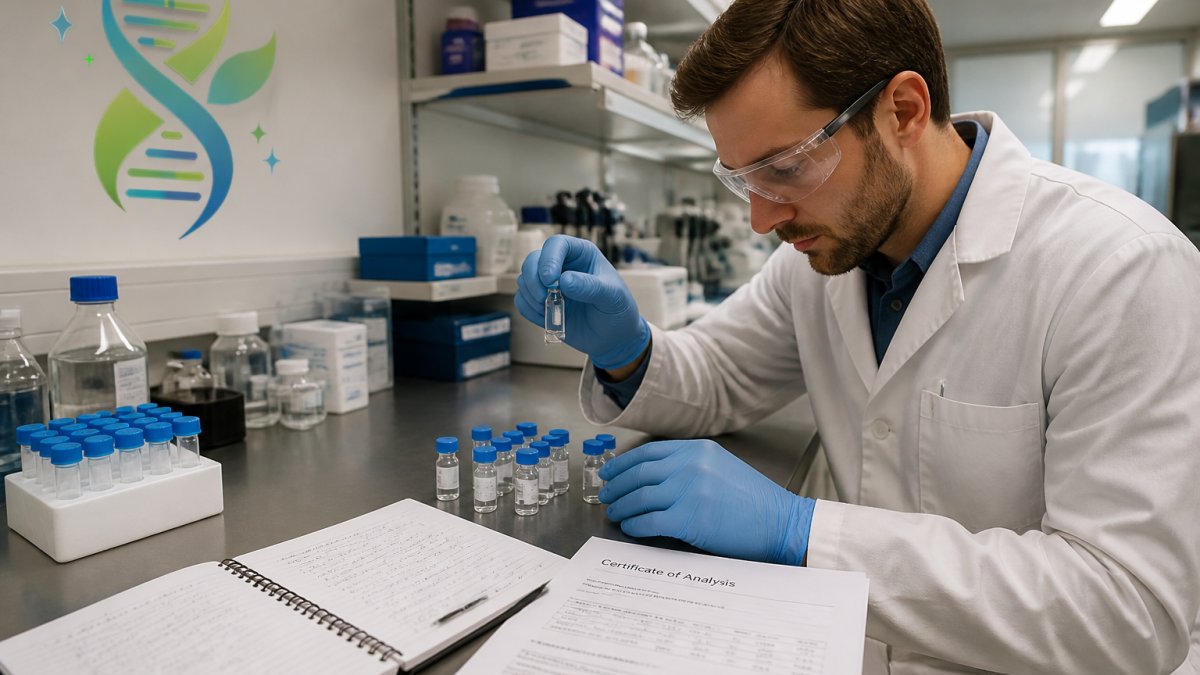
Step 1: Review the Certificate Before Opening the Vial
Before you even open your peptide shipment, examine the CoA. Check:
- Identity method is specified (MS, MS/MS, or Edman)
- Purity is above your minimum threshold (typically 95%+)
- Molecular mass matches your sequence
- Testing date is recent (within 6 months)
- All required fields are filled (no blanks or "contact supplier")
If the certificate is incomplete, contact the supplier before proceeding. Don't assume the peptide is good if the documentation is vague.
Step 2: Verify Physical Integrity
When the vial arrives:
- Vial is sealed and undamaged
- Label matches your order (sequence, lot number, quantity)
- Colour and appearance match certificate description
- Storage conditions have been maintained (check packaging)
Step 3: Perform Your Own Identity Check (When Critical)
For high-stakes experiments, run a quick mass spectrometry check yourself:
- Dissolve a small aliquot in your standard solvent
- Run intact mass spectrometry (not fragmentation, just mass)
- Compare observed mass to theoretical mass
- Acceptable range: ±0.1% of theoretical mass
This takes 30 minutes and costs little. It catches mislabelled vials or supplier errors before you waste weeks on experiments.
Step 4: Assess Purity for Your Application
Different applications need different purity levels:
- Structural studies: 98%+ purity required
- Functional assays: 95%+ usually acceptable
- Screening: 90%+ may be sufficient
Check the certificate purity against your requirement. If the supplied purity is borderline, consider requesting a higher-purity batch or running your own HPLC to confirm.
Step 5: Document and Store Properly
- File the CoA with your experimental records
- Store peptide at specified temperature (usually −20°C or −80°C)
- Label the vial with receipt date and expiration date
- Note any deviations from standard storage
- Record lot number for traceability
Step 6: Prepare Aliquots for Experiments
- Thaw vial once, divide into working aliquots
- Store aliquots at −80°C to minimise freeze-thaw cycles
- Use the same aliquot source for all replicates in one experiment
- Note which aliquot was used in your lab notebook
This workflow takes 30-60 minutes per shipment but prevents months of wasted work chasing phantom results caused by peptide quality issues.
When you choose a peptide supplier, ask how they support this kind of verification. Do they provide detailed certificates? Are they willing to re-test if you find discrepancies?
At Everform Research, we support your verification workflow with detailed certificates, accessible customer service, and the reassurance that every batch has been tested against rigorous standards.
Use code EVER15 for 15% off your next order and experience the difference that rigorous testing and transparent documentation make.
Frequently Asked Questions
What is the difference between peptide identity and purity?
Peptide purity measures the percentage of your desired peptide in the sample, typically assessed by HPLC. Peptide identity confirms that the compound is actually the correct sequence you ordered. A sample can be 99% pure but still contain the wrong peptide sequence. Mass spectrometry and Edman degradation verify identity, whilst HPLC measures purity. Both are essential for reliable research results.
How does mass spectrometry verify peptide sequence integrity?
High-resolution tandem mass spectrometry (MS/MS) measures the mass-to-charge ratios of peptide fragments generated during ionisation. These fragment ions create a unique fingerprint that confirms the amino acid sequence. The method generates sequence coverage across the entire peptide, allowing you to identify truncations, modifications, and substitutions that HPLC purity measurements alone cannot detect.
What should I look for when reading a peptide certificate of analysis?
Your certificate of analysis should include: the peptide sequence, molecular mass, purity percentage (typically ≥95%), the analytical methods used (HPLC, MS, amino acid analysis), retention time, and the testing date. Verify that the molecular mass matches your expected value and that multiple orthogonal methods were used. Check that testing was performed by a third-party laboratory, not the supplier alone.
Can HPLC alone confirm peptide sequence identity?
No. HPLC determines purity and consistency through chromatographic separation and UV detection, but it cannot confirm that the peptide sequence is correct. Two different peptides can have similar retention times and purity profiles. You need mass spectrometry or Edman degradation to verify sequence identity. Always combine HPLC purity data with identity-confirming methods for complete quality assurance.