 listicle
Best Ion Peptide Alternatives 2026: Top Lab Suppliers
Table of Contents
- Why Researchers Are Seeking Ion Peptide Alternatives in 2026
- Top Ion Peptide Alternatives: A Quick Comparison
- Third-Party Peptide Testing Requirements Every Supplier Must Meet
- How to Read a Peptide Certificate of Analysis
- Best Practices for Peptide Storage and Handling
- Cost-Benefit Analysis: Oral vs Injectable Peptide Formats
- Conclusion: Choosing Your Ion Peptide Alternative
- Frequently Asked Questions
Last Updated: September 18, 2026
Why Researchers Are Seeking Ion Peptide Alternatives in 2026
If you're hunting for the best Ion Peptide alternatives in 2026, the short answer is this: the market has split into two camps, and only one of them gives you documentation you can actually defend in a review meeting.
Peptide therapy has been named a leading frontier in targeted medicine for 2026, according to Ubie Health's clinical overview of emerging therapeutic trends, and the supplier side of that market has grown messier as a result. More vendors, more labels, more certificates that look official until you read them properly. At Everform Research, we've watched labs waste weeks re-validating protocols because a single batch came in under spec.
The 2026 shift is toward evidence-based ranking of compounds, with buyers increasingly separating peptides backed by human trial data from those supported only by mechanistic or animal work (FormBlends' peptide supplier analysis). That same logic now applies to who you buy from, not just what you buy.
Below, we'll walk through the suppliers and formats worth your budget, how to read the paperwork, and where most labs get burned.
Top Ion Peptide Alternatives: A Quick Comparison
Everform Research is our top pick for most research groups, because it combines third-party testing on every batch with cGMP-compliant manufacturing and documentation that holds up under procurement scrutiny.
The table below summarizes the main options. Note that pricing for research-grade compounds varies by quantity and compound, so check each supplier's site for current figures.
| Supplier | Testing Standard | Best For | Documentation |
|---|---|---|---|
| Everform Research | Third-party testing, cGMP manufacturing | Labs needing batch consistency | Full COA per lot |
| Koi Peptides | ISO 17025 re-testing | Purity verification focus | Lot-matched COAs |
| Peptide Sciences | In-house plus third-party | Wide catalog needs | Detailed specs |
| Compounded Tirzepatide | FDA-regulated pharmacies | Clinical metabolic work | Prescription records |
| Sermorelin (compounded) | Licensed compounding pharmacies | Hormone pathway studies | Clinical documentation |
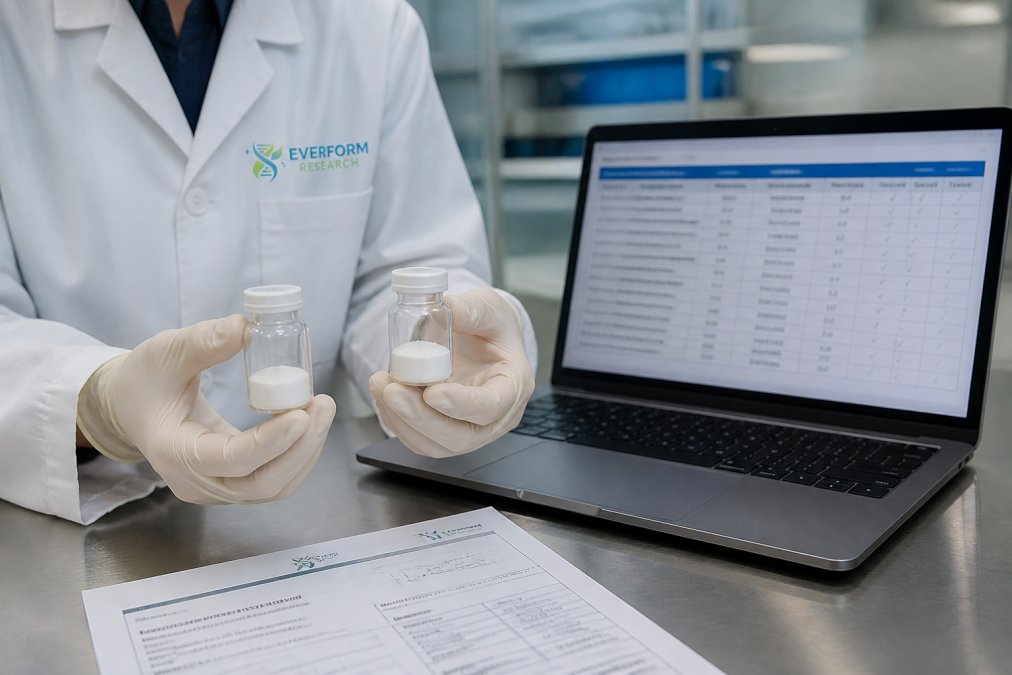
Everform Research stands out because batch-to-batch consistency is the whole point of its model. If you run high-throughput screening where a 2% purity drift ruins a dataset, that consistency matters more than a lower sticker price. The trade-off is that public pricing tiers are limited, so you'll need to request a quote.
Koi Peptides leans hard into transparency, with ISO 17025 laboratory verification and dated, lot-matched certificates.
Third-Party Peptide Testing Requirements Every Supplier Must Meet
Third-party peptide testing requirements come down to three non-negotiables: an independent laboratory, a lot-specific certificate, and purity benchmarks you can verify yourself. But testing is only one part of the safety picture. The other part is understanding what can go wrong and how to spot a supplier who cuts corners.
Here is what to demand:
- Independent lab verification from a facility with no financial relationship to the supplier
- Lot-matched documentation showing the exact batch number you received
- Purity figures from validated methods such as HPLC and mass spectrometry
- A dated report so you know how recently the batch was tested
- Traceable sourcing for the raw materials behind the compound
Safety, Side Effects, and Clinical Risks
The American Medical Association has noted that while some newer peptides show promise, clinical details remain limited, which makes rigorous evaluation of any source essential (AMA guidance on injectable peptides). That caution is not just bureaucratic. Peptides can trigger immune responses, cause injection-site reactions, or interact with other medications. Common concerns include redness or swelling at the injection site, fatigue, and in some cases, hormonal fluctuations.
FDA-Approved vs. Compounded Formulations
There is a meaningful difference between peptides that have gone through FDA approval and those that are compounded. FDA-approved peptides have undergone clinical trials for specific indications, with known safety profiles and dosing guidelines. Compounded peptides are prepared by licensed pharmacies and may not have the same level of evidence behind them. For research purposes, compounded formulations can be useful, but you should understand that they are not interchangeable with approved drugs.
How to Choose a Reputable Provider
When evaluating a supplier, look beyond the COA. Check whether they have a visible quality-control process, whether they respond to technical questions, and whether their documentation is consistent across batches. A supplier who cannot explain their testing methodology is a supplier you should avoid.
How to Read a Peptide Certificate of Analysis
A peptide certificate of analysis is a lot-specific laboratory report confirming identity, purity, and testing method for a single batch of compound. If it doesn't name your lot number, treat it as marketing material.
When you open a COA, check these in order:
- Lot number matches the vial label exactly
- Test date is recent, not recycled from an older batch
- Purity percentage is stated with the method used to measure it
- Molecular weight confirms the amino acid sequence is correct
- Laboratory name is a real, identifiable facility
- Signature or verification link lets you confirm authenticity
Best Practices for Peptide Storage and Handling
Best practices for peptide storage and handling start with temperature control, because most lyophilized peptides degrade faster than suppliers admit once they leave the cold chain.
- Avoid repeated freeze-thaw cycles, which break down the peptide structure
- Use sterile technique when reconstituting to prevent contamination
- Keep vials sealed and desiccated between uses
- Log every temperature excursion so you can flag affected batches
- Label with reconstitution dates so nothing sits past its usable window
Cost-Benefit Analysis: Oral vs Injectable Peptide Formats
Oral peptide formats cost less per unit and skip needles entirely, but injectable formats generally deliver better bioavailability for research applications. That gap is the whole decision, and it is where most guides stop short.
Bioavailability: The Numbers That Matter
Most oral peptides struggle to clear the gut wall intact. Proteolytic enzymes in the stomach and small intestine break down the amino acid chains before they can be absorbed. As a result, oral bioavailability for many peptides sits in the low single digits, while subcutaneous injection can push bioavailability well above 50% for many compounds. That difference is not marginal; it changes how you design a study.
Cost-Per-Dose: Where Oral Wins and Where It Does Not
On a per-milligram basis, oral peptides often look cheaper. But cost-per-dose tells a different story once you account for bioavailability. If you need a certain amount of active compound in circulation, you may need to administer far more oral peptide to achieve the same effect. That can erase the sticker-price advantage.
| Factor | Oral Format | Injectable Format |
|---|---|---|
| Unit cost | Lower | Higher |
| Bioavailability | Reduced by digestion | Higher, more predictable |
| Cost per effective dose | Often higher than it appears | More predictable |
| Handling | Simple storage | Cold chain required |
| Documentation burden | Lighter | Heavier |
| Best for | Screening, pilot work | Quantitative studies |
Practical Trade-Offs Beyond the Lab Bench
Conclusion: Choosing Your Ion Peptide Alternative
The best Ion Peptide alternatives in 2026 are the suppliers who hand you verifiable documentation without being asked twice. Testing standards, lot-matched certificates, and batch consistency separate a reliable vendor from an expensive gamble.
Frequently Asked Questions
What are the most in-demand peptides for 2026?
According to market demand analysis from Basic Medical Key (2026), the most popular peptides include BPC-157, CJC-1295 with Ipamorelin, GHK-Cu, and TB-500. Peptide therapy has been identified as a leading frontier in targeted medicine for 2026 by Ubie Health. These compounds are widely studied for tissue repair, growth hormone optimization, and skin rejuvenation, making them common benchmarks when evaluating ion peptide alternatives.
What criteria should be used to evaluate peptide research suppliers in 2026?
FormBlends (2026) recommends prioritizing suppliers that provide a Certificate of Analysis (COA) for every batch, adhere to specific purity benchmarks, and avoid sourcing red flags. Look for independent third-party testing, clear documentation, and evidence of cGMP-compliant manufacturing. A reputable supplier will also offer educational resources to help researchers interpret testing data and make informed decisions.
How does third-party testing ensure peptide quality and purity?
Third-party testing involves an independent laboratory analyzing each batch for purity, identity, and concentration. This verifies that the peptide matches its label and is free from contaminants. Suppliers like Everform Research use rigorous third-party testing to ensure batch consistency. Without independent verification, a COA may be unreliable, so always confirm the testing lab is genuinely separate from the supplier.
What regulatory standards should peptide suppliers follow in the United States?
In the United States, the FDA regulates peptide medications. As of 2026, the FDA has approved specific peptide medications for weight loss, including Zepbound (tirzepatide) and Wegovy (semaglutide). Other compounds like BPC-157 and MOTS-c remain under regulatory scrutiny and are categorized for research use only. Suppliers should operate within these frameworks and provide documentation of compliance.
How can researchers verify the authenticity of peptide COAs?
To verify a COA, check that it includes the supplier's name, batch number, test date, and the independent laboratory's contact information. Contact the lab directly to confirm the report's authenticity. Look for specific analytical methods like HPLC and mass spectrometry. Everform Research provides third-party COA verification, ensuring transparency and trust for research applications.
The real challenge isn't finding a supplier; it's finding one whose paperwork holds up when a reviewer asks hard questions. Everform Research addresses that with rigorous third-party testing, cGMP-compliant manufacturing, and batch consistency you can document. Use code EVER15 for 15% off and shop compounds built for reproducible research.