 ultimate-guide
Identifying High Quality Research Peptides Online
Table of Contents
- Why Quality Matters When Sourcing Research Peptides
- Understanding Purity Standards and Research-Grade Specifications
- How to Read a Certificate of Analysis for Peptides
- Third-Party Peptide Testing Standards and Verification
- Red Flags and Vendor Accountability in Peptide Sourcing
- Peptide Storage and Handling Best Practices
- Finding Reliable Vendors for Consistent Research Results
- Frequently Asked Questions
Last Updated: September 27, 2026
Why Quality Matters When Sourcing Research Peptides
The global peptide market reached $52.6 billion in 2026, yet a critical problem persists: purity verification remains inconsistent across suppliers. According to Los Angeles Times investigation into peptide purity, tested peptide batches labelled as 99% pure contained actual purity levels ranging from only 7.7% to 14.37%. This isn't a minor variance, it's the difference between reproducible research and failed experiments.
When sourcing high quality research peptides online, batch consistency directly impacts experimental outcomes. A peptide contaminated with even 2-3% impurities can skew results and waste months of work. The stakes are too high to settle for suppliers who cut corners on quality verification.
Understanding Purity Standards and Research-Grade Specifications
Research-grade peptides are expected to meet a minimum purity threshold of 98%, according to industry standards documented by Northline Labs' 2026 researcher's buying guide. But here's where vendors diverge: reputable suppliers now mandate independent, third-party Certificates of Analysis (COAs) verifying purity levels of 99% or higher for every batch.
Research-grade peptides meet analytical standards for laboratory experiments and are verified for experimental accuracy, not clinical safety, distinct from pharmaceutical-grade peptides designed for human therapeutic use.
Batch testing reproducibility separates quality from marketing. Lot numbers should be traceable, stability data should document performance under your storage conditions, molecular weight should be verified via mass spectrometry, and contaminant screening should identify endotoxin levels critical for cell-based assays.
| Specification | Research-Grade Standard | What It Means |
|---|---|---|
| Purity | 98-99%+ | Verified by third-party HPLC or mass spectrometry |
| Batch Testing | Per lot | Each batch independently tested, not assumed |
| COA Requirement | Mandatory | Certificate of Analysis with analytical data |
| Stability Data | Provided | Shelf life under specified storage conditions |
| Amino Acid Sequence | Verified | Confirmed by mass spectrometry or sequencing |
How to Read a Certificate of Analysis for Peptides
A legitimate CoA is your primary defence against contaminated peptides, but the document itself can be fabricated. Authenticate the CoA before trusting its data.
Verifying CoA Authenticity
Confirm the testing laboratory exists by searching online and visiting their official website independently, not via a vendor link. Legitimate labs maintain public accreditation directories and publish example reports. If you cannot find the lab's website or accreditation details, the CoA is likely fabricated.
Contact the laboratory directly using their official website contact information. Ask whether they tested the specific lot number listed on the CoA. If the lab has no record of testing that lot, the CoA is forged.
Verify accreditation credentials. Legitimate laboratories hold relevant accreditations. The CoA should list the accreditation body and number, verifiable through official channels.
Reading the Technical Data
Once authenticated, examine the analytical methods and data. The CoA should list lot number, synthesis date, and expiration date. HPLC or mass spectrometry results should show purity of 99% or higher, with molecular weight confirmed by mass spectrometry.
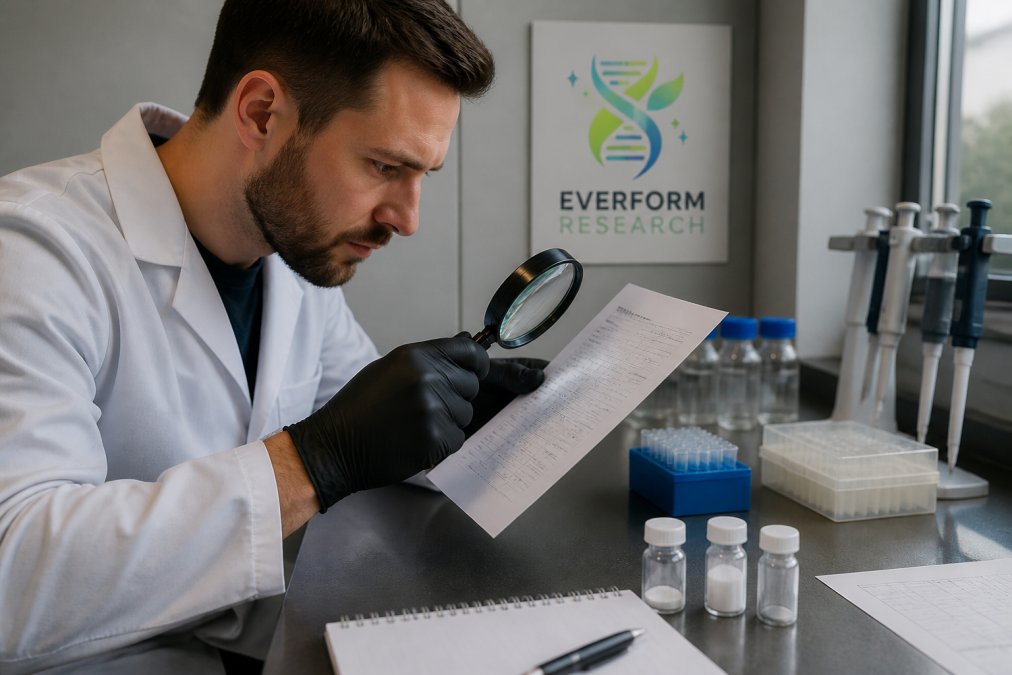
HPLC analysis should show a chromatogram with labelled peaks and integration data; mass spectrometry should display the mass spectrum with target mass highlighted and contaminant peaks identified. Both methods should be present for high-purity peptides. Storage conditions should be listed, as lyophilised peptides at −20 °C have different stability profiles than reconstituted solutions at 4 °C.
Red Flags on CoAs
Red flags include vague purity descriptions without percentages, missing lot numbers, no testing or expiration dates, and analytical data that does not match your peptide's expected molecular weight.
Inconsistent decimal precision in purity reporting or suspiciously round percentages (exactly 99.0% across multiple batches) suggest averaged or estimated data rather than actual chromatographic integration.
If a vendor cannot explain the CoA numbers or becomes defensive when you ask to verify the lab directly, that is a red flag. Trustworthy suppliers facilitate verification.
Third-Party Peptide Testing Standards and Verification
Third-party testing transforms peptide sourcing from guesswork to verification. Leading suppliers now mandate independent mass spectrometry and COA documentation for every lot, according to American Peptides industry standards. This shift reflects growing demand for accountability after years of unverified claims flooding the market.
Mass spectrometry confirms molecular weight with extraordinary precision; HPLC measures purity by separating the peptide from impurities. Both methods are complementary: mass spectrometry identifies what you have, HPLC quantifies purity.
Endotoxin testing matters for cell-based assays, as bacterial endotoxins trigger inflammatory responses in cultured cells. Reputable vendors test for endotoxin levels (typically below 100 EU/mg for most research applications).
Stability testing data should document shelf life at -20°C, 4°C, or room temperature, and reconstitution stability. Peptides reconstituted in water typically remain stable for 7-14 days at 4°C.
Red Flags and Vendor Accountability in Peptide Sourcing
Vendor accountability separates trustworthy suppliers from those cutting corners. A significant market shakeout occurred in late 2025, according to LinkedIn analysis of peptide industry consolidation, with many online vendors ceasing operations due to regulatory scrutiny. This consolidation actually benefits researchers; fewer vendors means less competition on price alone and more focus on quality.
Identifying Red Flags
Red flags include vendors refusing to provide CoAs, prices dramatically below market rates, purity claims without analytical data, and no verifiable track record or customer testimonials.
Batch consistency is critical. Ask vendors how frequently they test batches and whether they discard batches below 99% purity or sell them at discount. Vendors committed to consistency maintain tighter specifications than the minimum.
Vendor Accountability Protocols: What Happens When a Batch Fails
Ask vendors: Do they discard failed batches or reprocess them? Vendors that discard failed material demonstrate commitment to quality.
Ask whether the vendor replaces degraded batches immediately and covers return shipping costs. Vendors that charge for returns when they failed to maintain cold chain logistics are shifting accountability to you.
Ask what recourse you have if independent testing shows purity below claimed levels. Legitimate vendors replace batches, refund, or provide credit. Get this commitment in writing.
Ask whether vendors maintain batch records for traceability and can identify all customers who received a particular lot. This enables recalls or warnings if problems emerge.
Ask whether vendors guarantee peptides will meet specifications until the listed expiration date if stored correctly. Reputable vendors either guarantee longer shelf life or provide extended stability data.
Cold Chain Logistics and Shipping Accountability
Cold chain logistics directly impacts peptide integrity. Ask vendors:
- How are peptides packaged? Dry ice maintains −20 °C; standard insulated packaging allows temperature fluctuations.
- What is the maximum transit time your packaging supports?
- Do you provide temperature monitoring data loggers?
- What happens if cold chain is compromised during shipment?
Vendor Transparency on Manufacturing
Vendor transparency extends to sourcing and manufacturing. Where do they source raw materials? Do they synthesise in-house or outsource synthesis? In-house synthesis offers better quality control; outsourced synthesis introduces variability because you are dependent on a third party's processes. Reputable vendors disclose their manufacturing partners and can explain their quality assurance protocols.
Ask whether they conduct stability testing on every batch or only on representative batches. Testing every batch is more expensive but provides stronger quality assurance. Vendors that test only representative batches are assuming consistency across production runs, which is a riskier approach.
Building a Vendor Relationship
Once you identify a vendor that meets these accountability standards, maintain the relationship.
Peptide Storage and Handling Best Practices
Proper storage extends peptide shelf life and maintains experimental validity. Lyophilised peptides stored at -20°C remain stable for months to years, depending on the specific peptide sequence and storage environment. Reconstituted peptides, dissolved in water or buffer, degrade more rapidly. Most reconstituted peptides remain usable for 7-14 days at 4°C; longer storage requires -20°C or -80°C freezing.
Finding Reliable Vendors for Consistent Research Results
Identifying trustworthy vendors requires digging beyond marketing claims. Start by verifying third-party certifications. Vendors holding ISO 9001 certification or following cGMP manufacturing standards demonstrate commitment to quality systems. These certifications require external audits and documented processes, they're not trivial to maintain.
Frequently Asked Questions
What documentation should accompany high-quality research peptides?
High-quality research peptides must include a Certificate of Analysis (CoA) from an independent third party, detailing purity percentage, molecular weight, amino acid sequence verification, and batch-specific lot numbers. The CoA should document mass spectrometry or HPLC analysis results, endotoxin screening, and storage conditions. Reputable vendors provide this documentation automatically with every order, allowing researchers to verify that purchased compounds match specified parameters before use in experiments.
How can I verify that third-party peptide testing results are actually independent?
Verify independence by confirming the testing laboratory is a separate, accredited entity, not owned by or financially tied to the peptide supplier. Ask the vendor directly which laboratory conducted the analysis and request contact information. Cross-reference the laboratory's credentials and accreditation status. Leading suppliers now mandate independent mass spectrometry and COA documentation for every lot. Authentic third-party testing should be reproducible; if you retest a sample independently, results should align closely with the provided CoA.
What are the most common red flags when buying research peptides online?
Red flags include missing or vague Certificates of Analysis, purity claims without supporting data, vendors refusing to disclose testing methods, lack of batch-specific lot numbers, no clear storage or reconstitution instructions, and absence of vendor contact information or accountability protocols. Products labelled 'research only' that lack rigorous safety and efficacy documentation pose substantial risks. Tested peptide batches have revealed actual purity levels significantly lower than claimed, highlighting the importance of independent verification before purchase.
Why is HPLC and mass spectrometry analysis critical for peptide research?
HPLC (high-performance liquid chromatography) and mass spectrometry provide objective, quantifiable measurements of peptide purity, molecular weight, and amino acid sequence integrity. These analytical methods detect contaminants, verify that the compound matches its specification, and confirm batch consistency. For reproducible experimental outcomes, researchers need assurance that each vial contains the exact peptide at the stated purity level. Without these analyses, results may vary unpredictably across batches, compromising data validity and wasting research time and resources.