 ultimate-guide
What Are Research Grade Peptides? A 2026 Guide
Table of Contents
- What Research Grade Peptides Actually Means
- Why Research Grade Peptides Matter for Laboratory Research
- Peptide Purity Testing: HPLC, Identity, and What the Numbers Mean
- How to Read a Peptide Certificate of Analysis
- Third-Party Peptide Testing and Independent Verification
- Peptide Storage and Stability in the Lab
- Regulatory Boundaries: Research Use Versus Approved Medicines
- Conclusion: Choosing a Supplier You Can Verify
- Frequently Asked Questions
Last Updated: October 6, 2026
What Research Grade Peptides Actually Means
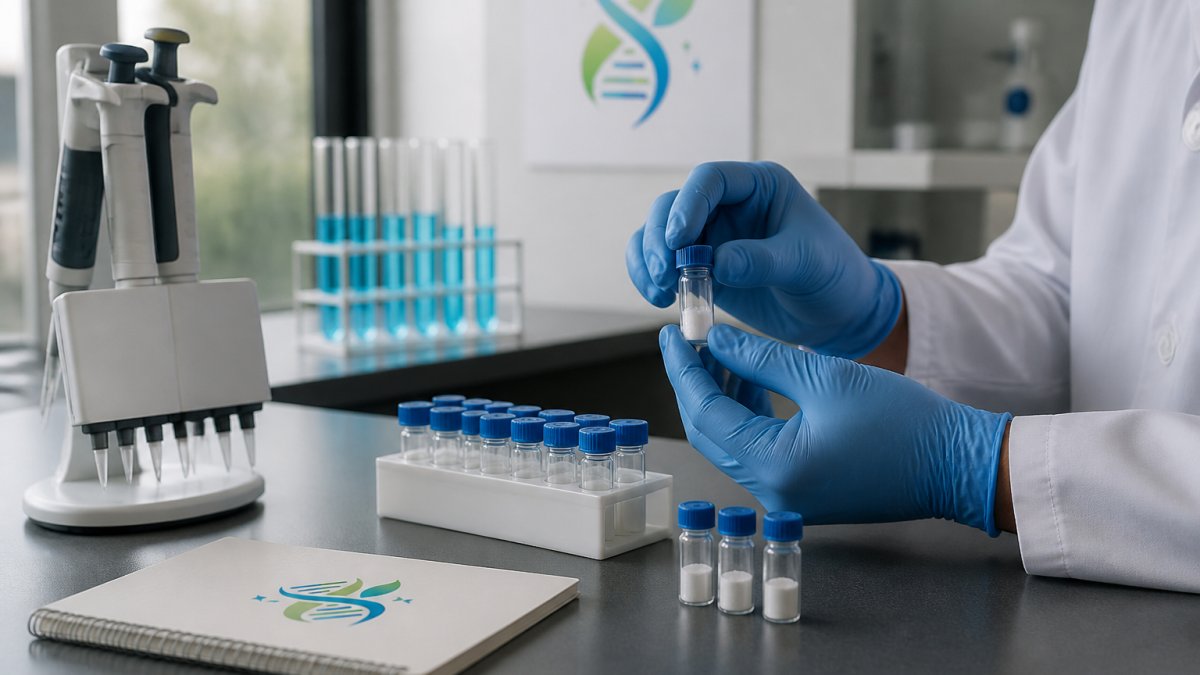
Research grade peptides are short chains of amino acids manufactured and sold specifically for laboratory and analytical work, not for human consumption.
Here is the tension nobody selling these compounds wants to name: the phrase "research grade" is a marketing and documentation category, not a regulatory one.
Below, we break down what those claims mean, how to read the testing behind them, and where the regulatory line sits.
How Peptides Differ from Proteins and Amino Acids
Amino acids are single building blocks. Proteins are long, folded chains. Peptides are the short sequences in between, and that size difference is not cosmetic.
Because peptides are small, they can move through biological systems differently than larger proteins, which is why they draw interest in drug development and therapeutic research.
For laboratory work, the practical takeaway is this: chain length affects both biological activity and handling requirements. You cannot treat a lyophilized peptide the way you treat a buffer.
Why Research Grade Peptides Matter for Laboratory Research
Reproducibility is the whole point, and it is where cheap sourcing quietly fails.
Research-grade peptides matter because they let you control for the compound itself. When purity, identity, and documentation are consistent, a failed experiment points to your method. When they are not, you are chasing ghosts.
The stakes are higher than most labs admit. NewYork-Presbyterian notes that research-grade peptides are largely unregulated for human use with respect to sterility, purity, and safety compared with FDA-approved peptides.
Peptide Purity Testing: HPLC, Identity, and What the Numbers Mean
Peptide purity testing typically relies on high-performance liquid chromatography, or HPLC, to measure how much of the sample is the target compound versus related impurities. The result is reported as a purity percentage.

Purity is only half the picture. Identity testing confirms that the compound in the vial is actually the peptide on the label, not a similar sequence with a different biological activity. Mass spectrometry is the common method here.
Reading a Purity Percentage Without Being Misled
A 98% purity figure sounds excellent until you ask what the other 2% is. That remainder can include truncated sequences, residual solvents, or water content, and the composition matters more than the headline number.
Three questions separate a meaningful purity claim from a decorative one:
- What method produced the number? HPLC with a stated column and detection wavelength is verifiable. A bare percentage is not.
- Was identity confirmed separately? Purity and identity are different tests. Ask for both.
- Is the result batch-specific? A purity figure that applies to "our peptides generally" applies to nothing.
How to Read a Peptide Certificate of Analysis
A peptide certificate of analysis, or COA, is the document that ties a specific batch to its test results. Read it as a verification record, not a brochure.
Start with the batch number and the date of analysis. Then check that the reported methods match what you would expect: HPLC for purity, mass spectrometry for identity, and appearance or solubility data where relevant. A COA that lists results without methods is a summary, not evidence.
The table below maps the common COA fields to what each one actually tells you.
| COA Field | What It Confirms | What to Watch For |
|---|---|---|
| Batch or lot number | Traceability to a specific production run | Must match the vial label exactly |
| Purity result | Percentage of target compound by HPLC | Method and detection wavelength should be stated |
| Identity result | The compound matches the label | Mass spectrometry data, not just a pass/fail |
| Appearance | Physical form, typically lyophilized powder | Unexpected color or clumping warrants a query |
| Storage guidance | Recommended handling conditions | Should specify temperature and light protection |
Third-Party Peptide Testing and Independent Verification
Third-party peptide testing means an outside laboratory, with no commercial stake in the result, performs the analysis. That independence is the entire value.
The distinction between in-house and independent testing is not academic.
Everform Research builds its quality signals around this principle: rigorous third-party testing and cGMP-compliant manufacturing, with documentation you can hand to a compliance team rather than take on faith.
Peptide Storage and Stability in the Lab
Peptide storage and stability come down to temperature, moisture, and light. Get those three right and most lyophilized peptides hold up well.
Lyophilized peptides are generally stored frozen, with desiccant, protected from light. Once reconstituted, most are handled under refrigeration and used within a defined window rather than stored long term.
A practical checklist for your bench:
- Confirm the storage temperature the supplier specifies on the COA
- Keep vials sealed with desiccant until the moment of use
- Protect from direct light during handling
- Aliquot before freezing to avoid repeated freeze-thaw cycles
- Label every aliquot with batch number and reconstitution date
- Record storage conditions alongside your experimental notes
Contamination is the quiet failure mode here. A vial opened in a non-sterile environment, or reconstituted with the wrong solvent, can introduce problems that show up as inconsistent results weeks later.
Regulatory Boundaries: Research Use Versus Approved Medicines
Research-use-only labeling is a legal boundary, not a suggestion. Compounds sold for laboratory research are not approved medicines, and the two categories carry different regulatory status, different evidence requirements, and different risks. Understanding where that line sits is essential for anyone handling these materials in a laboratory setting.
In the United States, a peptide that has not been evaluated and approved by the Food and Drug Administration (FDA) for a specific human indication is not a medicine, regardless of how it is marketed.
What Research-Use-Only Labeling Actually Means
Research-use-only, often abbreviated RUO, is a labeling designation that tells the buyer the product is intended for laboratory research and not for human or veterinary use. It is not a quality grade, and it is not a regulatory approval.
The practical implications are concrete:
- No sterility assurance. RUO peptides are not required to be manufactured under sterile conditions, and sterility testing is not a standard part of the documentation.
- No endotoxin testing. Bacterial endotoxins, which can cause severe reactions if introduced into the body, are not routinely tested for in RUO materials.
- No human dosing information. There is no established safe dose, no pharmacokinetic data, and no clinical guidance because the material was never evaluated for human use.
- No batch release for human use. The COA documents analytical results, not fitness for human administration.
A common pattern is for suppliers to use the RUO label as a legal shield while marketing the same compounds with language that implies therapeutic benefit. That gap between labeling and marketing is where the regulatory risk concentrates.
Evidence Grading: Separating Laboratory Findings from Human Evidence
One of the most useful skills for anyone reading about peptides is evidence grading: the practice of separating what has been shown in cells, what has been shown in animals, and what has been shown in controlled human trials.
A simple hierarchy helps:
- In vitro (cell) studies. These show a mechanism is plausible. They do not show that the effect occurs in a living organism, because cells in a dish lack the complexity of a whole body.
- Animal studies. These show an effect in a living system, but animal physiology differs from human physiology in ways that matter for dosing, metabolism, and safety.
- Human clinical trials. These are the only studies that can establish safety and efficacy in humans. They are also the studies that most research-grade peptides have never been through.
When you read a claim about a peptide, ask which level of evidence supports it. A cell study showing a signaling effect is not evidence of a clinical benefit. An animal study showing a result is not evidence that the same result occurs in humans.
The Practical Boundary for Laboratory Professionals
For laboratory professionals, the boundary is clearer than it is for consumers. Research-use-only compounds are not intended for human use, and treating them as interchangeable with approved peptide drugs is a category error with real consequences.
The regulatory line is not a technicality. It is the difference between a material that has been evaluated for human use and one that has not, and that difference should shape every decision you make about sourcing, handling, and interpretation of results.
Conclusion: Choosing a Supplier You Can Verify
Every sourcing decision comes down to one uncomfortable question: can you prove what is in the vial? If the answer depends on a supplier's word alone, you do not have a verifiable supply chain.
At Everform Research, we built our process around that problem rather than around it.
Use code EVER15 for 15% off your first order, and shop compounds with documentation you can check yourself.
Frequently Asked Questions
What is the difference between research peptides and regular peptides?
Research grade peptides are sold strictly for laboratory study, not for human use. They are typically lyophilized powders tested for purity, identity, and sterility, with documentation such as a certificate of analysis. Regular peptides in consumer products, by contrast, are formulated for human use and fall under a different set of rules. The key difference is intended use: research compounds are tools for experiments, not treatments, and their quality claims should be verified through analytical testing rather than marketing language.
Do research grade peptides actually work?
That depends on what you mean by work. In laboratory research, peptides are valuable because their amino acid sequence produces predictable biological signaling, which makes them useful tools for studying molecular mechanisms. Whether a given peptide produces a clinical benefit in humans is a separate question that only controlled trials can answer. The American Medical Association advises patients to look past hype around injectable peptides and discuss them with a clinician, since evidence and risks vary widely between compounds.
What does research grade mean for peptides?
Research grade describes a compound intended only for laboratory investigation, not for human consumption. In practice, it signals that the supplier should provide analytical documentation, typically a certificate of analysis showing purity by HPLC, identity confirmation, and batch details. NewYork-Presbyterian notes that research-grade peptides are largely unregulated for human use in terms of sterility, purity, and safety compared with FDA-approved peptides. That gap is exactly why documentation and independent testing matter so much when you source them.
How can you verify the purity of a research peptide?
Start with the certificate of analysis and check three things: the HPLC purity percentage, the identity test method, and the batch number matching your vial. Then confirm the testing was performed by a laboratory independent of the supplier. If your work is sensitive to small differences, consider sending a sample for your own analytical testing. A purity figure without a method, a batch number, and a named testing laboratory is difficult to substantiate.
What should a peptide certificate of analysis include?
A useful certificate of analysis lists the compound name, batch or lot number, molecular weight, appearance, purity percentage with the analytical method used, identity confirmation, and the date of testing. It should also name the laboratory that performed the testing and include a signature or verification reference. If any of those fields are missing, ask the supplier for a complete document before you commit a protocol to that batch.
Why does peptide storage and stability matter for experiments?
Peptides degrade when exposed to heat, moisture, light, or repeated freeze-thaw cycles. Lyophilized powder stored cold and dry typically holds its integrity far longer than a reconstituted solution. Once in solution, follow the supplier's guidance on temperature and handling, aliquot to avoid repeated thawing, and note the reconstitution date. Inconsistent storage is one of the most common reasons two batches of the same peptide produce different results in otherwise identical experiments.
This article is for informational purposes only and does not constitute medical advice. Research-use-only compounds are not approved for human use. Consult a qualified professional with any questions about peptide safety or regulation.