 comparison
Nationwide Peptides vs Luxury Peptides: 2026 Comparison
Table of Contents
- Nationwide Peptides vs Luxury Peptides: Quick Comparison
- Peptide Supplier Transparency: What Each Brand Discloses
- How to Verify Peptide Purity: Reading COAs and Lab Results
- Safety, Regulatory Compliance, and Third-Party Testing
- Best Practices for Peptide Storage and Handling
- Where Nationwide Peptides and Luxury Peptides Fall Short
- Conclusion: Choosing a Supplier You Can Trust
- Frequently Asked Questions
Last Updated: September 25, 2026
Nationwide Peptides vs Luxury Peptides: Quick Comparison
The peptide market is now worth $52.6 billion, according to Peptides Explorer's 2026 market report, and roughly one in eight adults has used a GLP-1 receptor agonist. That surge has produced a crowded supplier field, which is why the Nationwide Peptides vs Luxury Peptides question keeps coming up in research labs. This comparison from Everform Research looks at what each supplier discloses, how their documentation holds up, and where both leave gaps you should plan around.
Here is the short version:
| Factor | Nationwide Peptides | Luxury Peptides |
|---|---|---|
| Certificate of Analysis access | Limited public detail | Limited public detail |
| Third-party testing claims | Stated, hard to verify | Stated, hard to verify |
| Batch-specific documentation | Inconsistent | Inconsistent |
| Regulatory standing | Unapproved compounds carry risk | Unapproved compounds carry risk |
| Best for | Buyers prioritizing price | Buyers prioritizing branding |
Neither supplier wins on transparency. That is the honest finding, and it matters more than any price difference.
Peptide Supplier Transparency: What Each Brand Discloses
Peptide supplier transparency means publishing batch-specific Certificates of Analysis that name the testing laboratory, the analytical method, and the exact lot number. Both Nationwide Peptides and Luxury Peptides reference testing on their sites, but neither makes lot-level documentation easy to pull before purchase.
That gap is not unique to these two. An evaluation of more than 50 suppliers found that clear High-Performance Liquid Chromatography and Mass Spectrometry COAs are the main thing separating top-tier vendors from budget operations, according to Protide Health's 2026 supplier review.
So what should you actually ask for?
- A COA tied to the specific lot number you are buying, not a generic sample
- The name of the independent testing lab, not just a logo
- HPLC purity figures with the chromatogram attached
- Mass Spectrometry results confirming molecular weight
- Endotoxin and sterility testing where the application requires it
If a supplier cannot produce those on request, treat the purity claim as marketing.
How to Verify Peptide Purity: Reading COAs and Lab Results
Verifying peptide purity means matching the COA to your vial's lot number, checking that an independent lab ran the test, and confirming the reported purity against the chromatogram rather than the headline number. A COA is only useful if it belongs to the batch in your hand.
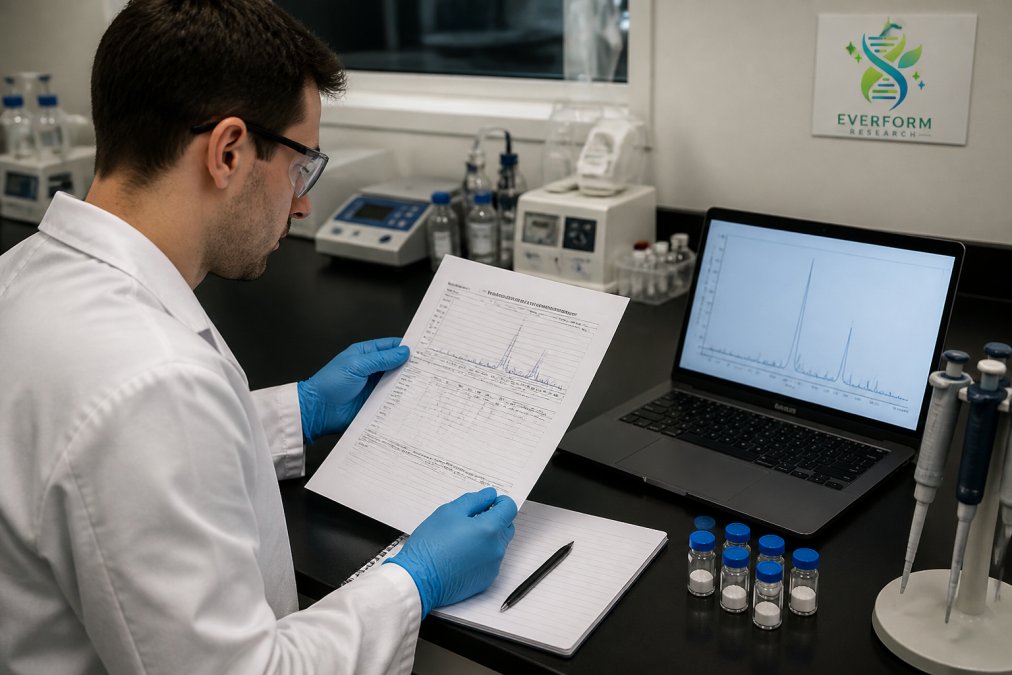
Here is what to look for, in order:
- Lot number match. The COA lot must match the vial label exactly.
- Testing lab identity. A named, independent laboratory beats an in-house stamp.
- Method disclosure. HPLC for purity, Mass Spectrometry for identity.
- Purity percentage. Research-grade material typically sits at 98% or above.
- Impurity and endotoxin data. These reveal what else is in the vial.
A 2026 report documented a persistent verification gap: products labelled 99% pure frequently failed to meet that standard under independent analysis, per the Kylo Peptides verification report. That is the single strongest argument for batch-specific verification over brand reputation.
Safety, Regulatory Compliance, and Third-Party Testing
Third-party testing is the backbone of peptide safety, because unapproved compounds that lack safety and efficacy data carry real risk. As Stuart Phillips, Professor and Researcher at McMaster University, put it:
"Unapproved peptides that lack safety and efficacy data carry substantial risks and belong in a laboratory, not your body."
To judge a supplier properly, you need to know which regulatory bucket a compound falls into, because the rules, and the risks, differ sharply between them.
The three categories that matter
- FDA-approved drugs. A small number of peptide therapeutics have full approval for specific indications. These carry the strongest evidence base and the clearest labelling.
- Compounded preparations. Under Section 503A and Section 503B of the Federal Food, Drug, and Cosmetic Act, licensed pharmacies may compound certain peptides when a bulk drug substance appears on the FDA's 503A or 503B bulks lists. If a substance is not on those lists, compounding it is generally not permitted.
- Research-grade ("not for human consumption") material. Sold for laboratory use only. It sits outside the drug-approval framework entirely, which is precisely why documentation, not marketing, is the only quality signal available.
The FDA has cautioned that compounded injectable drugs containing GHK-Cu may present significant safety risks related to immunogenicity from peptide-related impurities and aggregation, per FDA guidance on bulk drug substances in compounding.
What enforcement actually looks like
The liability angle most guides skip
Third-party testing as the practical control
- A named, independent laboratory, not an in-house stamp
- HPLC purity data with the chromatogram attached
- Mass spectrometry confirming molecular identity
- Endotoxin and sterility results where the application requires them
- A lot number that ties the report to the vial in your hand
Best Practices for Peptide Storage and Handling
Peptide storage comes down to temperature, moisture, and light. Most research-grade peptides ship as lyophilized powder precisely because the dry form resists degradation far better than a reconstituted solution.
Get these right:
- Store lyophilized powder at -20°C for standard work, -80°C for long-term archiving
- Keep vials sealed and dry; moisture degrades peptides faster than heat
- Protect from light, which breaks down susceptible sequences
- Reconstitute only what you will use within the stability window
- Use appropriate solvents and sterile technique for reconstitution
- Label everything with lot number and reconstitution date
Where Nationwide Peptides and Luxury Peptides Fall Short
Both suppliers fall short in the same place: batch-specific verification. Neither makes it straightforward to confirm that the COA you are shown belongs to the lot you receive. That is a common weakness across the category, but it is also the one you can work around, if you know how to cross-reference a report to a batch.
The representative sample problem
A batch-specific verification protocol
- Record the lot number before ordering. Ask the supplier to confirm the lot that will ship. If they cannot name it, that is your first signal.
- Request the COA for that lot, not a sample. The report should carry the same lot identifier as the vial label.
- Check the report date against the batch date. A COA dated well before or well after the manufacturing window is a red flag.
- Confirm the testing laboratory is independent. Look the lab up. A named lab with a public presence is verifiable; a logo is not.
- Match the method to the claim. HPLC supports purity claims; mass spectrometry supports identity claims. A purity figure without a chromatogram is an assertion, not evidence.
- Inspect the chromatogram itself. Look for a single dominant peak and note the retention time and any secondary peaks. A headline "99% pure" with a messy trace does not add up.
- Re-verify on receipt where feasible. If your lab can run an in-house check, compare it against the supplier's report. Discrepancies are worth documenting.
Why this beats brand reputation
Where the two diverge
Conclusion: Choosing a Supplier You Can Trust
The Nationwide Peptides vs Luxury Peptides decision comes down to documentation, not branding or price. Ask for lot-specific COAs, confirm independent testing, and check storage and shipping practices before you commit a research budget.
Frequently Asked Questions
What is the most trusted company for peptides?
Trust depends on verifiable third-party testing and transparent documentation. In 2026, industry reviews rank suppliers by their commitment to batch-specific Certificates of Analysis, HPLC and Mass Spectrometry results, and cGMP-compliant manufacturing. The global peptide market is valued at $52.6 billion, and the quality gap between research-grade and pharmaceutical-grade suppliers continues to widen. Look for vendors who publish independent lab results for every batch, not just representative samples.
Are Nationwide Peptides and Luxury Peptides considered reputable sources?
Both names appear frequently in search results, but reputation should be judged on documentation, not recognition. A 2026 review found that 78% of reported peptide complications were linked to contamination or incorrect dosing from unregulated providers. The FDA and DOJ have issued over 50 warning letters since September 2025, leading to a supplier shakeout. Verify any vendor's third-party COAs, purity levels, and regulatory compliance before purchasing.
How do third-party testing standards differ between peptide suppliers?
Standards vary widely. Some vendors test every batch with independent labs and publish full HPLC and Mass Spectrometry data. Others rely on self-sourced documentation or representative samples that may not reflect the shipped product. A 2026 evaluation of 50+ suppliers found that transparency in COAs is the primary differentiator between high-end and budget-tier vendors. Ask whether testing is batch-specific and whether the lab is truly independent.
What are the risks of purchasing peptides from non-pharmacy sources?
Unapproved peptides that lack safety and efficacy data carry substantial risks, as Professor Stuart Phillips of McMaster University notes. Contamination, incorrect dosing, and impurity issues are common. The FDA has cautioned that compounded injectable drugs containing GHK-Cu may present immunogenicity risks from peptide-related impurities. Researchers should prioritize vendors with verified purity levels, sterility testing, and clear documentation to reduce these risks.
How can researchers verify the authenticity of a Certificate of Analysis?
Check that the COA includes the batch number, testing date, and results from an independent laboratory. Look for HPLC and Mass Spectrometry data showing purity levels, molecular weight verification, and impurity profiling. Contact the testing lab directly to confirm the report is genuine. Be aware of the representative sample fallacy, where vendors test high-quality samples but ship lower-quality batches. Batch-specific verification is essential for reproducible research.