 comparison
Research vs Pharmaceutical Grade Peptides: Key Differences
Table of Contents
- Research Grade vs Pharmaceutical Grade Peptides: A Quick Comparison
- What Are Research Grade Peptides?
- What Are Pharmaceutical Grade Peptides?
- Peptide Purity Standards and Contaminant Profiles
- Third-Party Peptide Testing and Analytical Methods
- Analytical Documentation for Peptides: COAs and Labeling
- Storage, Stability, and Adverse Event Reporting
- Conclusion
- Frequently Asked Questions
Last Updated: September 28, 2026
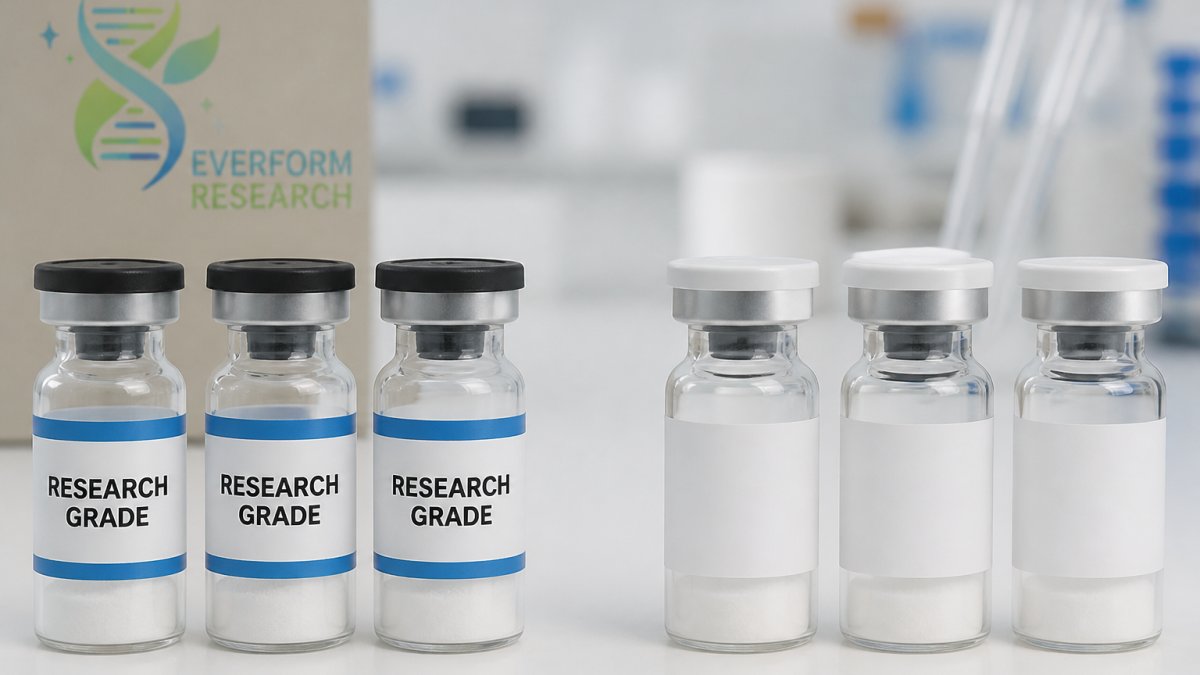
Research Grade vs Pharmaceutical Grade Peptides: A Quick Comparison
Half of all people using research-grade peptides wrongly believe those products are FDA-approved, according to a Hone Health peptide survey from 2026. That single statistic explains why the difference between research grade and pharmaceutical grade peptides matters so much. One is a laboratory reagent. The other is a regulated medicine. They can share an identical amino acid sequence and still behave nothing alike in a living system.
At Everform Research, we supply research-grade compounds and publish third-party testing data with every batch, so we have a clear stake in this conversation. Below, we break down what separates the two grades, how purity is actually measured, and how to read the paperwork that proves it.
Comparison Table: Research vs Pharmaceutical Grade
| Factor | Research Grade | Pharmaceutical Grade |
|---|---|---|
| Primary use | Lab and bench testing | Human clinical use |
| Manufacturing | Varies by vendor | cGMP-certified facilities |
| Purity benchmark | 98-99%+ claimed | Pharmacological purity verified |
| Testing | Often vendor-reported | Independent, batch-specific |
| Regulatory status | Not for human use | Prescription-based |
| Documentation | COA varies in detail | Full analytical package |
What Are Research Grade Peptides?
Research grade peptides are compounds synthesized for laboratory work, not for human administration. They are used in cell cultures, animal studies, and in vitro testing, where the goal is to probe a biological mechanism rather than treat a patient.
The label "research grade" carries no legal definition. That is the core problem. A vendor can apply it to almost anything, and purity claims rest largely on the supplier's own word.
A 2026 evaluation published via ResearchGate study on research-grade peptides found extensive variability in both purity and measured abundance across products marketed directly to consumers. In practice, that means two vials with the same label can differ meaningfully in what they actually contain.
What Are Pharmaceutical Grade Peptides?
Pharmaceutical grade peptides are produced under current Good Manufacturing Practice (cGMP) standards for use in humans. Every step, from synthesis to sterile compounding, is documented and inspected.
The distinction is not cosmetic. As Plastic Surgery Key reporting on peptide manufacturing notes, pharmaceutical-grade ingredients are built in contract facilities operating under cGMP oversight, while research-grade material is intended only for experimental models.
Regulatory status follows from that. Research-grade peptides are not legally permitted to be compounded into prescription medications, because they lack the regulatory verification and manufacturing oversight that pharmaceutical-grade products require.
Peptide Purity Standards and Contaminant Profiles
Purity numbers get quoted constantly, and they get misread just as often. A 98% purity figure tells you how much of the sample is the target peptide. It says nothing about what the remaining 2% is, and it says nothing about how that figure was produced.
That gap is where contaminant profile matters. The impurity fraction in a peptide vial is not a single mystery substance. It is a mixture, and the usual suspects are consistent across the industry:
- Truncated sequences, peptides that stopped growing early during synthesis, so they are missing one or more amino acids.
- Deletion and insertion impurities, sequences with the wrong residue in the wrong position.
- Residual solvents, traces of the organic solvents used in synthesis and purification, such as trifluoroacetic acid or acetonitrile.
- Counterions and salts, acetate or trifluoroacetate left behind from the purification step.
- Endotoxin, bacterial cell-wall fragments that matter enormously if the material ever touches a living system.
- Water content, residual moisture that inflates the weight of the powder without adding any peptide.
This is why net peptide content is a separate number from purity. A vial can read 99% pure by area under the curve and still deliver far less peptide by mass once you account for counterions, water, and salts. Purity describes the ratio of target peptide to everything else in the chromatogram. Net peptide content describes how much actual peptide is in the vial. Buyers who only check the first number routinely overpay for filler.
How Purity Is Actually Measured
Two analytical methods do most of the work, and they answer different questions.
High-performance liquid chromatography (HPLC) separates compounds by how they travel through a packed column under pressure. Each compound elutes at a characteristic time, and the detector records a peak. The area under the main peak, divided by the total area of all peaks, gives the purity percentage. Reverse-phase HPLC is the industry standard for peptides because it resolves closely related sequences well.
Mass spectrometry (MS) measures molecular weight.
What a Purity Claim Should Include
A bare percentage is not evidence. A defensible purity claim names the method, states the column and detection wavelength for HPLC, reports the observed mass against the theoretical mass for MS, and attaches the actual chromatogram and spectrum. Without those, the number is a marketing line, not a measurement.
Why This Matters More for Research-Grade Material
Pharmaceutical-grade peptides are released against a specification that includes identity, purity, potency, and sterility, and the batch cannot ship until it passes. Research-grade material has no such release gate. The vendor decides what to test, what to publish, and what to leave out. That is the structural reason two vials with the same label can differ meaningfully in what they actually contain, and why the documentation matters more than the headline number.
Third-Party Peptide Testing and Analytical Methods
Third-party peptide testing means an independent laboratory, with no financial tie to the vendor, runs the analysis and signs the result. That independence is the whole point.
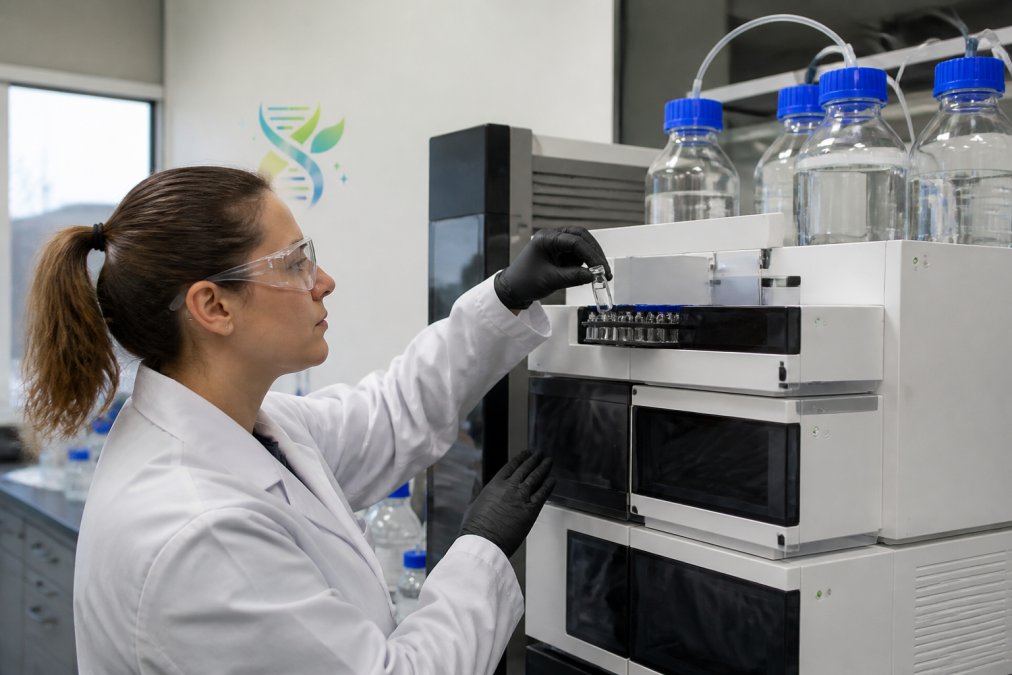
Two methods do most of the work:
- High-performance liquid chromatography (HPLC) separates compounds by how they travel through a column, producing a purity percentage and a visual trace.
- Mass spectrometry (MS) measures molecular weight, confirming the peptide is the sequence it claims to be.
Analytical Documentation for Peptides: COAs and Labeling
A certificate of analysis is only as good as the details inside it. Most buyers skim the purity line and stop. That is a mistake.
Check for these before you trust a COA:
- Laboratory name and contact details, not just a logo
- Batch or lot number matching the vial in your hand
- Testing method named (HPLC, MS, or both)
- Actual chromatogram or spectrum attached
- Date of analysis, ideally within the last 12 months
- Net peptide content, not just purity percentage
Storage, Stability, and Adverse Event Reporting
Storage conditions decide how much of your peptide survives to the experiment, and the two grades are handled very differently after they leave the facility.
Stability Basics
Lyophilized powder is the most stable form. Kept cold, dry, and dark, most peptides hold their integrity for extended periods. The enemies are heat, moisture, light, and repeated temperature swings. A frost-free freezer that cycles through defrost cycles is a poor choice for long-term storage because the temperature fluctuation drives moisture migration.
How Pharmaceutical-Grade Material Is Shipped and Stored
Pharmaceutical-grade peptides move through a controlled chain. Licensed compounding pharmacies and manufacturers follow United States Pharmacopeia (USP) general chapters for handling and storage, maintain temperature logs, and use validated shipping containers with temperature indicators. If a shipment goes out of range, the batch is quarantined rather than quietly released. That documentation trail is part of what you are paying for.
Adverse Event Reporting: The Structural Difference
For anyone weighing human administration, that missing reporting infrastructure is the strongest argument for clinical oversight. Supervised therapy with pharmaceutical-grade material is not just about purity. It is about being inside a system that notices when something goes wrong.
Conclusion
The gap between research-grade and pharmaceutical-grade peptides comes down to verification. Same sequence, different standards, and only one of them is built for human use. If your work is bench-based, buy on documentation quality. If it involves people, the answer is supervised therapy with pharmaceutical-grade material, full stop.
Frequently Asked Questions
Is it illegal to purchase research grade peptides?
Research grade peptides are legal to purchase for laboratory research, but they are not FDA-approved for human use. The FDA does not evaluate these products for safety, effectiveness, or quality. Buying them is not illegal, but using them for human consumption, especially without medical supervision, carries significant risks. Always check your state's laws and institutional policies before purchasing.
What are the primary purity differences between research grade and pharmaceutical grade peptides?
Pharmaceutical grade peptides must meet strict purity standards, often 98% to 99% or higher, set by the FDA and cGMP guidelines. Research grade peptides, however, show extensive variability in purity and measured abundance according to a 2026 ResearchGate study. Some may meet high purity benchmarks, but without regulatory oversight, the actual purity can differ from batch to batch.
How does the FDA regulate research chemicals versus pharmaceutical products?
The FDA does not approve research chemicals, including research grade peptides, for human use. Pharmaceutical products, however, must go through rigorous clinical trials and manufacturing inspections to ensure safety, purity, and effectiveness. A 2026 survey found that 50% of research-grade peptide users incorrectly believe these products are FDA-approved, highlighting a major misunderstanding of the regulatory landscape.
What documentation should accompany high-quality peptides?
High-quality peptides should come with a certificate of analysis (COA) from a third-party lab. The COA should include results from HPLC and mass spectrometry tests, showing purity levels, molecular weight, and batch-specific data. For pharmaceutical grade, documentation also includes cGMP compliance records and sterility testing. Always verify that the COA is recent and from an independent lab.
Are research grade peptides intended for human consumption?
No. Research grade peptides are intended for laboratory use only, such as cell cultures, animal studies, and in vitro testing. They are not manufactured under the same strict standards as pharmaceutical grade peptides and are not approved for human administration. Using them for human consumption bypasses safety protocols and can lead to adverse reactions. Always consult a licensed healthcare provider for any peptide therapy.