 comparison
Peptide Testing Cost vs Accuracy Analysis: 2026 Guide
Table of Contents
- Peptide Testing Cost vs Accuracy: What the 2026 Numbers Show
- Analytical Testing Methods for Peptides: HPLC, LC-MS and Safety Panels
- What Drives the Price of a Peptide Test
- The Importance of Third Party Testing for Research Reproducibility
- How to Verify Peptide Supplier Quality Before You Buy
- Batch Testing, Lab Error and the Limits of a Single COA
- Conclusion
- Frequently Asked Questions
Last Updated: September 24, 2026
Peptide Testing Cost vs Accuracy: What the 2026 Numbers Show
Peptide testing cost vs accuracy analysis starts with one uncomfortable fact: the global peptide therapeutics market was valued at $140.86 billion in 2025 Koi Peptides 2026 Peptide Industry Report, and a chunk of that money flows into compounds nobody has independently verified. At Everform Research, we see this play out constantly. A lab orders a peptide, trusts the supplier's paperwork, and six weeks later the assay results make no sense.
Analytical Testing Methods for Peptides: HPLC, LC-MS and Safety Panels
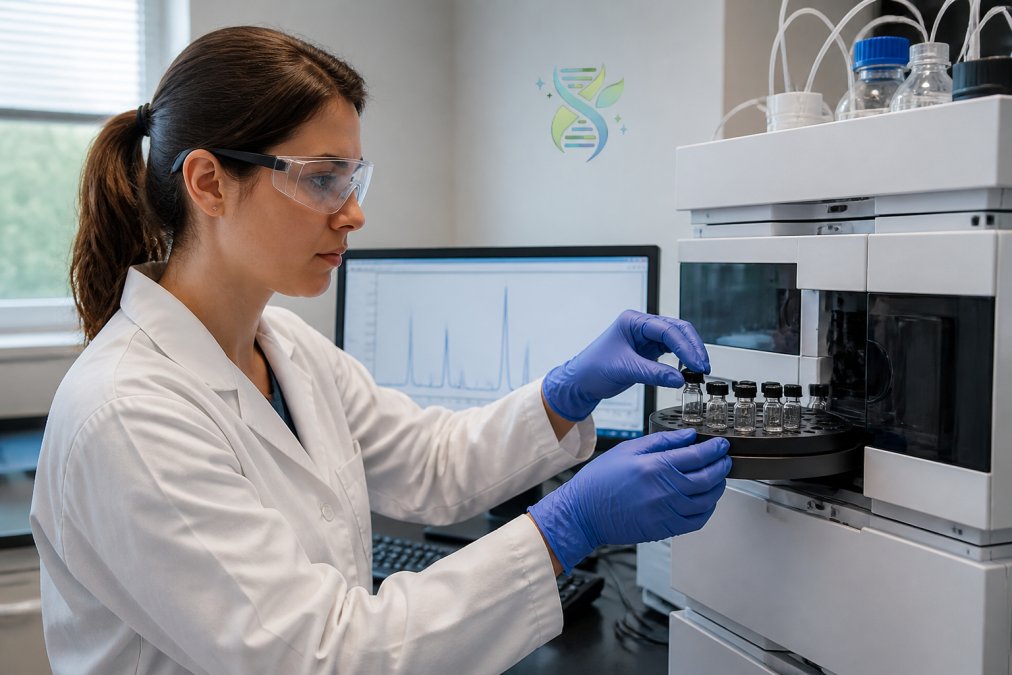
High-Performance Liquid Chromatography (HPLC) is the workhorse method for measuring peptide purity, separating compounds by how they travel through a packed column. Basic HPLC purity analysis typically costs between $50 and $150 per sample EXTERNAL_LINK: Peptidepedia purity [testing guide | peptidepedia.com].
| Method | What It Confirms | Typical Cost |
|---|---|---|
| Basic HPLC | Purity percentage | $50-$150 |
| LC-MS | Purity plus identity | Higher than HPLC |
| Full safety panel | Sterility, endotoxins | Adds significant cost |
Purity Testing vs Identity Testing
Purity testing measures how much of your sample is the target peptide. Identity testing confirms the molecule is actually the right compound. A sample can hit 98% purity and still be the wrong peptide entirely. Purity numbers are easy to quote in marketing; identity verification requires mass spectrometry and costs more, which is why budget suppliers skip it.
What Drives the Price of a Peptide Test
Sample complexity is the biggest cost lever. A straightforward synthetic peptide runs through standard HPLC quickly. Modified peptides, long sequences, or heavily contaminated samples need method development first, adding laboratory hours before a single result is produced.
The Cost Levers Most Buyers Never See
Four mechanisms explain most of the variation between two quotes for the same peptide:
- Method development versus method transfer. If the laboratory already has a validated method for your sequence, you pay for a run. If they must build one, you pay for the scientist's time, trial runs, and failed attempts, the single largest swing factor.
- Instrument time. Mass spectrometry consumes more instrument hours per sample than ultraviolet detection alone, and instrument time is the scarcest resource in most analytical laboratories.
- Replicate runs. A single injection can look clean and still be wrong. Laboratories that run duplicates or triplicates charge for each injection, so a "cheap" single-injection quote is not comparable to a triplicate quote.
- Sample preparation. Filtration, dilution, and weighing are manual steps. A pre-weighed, pre-diluted sample costs less to process than a raw powder prepared from scratch.
Why Two Laboratories Quote Different Prices for the Same Test
This is the standardisation problem, and it is why price comparisons across laboratories are so unreliable. Two laboratories can both advertise "HPLC purity" and mean different things: different column chemistry, mobile-phase gradients, detection wavelengths, and integration rules for where a peak starts and stops. A stricter integration threshold produces a lower purity number from the same vial. The honest way to compare quotes is to ask three questions before price: which method, which detection, and how many injections.
The Bulk-Testing Angle Nobody Prices Properly
Almost every guide prices a single sample, but research rarely works that way. If you are running a long study, you are buying a testing programme, and the economics change at volume. Laboratories typically discount per-sample rates once a batch submission crosses a threshold, because the fixed cost of setting up the instrument and method is spread across more vials.
The Importance of Third Party Testing for Research Reproducibility
Third-party verification exists because supplier-issued Certificates of Analysis have a structural problem: the seller grades their own homework. Some researchers argue a supplier COA is sufficient documentation. That position gets harder to defend when independent labs keep finding failures.
How to Verify Peptide Supplier Quality Before You Buy
Verification starts before payment. Ask three questions and watch how the vendor answers.
- Who performed the testing? A named independent lab with a verifiable reputation beats an unnamed "third-party lab."
- What method was used? HPLC alone confirms purity. LC-MS confirms identity. You want both.
- Can you see the raw data? Chromatograms and spectra, not just a summary percentage.
What a Legitimate COA Contains
A legitimate Certificate of Analysis includes the testing method, the instrument used, the purity figure with the method's detection limits, the sample's molecular weight, and the testing lab's identity. Missing any of those, treat the document as marketing material.
Batch Testing, Lab Error and the Limits of a Single COA
One COA covers one sample from one batch; it says nothing about the next shipment. That gap is where cost-benefit thinking gets real. Batch testing every order costs money; skipping it costs data integrity. For critical experiments, the maths usually favours testing. For broad exploratory screening, a periodic spot check may be enough.
Why Two Laboratories Can Disagree About the Same Vial
This is the question most guides avoid, and it matters most when deciding whether to pay for a second opinion. Laboratories disagree for predictable reasons:
- Different methods. A laboratory running a shallow gradient resolves fewer impurities than one running a deep gradient. Both report a purity percentage. They are not measuring the same thing.
- Different integration rules. Where a chromatogram peak begins and ends is a judgement call. A conservative integration captures more of the tail and reports lower purity. An aggressive integration clips the tail and reports higher purity.
- Different detection. Ultraviolet detection at one wavelength sees different impurities than at another, and mass spectrometry sees compounds ultraviolet detection misses entirely.
- Sample handling. Filtration can strip material from the sample. A 2026 case study identified two primary sources of error in peptide assay methods: filtration and assay-specific quantification Chromatography Online quantification case study. Both can produce significant inaccuracies in purity results even at a reputable laboratory.
False Positives, False Negatives and What They Cost You
A false positive says "pass" when the sample should have failed; a false negative says "fail" when the sample was fine. Both have a price, and the prices are not symmetrical. A false positive is the dangerous one: it lets a compromised batch into your study, quietly corrupting months of work before anyone notices. A false negative is expensive differently, you discard a usable batch, reorder, and lose time.
Supplier COAs Versus Independent Verification
A supplier-issued COA is not worthless. It is a claim, and claims are worth checking in proportion to what you are risking. The structural problem is that the seller grades their own homework: a supplier COA can be accurate, out of date, copied from a previous batch, or fabricated, and from the document alone you cannot tell which. Independent verification breaks that circularity because a different party, with no commercial interest in the result, signs off on the numbers.
A sensible hierarchy looks like this:
- Supplier COA alone: acceptable for exploratory screening where a failed result costs you an afternoon.
- Supplier COA plus periodic independent spot checks: the practical middle ground for routine work.
- Independent verification on every batch: the standard for critical experiments, regulatory submissions, or anything you intend to publish.
A Framework You Can Actually Apply
A single COA is a snapshot, not a guarantee. The practical framework:
- Critical experiments: test every batch, full LC-MS plus safety panel
- Routine work: test every third or fourth batch
- Screening runs: verify the first batch, then spot check
Conclusion
The real challenge in peptide testing is not finding a cheap lab or an expensive one. It is matching your testing spend to the cost of being wrong, batch by batch, experiment by experiment.
Frequently Asked Questions
How expensive is it to get peptides tested?
Basic HPLC purity analysis runs about $50 to $150 per sample, while independent third-party verification is commonly quoted at $150 to $200 per sample. Comprehensive characterization that adds LC-MS identity confirmation and safety panels costs more, with characterization services priced between $800 and $5,000 per sample depending on complexity. Sterility testing is optional at roughly $150 per sample and needs an extra vial.
What factors influence the cost of third-party peptide testing?
Four things move the price most: the method used (HPLC alone versus HPLC plus mass spectrometry), sample complexity and the preparation it needs, how many analytes or panels you request, and turnaround time. A rushed result costs more than a standard queue. Batch consistency work also adds up, because testing one vial tells you less than testing across a production run.
How does mass spectrometry improve the accuracy of peptide analysis?
HPLC separates and quantifies, but it cannot confirm that the peak is the right molecule. Mass spectrometry measures molecular weight, so it verifies identity rather than assuming it. Combining the two as LC-MS catches cases where purity looks acceptable but the compound is not what the label claims. This is why identity testing is treated as separate from purity testing.
Why is third-party verification essential for peptide quality?
A supplier's own Certificate of Analysis is a self-report. Independent testing re-runs the sample at a lab with no commercial stake in the result. In a 2026 investigation, 10 peptide samples were sent to an independent laboratory and 3 failed to meet quality or purity standards. That failure rate is why researchers treat verification as a purchasing step rather than a formality.
What is the difference between purity testing and quantitative analysis?
Purity testing reports what percentage of the sample is the target peptide. Quantitative analysis reports how much peptide is actually present, which matters because water, salts and counter-ions inflate weight without adding active material. Research from Chromatography Online identified filtration and assay-specific quantification as two error sources that cause significant inaccuracies in purity results if protocols are not validated.