 blog
Peptide Manufacturing Technology vs Traditional Synthesis
Table of Contents
- Peptide Manufacturing Technology vs Traditional Synthesis: A Comparison
- Why the Method Matters for Research Reproducibility
- Solid-Phase Peptide Synthesis: The Industry Standard
- Chemical vs Recombinant Peptide Production
- Peptide Synthesis Scale-Up: From Milligrams to Kilograms
- Peptide Purity Testing: What the Data Actually Shows
- Pros and Cons: Matching Method to Application
- Frequently Asked Questions
Last Updated: October 12, 2026
Peptide Manufacturing Technology vs Traditional Synthesis: A Comparison
The global peptide synthesis market was estimated at USD 774.06 million in 2025, with one analysis projecting a 12.74% compound annual growth rate through the decade ahead (Towards Healthcare peptide synthesis market analysis). That growth is forcing a quiet reckoning in laboratories: the method you choose to build a peptide now shapes everything that follows, from batch consistency to whether your results hold up when someone else tries to repeat them.
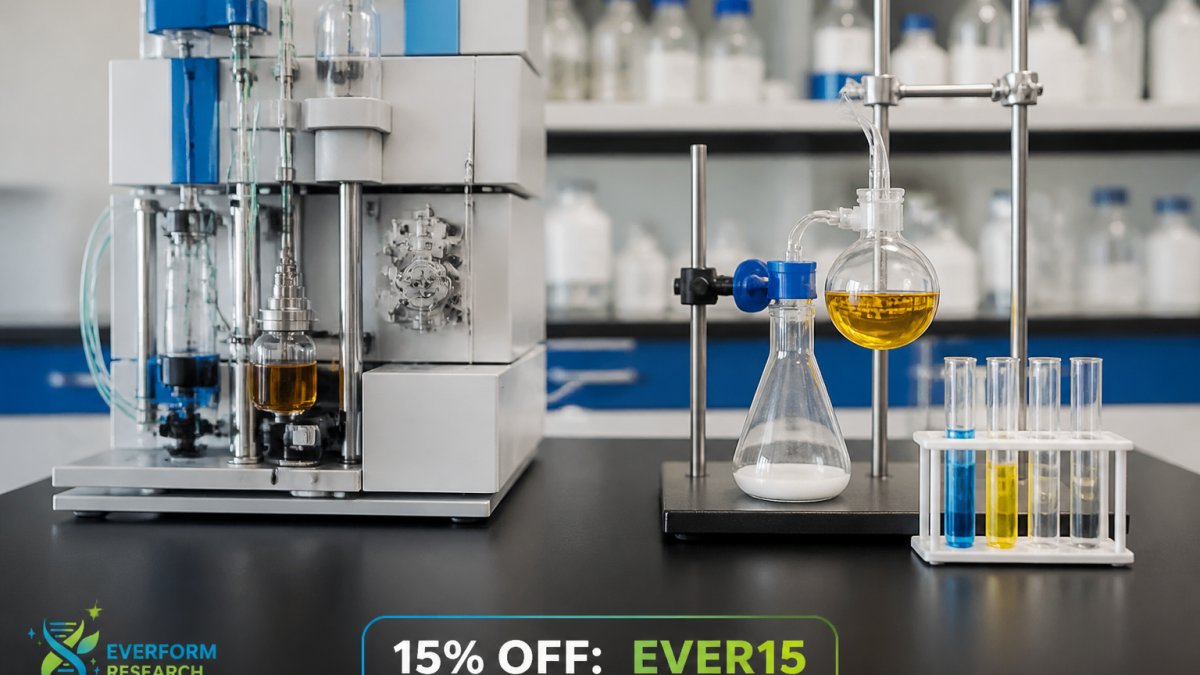
This guide from Everform Research breaks down how peptide manufacturing technology compares with traditional synthesis, where each approach wins, and how to match the method to your actual application.
Peptide manufacturing is the process of producing peptide chains at a defined scale and purity, whether through chemical synthesis, recombinant biology, or a hybrid of both. The choice of method determines yield, cost, and how reproducible your final material will be.
Here is the part most overviews skip: the "best" method does not exist in isolation. It depends on chain length, required purity, and how much material you need.
Below, we compare the major approaches side by side so you can pick the right one for your work.
Why the Method Matters for Research Reproducibility
Reproducibility lives or dies on batch consistency. If one lot of a peptide arrives at 98% purity and the next at 96%, experiments that depend on tight tolerances start producing noise instead of signal.
The synthesis method drives that consistency. Solid-phase chemistry, solution-phase chemistry, and recombinant expression each introduce different sources of variability, from incomplete coupling to host-cell impurities.
For research groups running high-throughput work, this is not a minor detail. A single inconsistent batch can invalidate weeks of screening data.
That is why documentation matters as much as the chemistry itself. Certificates of analysis, purity traces, and mass spectrometry data tell you whether the method actually delivered what it promised.
Solid-Phase Peptide Synthesis: The Industry Standard
Solid-phase peptide synthesis (SPPS) is a method where the peptide chain is built step by step while anchored to a solid resin support, allowing reagents to be washed away between each coupling step.
It is the dominant technique for a reason. According to Business Research Insights on the peptide CDMO market, solid-phase peptide synthesis accounted for nearly 68% of peptide manufacturing operations, cited for its high purity levels and scalable production capabilities.
How SPPS Works and Why It Dominates
The process attaches the first amino acid to a resin bead, then adds protected amino acids one at a time. Excess reagents wash off, so each step can be driven to completion more reliably than in free solution.
That repeatability is the whole appeal. You get cleaner intermediate steps, easier automation, and a workflow that scales from small research batches upward.
The trade-off is material intensity. SPPS uses a large excess of reagents per coupling, which adds cost and waste at scale.
Chemical vs Recombinant Peptide Production
Chemical and recombinant production are not competitors so much as tools for different jobs. Chemical synthesis, including both SPPS and solution-phase methods, builds peptides from amino acid building blocks. Recombinant production expresses them in living systems such as bacteria or yeast.
A review of chemical methods for peptide and protein production identifies solid-phase and solution-phase synthesis as the two major chemical techniques, with classical solution-phase synthesis requiring multiple discrete operations.
Recombinant methods suit longer chains and proteins that are difficult to assemble chemically. Chemical methods give you finer control over modifications and unnatural amino acids.
The catch with recombinant work is purification complexity. Host-cell proteins and post-translational variability can complicate the final product.
| Method | Best For | Main Strength | Main Limitation |
|---|---|---|---|
| Solid-phase synthesis | Short to medium peptides | High purity, automatable | High reagent use |
| Solution-phase synthesis | Specialized small peptides | Flexible chemistry | Slow, many steps |
| Recombinant production | Long chains, proteins | Scales biologically | Complex purification |
| Hybrid processes | Long-chain peptides | Lower material intensity | More process development |
Peptide Synthesis Scale-Up: From Milligrams to Kilograms
Scaling a peptide from milligrams to kilograms exposes problems that never appear at bench scale. Mixing, heat transfer, and reagent distribution all change as volume grows.
PolyPeptide published a case study describing process development and the first GMP production of a 25-mer linear peptide, scaling from 10 grams to several hundred (PolyPeptide peptide GMP process development case study). The title alone signals the real challenge: the jump between small and large batches, not the chemistry itself.
For long-chain peptides, hybrid processes are drawing attention. The American Chemical Society reports that conventional hybrid processes can substantially reduce process mass intensity compared with fully solid-phase synthesis for long-chain peptides such as GLP-1 (ACS Green Chemistry Nexus on next-generation peptide manufacturing).
Peptide Purity Testing: What the Data Actually Shows
Purity testing is where marketing claims meet analytical reality. A certificate of analysis is only as good as the method behind it.
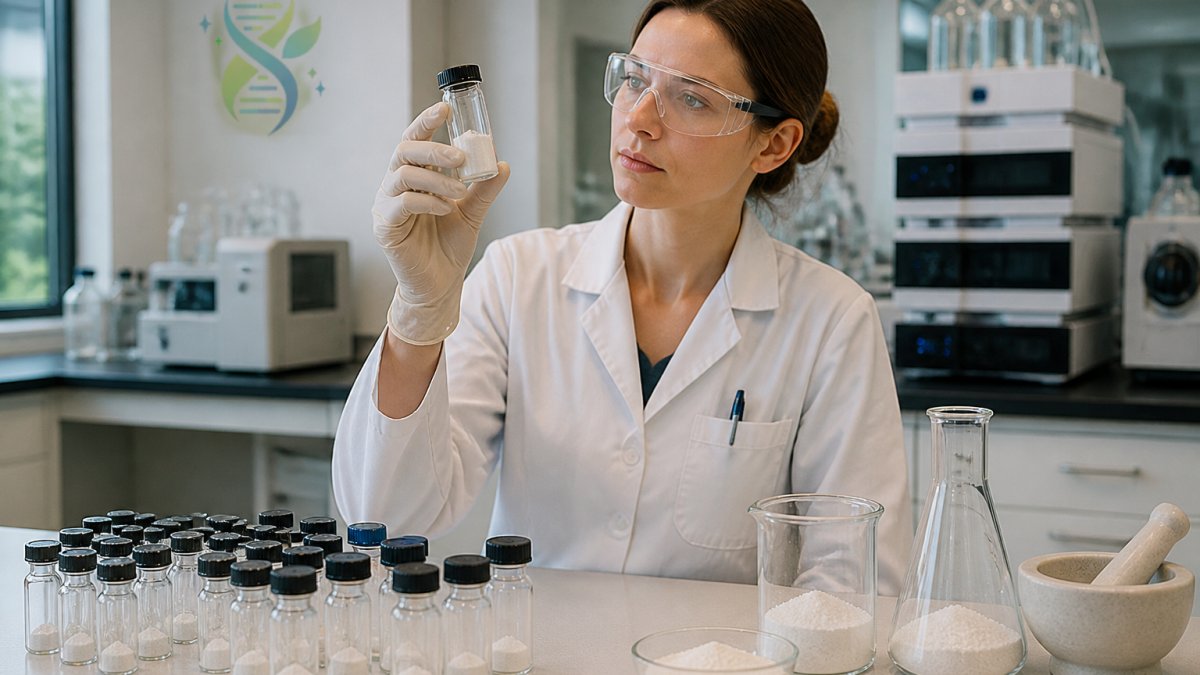
High-performance liquid chromatography remains the workhorse for purity assessment, and mass spectrometry confirms identity. Together they tell you what percentage of your sample is the target peptide and whether it is the right molecule.
Third-party verification matters here. In-house testing can be rigorous, but independent analysis removes the conflict of interest. At Everform Research, we rely on rigorous third-party testing and cGMP-compliant manufacturing so that the documentation you receive reflects an independent check, not a rubber stamp.
What most guides miss is that purity percentage alone is not enough. You also need to know what the impurities are. A 98% pure sample with a problematic 2% can behave worse than a 96% sample with benign contaminants.
Pros and Cons: Matching Method to Application
There is no universal winner, only the right fit for your application. Match the method to chain length, purity requirement, and scale.
Solid-phase synthesis
- Pros: high purity, automatable, well-documented
- Cons: high reagent consumption, costlier at large scale
Solution-phase synthesis
- Pros: flexible chemistry, useful for specific modifications
- Cons: cumbersome and slow, requiring multiple operations, as noted in a review of commercial cGMP peptide manufacturing (Pennington et al. on commercial cGMP peptide therapeutics)
Recombinant production
- Pros: suited to long chains and proteins, biologically scalable
- Cons: complex purification, potential host-cell impurities
Hybrid processes
- Pros: lower material intensity for long-chain peptides
- Cons: more process development up front
Frequently Asked Questions
What is the difference between modern peptide manufacturing and traditional synthesis?
Traditional synthesis often refers to classical solution-phase methods, which require multiple isolation and purification steps between each amino acid addition. Modern peptide manufacturing is dominated by solid-phase peptide synthesis (SPPS), where the peptide chain is built on a resin and washed between steps. Business Research Insights reports that SPPS accounted for nearly 68% of peptide manufacturing operations, cited for its purity levels and scalability. The trade-off is material intensity: the American Chemical Society notes that hybrid processes can substantially reduce process mass intensity for long-chain peptides like GLP-1.
When is recombinant peptide production preferable to chemical synthesis?
Recombinant production uses biological systems to express peptides, which suits longer sequences that are difficult to build chemically. Chemical synthesis, particularly solid-phase peptide synthesis, remains the standard for shorter peptides and those requiring non-natural amino acids. The choice depends on chain length, required modifications, and whether the peptide must be produced at scale. For research applications demanding exact purity and identity, chemical synthesis with rigorous peptide purity testing is often the more transparent route.
How do manufacturers assess peptide purity and identity?
Purity is typically assessed by high-performance liquid chromatography (HPLC), which separates the target peptide from impurities and byproducts. Identity is confirmed by mass spectrometry, which verifies the molecular weight matches the expected sequence. Third-party verification adds an independent layer: a certificate of analysis (COA) from an external lab confirms the results are not self-reported. For research groups running high-throughput screening, consistent purity across batches matters as much as the absolute percentage.
What does cGMP mean for peptide manufacturing?
cGMP stands for current Good Manufacturing Practice, a set of regulations enforced by the FDA for pharmaceutical production. For peptide manufacturing, cGMP compliance means documented processes, validated equipment, controlled environments, and traceable batch records. It does not guarantee a specific purity level, but it provides a framework for consistency. Research institutions with strict procurement rules often require documented proof of cGMP compliance before approving a vendor. Everform Research operates cGMP-compliant manufacturing with third-party COA verification.
Matching the right manufacturing method to your application is only half the equation. The other half is sourcing material you can actually trust, batch after batch. Everform Research supports researchers with cGMP-compliant manufacturing, rigorous third-party testing, and clearer documentation so your purity data holds up under scrutiny. Use code EVER15 for 15% off your order, and shop compounds at Everform Research to get quality-verified peptides built for reproducible work.