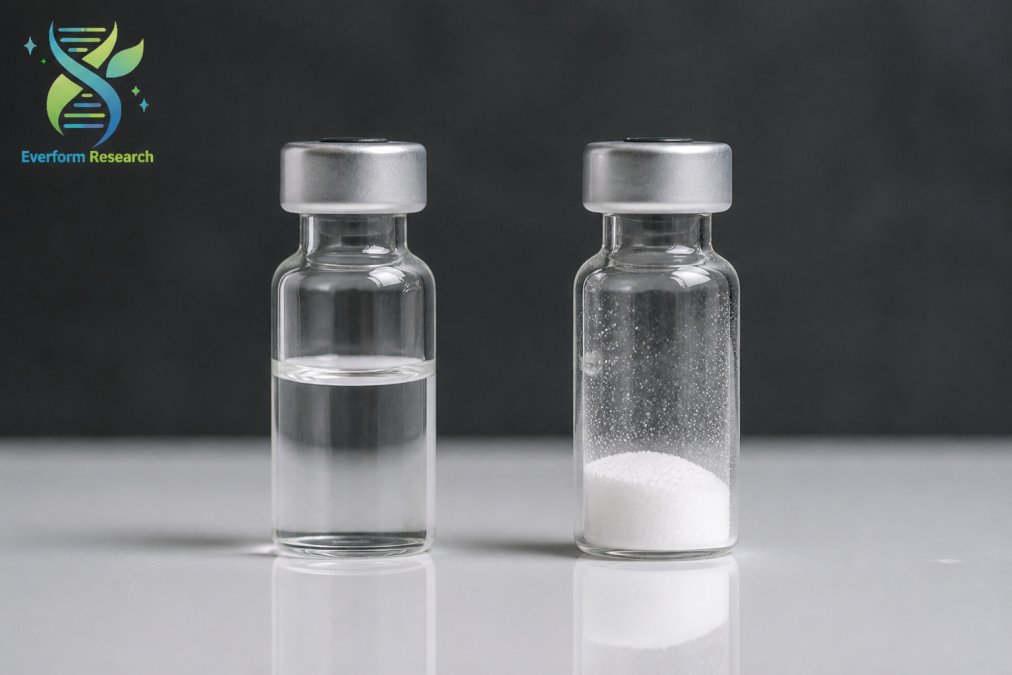
 comparison
Peptide Stability in Solution vs Lyophilised
Table of Contents
- Peptide Stability in Solution vs Lyophilised: Core Differences
- How Lyophilisation Preserves Peptide Integrity
- Chemical Degradation in Peptide Solutions
- Peptide Shelf Life in Solution: Duration and Factors
- Storage Temperature Requirements and Long-Term Stability
- Best Practices for Peptide Storage and Handling
- Reconstituting Peptides for Research: Techniques and Stability
- Frequently Asked Questions
Last Updated: September 4, 2026
Peptide Stability in Solution vs Lyophilised: Core Differences
Understanding peptide stability in solution versus lyophilised form is critical for anyone working with research-grade peptides. The difference between these two storage states fundamentally determines how long your compounds remain viable, how much preparation time you need before experiments, and ultimately, whether your results will be reproducible. This guide from Everform Research breaks down the chemistry, the timelines, and the practical decisions that separate a stable, usable peptide from one that's degraded into uselessness.
Here's the core tension: lyophilised peptides can last years in the freezer. Reconstituted solutions? They're measured in days. That single fact shapes everything about how researchers handle, store, and deploy peptides. But the reasons behind it, and the practical implications for your workflow, are what actually matter.
| Storage Form | Stability Duration | Temperature Requirement | Water Content | Best Use Case |
|---|---|---|---|---|
| Lyophilised | 2-5 years | -20°C to -80°C | <2% | Long-term storage, batch consistency |
| Reconstituted Solution | 24-72 hours | 4°C | High | Immediate use, short-term experiments |
According to Koi Peptides stability research, lyophilised peptides typically remain stable for 2 to 5 years when stored at temperatures between -20°C and -80°C. Reconstituted peptide solutions, by contrast, maintain stability for only 24 to 72 hours when stored at standard refrigeration temperatures.
How Lyophilisation Preserves Peptide Integrity
Lyophilisation, freeze-drying, removes water from peptides while they're frozen. This is not a passive process. The technique actively halts the chemical reactions that destroy peptides in aqueous form.
When water is present, peptides undergo hydrolysis. Water molecules attack the peptide bonds, breaking them apart. Remove the water, and hydrolysis stops. It's that straightforward. MDPI Pharmaceutics research confirms that peptides are frequently unstable in aqueous solutions, which negatively impacts their bioactivity and overall stability compared to dry formulations.
The freeze-drying process explained
Freeze-drying works in three stages. First, the peptide solution is frozen solid, typically to -40°C or below. The solution must be completely frozen, partial freezing creates ice crystals that damage peptide structure. Second, the pressure inside the chamber drops dramatically, and heat is applied carefully. The frozen water sublimes directly from solid to vapour, bypassing the liquid phase entirely. This gentle transition preserves the peptide's three-dimensional shape. Third, residual moisture is removed under vacuum. The result: a stable, dry powder with water content below 2%.
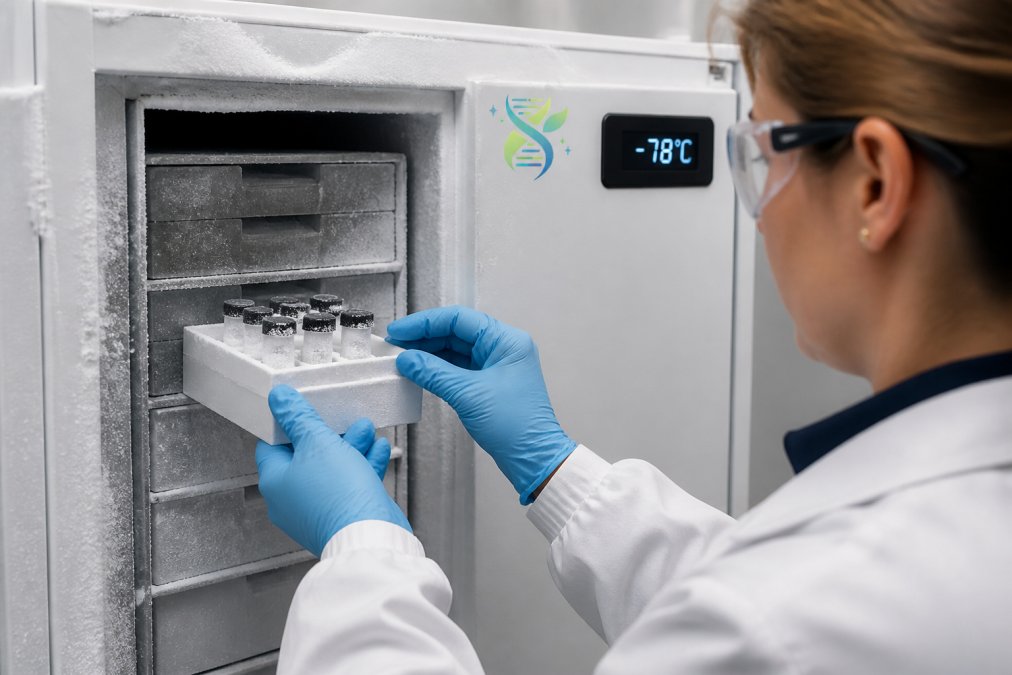
Most lyophilised peptides are stable for 12-24 months or longer when stored under appropriate conditions, according to Peptides Lab UK guidelines. Some formulations, particularly those with stabilising excipients, extend beyond this window.
Why moisture removal matters
Water is the enemy of peptide longevity. Moisture facilitates every degradation pathway: hydrolysis, oxidation, deamidation. Remove it, and you remove the mechanism driving breakdown. This is why lyophilisation is prioritised as the standard for storage, it removes the water that catalyses hydrolysis.
The stability difference is dramatic. NCBI research on peptide shelf-life documents that the shelf-life of peptides in solution is significantly limited compared to lyophilised forms, which can remain stable for several years. A lyophilised peptide stored at -20°C can sit untouched for years. The same peptide reconstituted in water degrades noticeably within a week.
Chemical Degradation in Peptide Solutions
Peptides in aqueous solution face a hostile environment. The moment you dissolve a lyophilised peptide in water, degradation pathways activate simultaneously.
Hydrolysis and oxidation pathways
Hydrolysis is the primary culprit. Water molecules attack the peptide backbone, the bonds linking amino acids together. This process accelerates with temperature and pH drift. A peptide solution stored at room temperature degrades faster than one refrigerated at 4°C, which itself degrades faster than a frozen solution. But even refrigeration buys you only days, not weeks.
Oxidation compounds the problem. Dissolved oxygen in the solution attacks sensitive amino acids, particularly methionine and tryptophan. These oxidised residues alter the peptide's structure and function. Researchers often add antioxidants like ascorbic acid or methionine to solutions, but this merely slows oxidation, it doesn't stop it.
Deamidation, the spontaneous loss of ammonia from asparagine and glutamine residues, proceeds relentlessly in solution. This single-atom change shifts the peptide's charge and structure, rendering it unsuitable for experiments requiring precise characterisation.
Sequence-specific stability concerns
Not all peptides degrade at the same rate. Sequence matters profoundly. A peptide rich in hydrophobic residues may aggregate and precipitate out of solution within hours. One containing multiple lysine residues may undergo cross-linking, forming insoluble aggregates. A sequence with exposed methionine will oxidise faster than one without it.
This is where many researchers stumble. They assume all peptides behave identically in solution. They don't. Inherent sequence instability means some peptides may undergo chemical degradation processes depending on their specific amino acid sequence, even in lyophilised form under ideal conditions.
Peptide Shelf Life in Solution: Duration and Factors
How long does a reconstituted peptide actually last? The honest answer: it depends on your definition of "stable."
Peptide solutions are generally stable for up to one week when stored at 4°C, provided the sequence does not possess inherent instability, according to Sigma-Aldrich storage guidelines. But "stable" here means detectable by standard assays. It does not mean unchanged. A peptide that measures as 98% pure on day one may be 94% pure by day four. For high-precision experiments, that degradation is unacceptable.
Reconstituted peptide solutions generally maintain stability for only 24 to 72 hours when stored at standard refrigeration temperatures. This tight window forces a decision: either use the peptide immediately, or accept that you're working with progressively degraded material.
Temperature is the dominant variable. Room temperature accelerates all degradation pathways. A solution left on the bench degrades in hours. The same solution at 4°C lasts days. At -20°C, stability extends to weeks, though freeze-thaw cycles introduce their own damage.
Storage Temperature Requirements and Long-Term Stability
Temperature control separates usable peptides from waste.
Freezer storage for lyophilised peptides
Lyophilised peptides stored at -20°C remain stable for 2 to 3 years, according to current 2026 industry benchmarks. Move to -80°C, and stability extends to 5 years or beyond. The difference is simple chemistry: lower temperature slows all chemical reactions exponentially.
But temperature stability matters as much as absolute temperature. Repeated temperature fluctuations, opening a -20°C freezer dozens of times per week, introduce subtle damage. Each thaw cycle allows trace moisture to condense on the peptide surface. Each refreezing concentrates this moisture, accelerating hydrolysis in localised spots. Researchers working with precious peptides often store vials in -80°C freezers specifically to minimise access and temperature swings.
Lyophilised peptides are stable at room temperature for several weeks if kept away from heat, light, and moisture, though this is not recommended for long-term storage.
Refrigeration protocols for solutions
Standard refrigeration at 4°C extends solution stability to approximately one week, but only if the vial remains sealed and undisturbed. Every time you open the vial, you expose the solution to oxygen and introduce the risk of microbial contamination.
This is why bacteriostatic water, water containing a preservative like benzyl alcohol, is standard for reconstitution. The preservative inhibits bacterial growth but does nothing to slow peptide degradation. It merely prevents your solution from becoming a bacterial culture.
Best Practices for Peptide Storage and Handling
Stability is not passive. It requires deliberate choices about storage, handling, and preparation.
Preventing freeze-thaw cycles and photodegradation
Freeze-thaw cycles are surprisingly destructive. When a frozen solution thaws, ice crystals melt unevenly. Localised areas become concentrated in peptide and salt, creating osmotic stress that denatures the peptide. Refreezing locks this denatured state into place. Repeat this cycle three or four times, and your peptide is compromised.
The solution: store lyophilised peptides in a -80°C freezer and remove only what you need. Divide precious peptides into smaller aliquots before freezing, so you never thaw the entire batch. For reconstituted solutions, prepare only the volume you'll use immediately. Do not store reconstituted peptides expecting to use them over multiple weeks.
Light degrades peptides, particularly those containing aromatic amino acids. Amber vials protect against photodegradation, but the best practice is storage in a dark freezer. Exposure to direct sunlight or even intense laboratory lighting accelerates oxidation noticeably.
Vial integrity and environmental controls
The vial itself matters. Lyophilised peptides must be stored in vials with inert closures, rubber septa and aluminium crimp seals that prevent moisture ingress. Plastic containers, even when sealed, allow slow water vapour transmission. Over months, this moisture accumulates and triggers degradation.
Humidity is often overlooked. A lyophilised peptide stored in a humid environment absorbs moisture from the air. This is why desiccant packets are often included in peptide shipments. Store your vials in a dry environment, ideally, in a freezer with low humidity, and replace desiccants periodically if storing at -20°C rather than -80°C.
Environmental controls extend beyond the freezer. If you work with peptides regularly, maintain consistent room temperature and humidity in your lab. Temperature swings and high humidity accelerate degradation in any peptide you're handling, even temporarily.
Reconstituting Peptides for Research: Techniques and Stability
Reconstitution is where theory meets practice. How you dissolve a lyophilised peptide determines how stable the solution will be.
Solvent selection and buffer compatibility
The solvent you choose shapes stability. Water alone is acceptable for short-term use, but peptides dissolve more readily and remain more stable in buffered solutions. A pH-neutral buffer, typically phosphate-buffered saline (PBS) or Tris buffer, prevents the peptide from drifting into acidic or basic conditions that accelerate degradation.
Some peptides require organic solvents. Highly hydrophobic sequences may precipitate in pure aqueous buffer. Adding 10-20% dimethyl sulfoxide (DMSO) or acetonitrile can keep these peptides in solution. But organic solvents introduce their own complications: they're volatile, they can denature some peptide sequences, and they complicate downstream assays.
Buffer pH is critical. Most peptides are most stable at pH 6.5 to 7.5. Deviations accelerate deamidation and oxidation. If your buffer drifts in pH over time, which can happen if the buffer is exposed to air and CO₂, peptide stability declines.
Post-reconstitution storage windows
Once reconstituted, treat the solution as perishable. Use it within 24 to 72 hours if stored at 4°C. If you must store it longer, freeze it at -20°C, but accept that freeze-thaw cycles will cause some degradation. Never refreeze a thawed solution multiple times.
For critical experiments, reconstitute fresh immediately before use. This eliminates storage degradation entirely. Yes, it's inconvenient. Yes, it adds preparation time. But it guarantees that your peptide is in its original state when you begin the experiment.
Peptide stability hinges on a single principle: water and heat drive degradation. Lyophilised peptides dodge both. Reconstituted solutions embrace both, which is why they degrade rapidly. Understanding this difference, and choosing the right storage strategy, is the foundation of reproducible peptide research.
At Everform Research, we prioritise stability from synthesis through delivery. Our lyophilised peptides are stored at -80°C and shipped with thermal packaging to maintain integrity. Every batch includes third-party testing documentation showing purity and stability markers, so you know exactly what you're working with before experiments begin. For researchers managing multiple projects and tight timelines, this transparency eliminates guesswork.
Ready to simplify peptide sourcing? Shop our range of research-grade peptides, all third-party tested and cGMP-manufactured. Use discount code EVER15 for 15% off your first order.
Frequently Asked Questions
Are lyophilised peptides shelf stable?
Yes. Lyophilised peptides remain stable for 2 to 5 years when stored between -20°C and -80°C, and for 12-24 months or longer under appropriate conditions. The freeze-drying process removes water, which prevents hydrolysis and oxidation. Short-term stability at room temperature is possible for several weeks if kept away from heat, light, and moisture, though freezer storage is strongly recommended for research applications requiring reproducible results.
What is the shelf life of peptides in solution?
Reconstituted peptide solutions have significantly limited shelf life compared to lyophilised forms. Solutions stored at 4°C (standard refrigeration) remain stable for up to one week, though most maintain stability for only 24 to 72 hours. The presence of water accelerates chemical degradation through hydrolysis and deamidation. Once reconstituted, treat solutions as time-sensitive reagents and use them promptly for highest fidelity in your research.
How should peptide solutions be stored to prevent degradation?
Store reconstituted peptides at 4°C in sterile, sealed vials away from light exposure. Use bacteriostatic water or appropriate buffer solutions compatible with your peptide sequence. Minimise repeated freeze-thaw cycles, which disrupt structural integrity and cause aggregation. If longer storage is necessary, consider reconstituting only what you need for immediate use rather than preparing large batches. Proper vial integrity and cold-chain maintenance are essential to prevent photodegradation and moisture ingress.
Why is lyophilisation preferred for long-term peptide storage?
Lyophilisation removes water that facilitates hydrolytic degradation, oxidation, and deamidation. This freeze-dried state preserves amino acid residues and maintains structural integrity far longer than aqueous solutions. Researchers gain predictable shelf-life windows (2-5 years at -20°C), reduced batch-to-batch variability, and the flexibility to reconstitute only when needed. For high-throughput screening and multi-experiment protocols requiring consistency, lyophilised peptides deliver the purity and stability that solution forms cannot match.
This article was written using GrandRanker
Frequently Asked Questions
Q: Are lyophilised peptides shelf stable?
A: Yes. Lyophilised peptides remain stable for 2 to 5 years when stored between -20°C and -80°C, and for 12-24 months or longer under appropriate conditions. The freeze-drying process removes water, which prevents hydrolysis and oxidation. Short-term stability at room temperature is possible for several weeks if kept away from heat, light, and moisture, though freezer storage is strongly recommended for research applications requiring reproducible results.
Q: What is the shelf life of peptides in solution?
A: Reconstituted peptide solutions have significantly limited shelf life compared to lyophilised forms. Solutions stored at 4°C (standard refrigeration) remain stable for up to one week, though most maintain stability for only 24 to 72 hours. The presence of water accelerates chemical degradation through hydrolysis and deamidation. Once reconstituted, treat solutions as time-sensitive reagents and use them promptly for highest fidelity in your research.
Q: How should peptide solutions be stored to prevent degradation?
A: Store reconstituted peptides at 4°C in sterile, sealed vials away from light exposure. Use bacteriostatic water or appropriate buffer solutions compatible with your peptide sequence. Minimise repeated freeze-thaw cycles, which disrupt structural integrity and cause aggregation. If longer storage is necessary, consider reconstituting only what you need for immediate use rather than preparing large batches. Proper vial integrity and cold-chain maintenance are essential to prevent photodegradation and moisture ingress.
Q: Why is lyophilisation preferred for long-term peptide storage?
A: Lyophilisation removes water that facilitates hydrolytic degradation, oxidation, and deamidation. This freeze-dried state preserves amino acid residues and maintains structural integrity far longer than aqueous solutions. Researchers gain predictable shelf-life windows (2-5 years at -20°C), reduced batch-to-batch variability, and the flexibility to reconstitute only when needed. For high-throughput screening and multi-experiment protocols requiring consistency, lyophilised peptides deliver the purity and stability that solution forms cannot match.