 ultimate-guide
Why Peptide Batch Variability Occurs: A 2026 Guide
Table of Contents
- What Is Peptide Batch Variability and Why It Matters
- Chemical Synthesis Factors That Drive Batch-to-Batch Variation
- The Role of HPLC and Mass Spectrometry in Detecting Variability
- How Third-Party Peptide Testing Exposes Hidden Inconsistencies
- Peptide Purity Standards: What Certificates of Analysis Really Tell You
- Building a Peptide Traceability Framework for Reproducible Research
- Storage, Handling, and Biological Factors That Mimic Batch Defects
- Conclusion
- Frequently Asked Questions
Last Updated: September 23, 2026
What Is Peptide Batch Variability and Why It Matters
Peptide batch variability is the measurable difference in purity, concentration, and biological activity between separate manufacturing lots of the same peptide sequence. It shows up as inconsistent assay results, drifting dose-response curves, and experiments that refuse to replicate. At Everform Research, we understand the frustration when the sequence on the label matches, but the results don't. (Source: Nature Communications on protein-level batch-effect correction)
The scale of the problem is bigger than most labs realize. Research published in Nature Communications on protein-level batch-effect correction drew 14 citations in 2025 alone for its finding that aggregating peptide data to the protein level improves stability by smoothing individual peptide variability. That's a workaround, not a fix. It tells you the underlying inconsistency is real and widespread enough that statisticians are building corrections for it.
Why does it matter so much? Because a single variable batch can invalidate months of work. If you're running a 50-experiment screening panel and one lot sits at 96% purity while the rest sit at 98%, your outlier isn't biology. It's manufacturing.
Chemical Synthesis Factors That Drive Batch-to-Batch Variation
Solid-phase peptide synthesis is a chain of sequential reactions, and every step introduces a chance for error. The most common drivers of batch-to-batch variation fall into a handful of categories:
- Reagent quality and lot-to-lot drift: Even certified reagents vary. Ordering amino acids at lower purity can produce measurable batch-to-batch variation in the proportion of the desired product.
- Coupling efficiency: Incomplete coupling creates deletion sequences that are structurally similar to the target peptide and hard to separate.
- Cleavage and deprotection conditions: Temperature, time, and scavenger ratios all shift the final profile.
- Purification losses: Each preparative HPLC run recovers a slightly different fraction of the target peak.
Here's the part most guides miss: not every inconsistency is a manufacturing defect. Incorrect concentration calculations can be a primary driver of perceived batch-to-batch variability. The peptide may be fine, but the calculations may not be.
The Role of HPLC and Mass Spectrometry in Detecting Variability
HPLC purity and mass spectrometry answer two different questions, and you need both. HPLC tells you what percentage of the sample elutes as the target peak. Mass spectrometry confirms the molecular weight is what it should be, which catches sequence errors and truncations that co-elute with your target.
Neither method, on its own, tells you the full story. A sample can show 98% HPLC purity and still contain a structurally similar impurity that mass spec would flag. This is why analytical validation matters: a single method gives you a number, but two orthogonal methods give you confidence.
The practical takeaway for researchers is simple. If a certificate of analysis reports HPLC purity without a mass spec confirmation, you're looking at half the picture. Ask for both.
How Third-Party Peptide Testing Exposes Hidden Inconsistencies
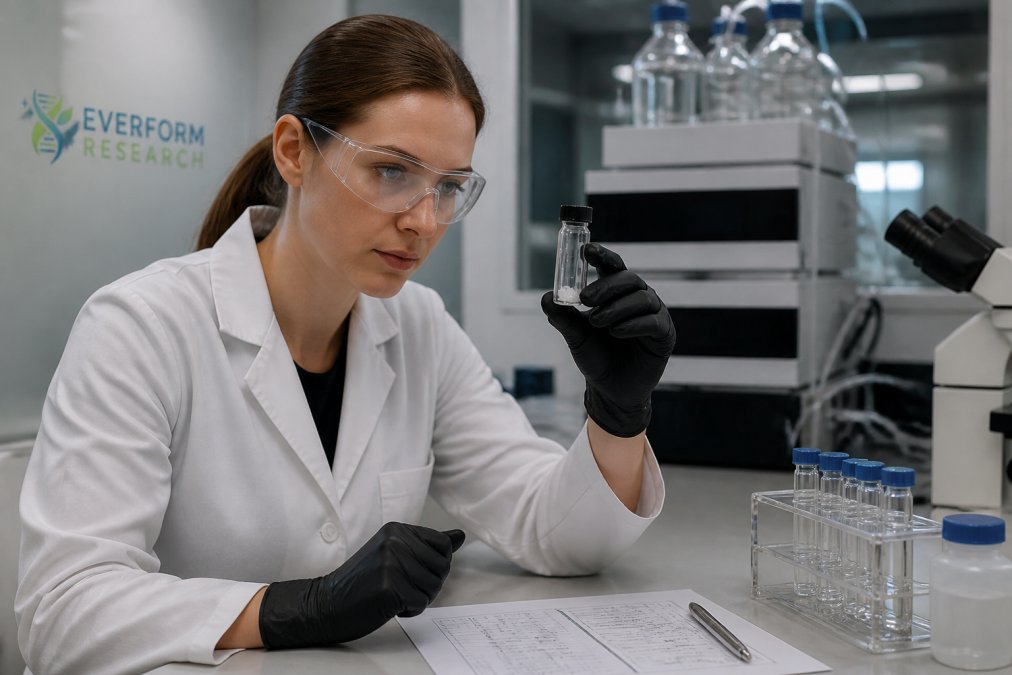
Third-party peptide testing is the practice of sending samples to an independent laboratory, unaffiliated with the manufacturer, to verify purity, identity, and concentration before the material enters your workflow.
Peptide Purity Standards: What Certificates of Analysis Really Tell You
A certificate of analysis is only as useful as the data behind it. Most COAs report four things: lot number, appearance, HPLC purity percentage, and mass confirmation. What they often omit is the analytical method used, the column type, the detection wavelength, and whether the sample was tested by the manufacturer or an outside lab.
When you're reading a COA, check these items first:
| COA Element | What It Tells You | Red Flag If Missing |
|---|---|---|
| Lot number | Traceability to a specific manufacturing run | No lot number at all |
| HPLC purity % | Percentage of target peak in the sample | Method not stated |
| Mass confirmation | Identity match to expected molecular weight | Absent entirely |
| Testing lab name | Whether verification was independent | "In-house" only |
| Analytical method | Reproducibility of the test itself | No column or wavelength detail |
Building a Peptide Traceability Framework for Reproducible Research
A peptide traceability framework is a documented system that links every vial in your freezer to its manufacturing lot, analytical data, and handling history. It is the difference between "this batch seems off" and "this batch is off, and here is the evidence."
Step 1: Capture the chain of custody.
- Record the lot number, receipt date, and COA reference for every vial on arrival
- Photograph the vial label and store the image with your inventory record
- Log storage temperature and any freeze-thaw cycles the material undergoes
- Retain a small aliquot from each lot for side-by-side comparison if results drift
- Note the reconstitution date, diluent, and final concentration for each working stock
Step 2: Establish a baseline before you need it.
A workable threshold for most research assays:
| Deviation from running mean | Interpretation | Action |
|---|---|---|
| Within 1 standard deviation | Normal assay noise | Proceed; no action |
| 1-2 standard deviations | Worth noting | Re-run the sample once before drawing conclusions |
| 2-3 standard deviations | Possible batch issue | Run the suspect lot against your reference lot on the same plate |
| Beyond 3 standard deviations | Likely batch failure | Quarantine the lot and request independent verification |
Step 4: Isolate the variable.
Step 5: Close the loop.
Storage, Handling, and Biological Factors That Mimic Batch Defects
Not every bad result comes from the vial. A meaningful share of what researchers report as batch-to-batch variability is user-induced degradation, the same lot behaving differently because of how it was stored, reconstituted, or handled. Distinguishing the two is the single most useful skill in this area, and it is the step most guides skip.
- Repeated freeze-thaw cycles. Each thaw exposes the peptide to a transient spike in local concentration and to repeated ice-crystal formation. Many sequences tolerate a handful of cycles; some do not. Aliquoting a working stock into single-use volumes on day one eliminates this variable entirely.
- Reconstitution in the wrong diluent. Some sequences dissolve cleanly in water; others need a small amount of acetonitrile, acetic acid, or a buffered solution first. Forcing a poorly soluble peptide into pure water can leave aggregates that read as low purity or low activity even though the material is intact.
- pH drift in working stocks. A stock left at the wrong pH for hours can deamidate or oxidize at sensitive residues. The label still says the right sequence; the molecule no longer matches it.
- Adsorption to plastic. Dilute peptide solutions can bind to tube and plate surfaces, lowering the effective concentration in a way that looks exactly like a weak batch.
- Lyophilized powder left at room temperature. Short exposures are usually harmless; weeks on a bench are not, particularly in humid conditions.
- Confirm the lot number and receipt date match your records.
- Check the storage log for temperature excursions and freeze-thaw count.
- Re-run the assay with a fresh aliquot from the same lot, reconstituted correctly.
- Run the suspect lot against your reference lot on the same plate.
- Only if the suspect lot underperforms in isolation, request independent verification.
Before you blame the manufacturer, rule out the freezer.
Conclusion
Peptide batch variability is a real problem, but it's not an unsolvable one. The labs that get reproducible results aren't using magic peptides. They're using documented supply chains, independent verification, and disciplined handling protocols.
Frequently Asked Questions
How do I know if I ruined my peptide?
Signs include visible cloudiness, precipitation, or a change in color from the original vial. Aggregation and degradation often show up as reduced activity in your assay or unexpected results compared to a previous batch. Storage temperature, freeze-thaw cycles, and improper reconstitution are common culprits. If you suspect degradation, run a fresh aliquot through HPLC or mass spectrometry. Always store lyophilized peptides at -20°C or lower, and avoid repeated freeze-thaw cycles. Keeping a lot number log helps you trace whether the issue is handling or a batch defect.
What environmental factors destroy peptides?
Heat, moisture, oxygen, UV light, and extreme pH shifts are the main threats. Even brief exposure to room temperature during shipping can accelerate degradation, especially for peptides with methionine or cysteine residues. Humidity causes hydrolysis, while oxygen drives oxidation. Biological variability in gastric emptying and enzyme expression can further complicate oral peptide performance. Store vials desiccated, protected from light, and at the temperature recommended on the certificate of analysis. A peptide traceability framework that logs shipping conditions and storage history helps you spot environmental damage before it ruins an experiment.
Why is third-party testing essential for peptide batch consistency?
Industry reports have found a widening quality gap in the research-grade peptide market, with non-regulated supply chains frequently lacking consistency. Third-party peptide testing provides an independent verification of purity, identity, and concentration that a supplier's in-house COA may not catch. Without it, you risk using a batch that is 96% pure when your protocol assumes 98%, which can skew high-throughput screening results. Independent testing also validates that the lot number on the vial matches the documented analysis. For research groups with strict procurement rules, third-party results are often the only acceptable proof of quality.
How long do peptides stay stable under typical lab conditions?
Lyophilized peptides generally remain stable for months to years when stored at -20°C or lower, away from light and moisture. Once reconstituted, most peptides are stable for days to weeks at 4°C, depending on the sequence. Peptides containing methionine, cysteine, or tryptophan are more prone to oxidation and should be handled under inert gas if possible. Studies have highlighted that biological variability in plasma degradation dynamics means stability data from one matrix may not apply to another. Always follow the storage instructions on the certificate of analysis and run a pilot stability check for critical assays.