 listicle
5 Best Peptide Products for Cellular Regeneration (2026)
Table of Contents
- How We Evaluated These Peptide Products
- Quick Comparison of Top Peptide Products
- 1. Eighth Day The Regenerative Serum: Best for Advanced Skin Rejuvenation
- 2. SkinCeuticals P-Tiox: Best for Expression Lines
- 3. COSRX The 6 Peptide Skin Booster: Best Budget Option
- 4. Allies of Skin Multi Peptides & GF Lifting Serum: Best for Firmness
- 5. The Ordinary Multi-Peptide Serum: Best for Hair Density
- Which Peptide Product Should You Choose?
- Frequently Asked Questions
Last Updated: September 6, 2026
The market for peptide products has moved far beyond basic anti-aging serums. Recent research catalogued by the National Center for Biotechnology Information shows that specific cosmetic peptides support tissue repair and regeneration through cellular signaling pathways, with 97 citations on wound healing and tissue regeneration properties alone. At Everform Research, we track this science closely because it separates genuine peptide products from marketing noise. This guide reviews the five best peptide products for cellular regeneration in 2026, based on clinical evidence, formulation quality, and real-world performance.
The 5 best peptide products for cellular regeneration span a wide price range, from budget-friendly boosters to clinical-grade serums. What matters most is matching the peptide sequence and delivery system to your specific goal, whether that is collagen synthesis, expression line reduction, or skin barrier repair. Below, we break down each option with its strengths, limitations, and ideal use case.
How We Evaluated These Peptide Products
We assessed each peptide product against four criteria: clinical evidence for the active peptide sequences, concentration and bioavailability, formulation stability, and value relative to price. A 2017 study published in MDPI's Cosmetics Journal applied palmitoyl tripeptide-3/5 twice daily over 84 days in 60 volunteers and confirmed anti-wrinkle efficacy with reduced skin roughness. That kind of longitudinal data informed our rankings.

However, the single most important factor separating effective products from expensive placebos is bioavailability, the ability of a peptide molecule to actually reach its target cells beneath the skin's surface. Most topical peptides are hydrophilic (water-loving) molecules with molecular weights exceeding 500 daltons, which makes passive diffusion through the lipid-rich stratum corneum inherently difficult. This is the central challenge every formulator must solve.
Here is the technical reality that most product guides ignore: the stratum corneum acts as a selective barrier, and large or charged molecules simply cannot slip through unaided. Effective products employ one or more of the following strategies to overcome this:
- Palmitoylation (fatty acid conjugation): Attaching a palmitic acid chain (as in palmitoyl pentapeptide-4 or palmitoyl tripeptide-1) increases lipophilicity, allowing the molecule to partition into the lipid matrix of the stratum corneum. This is the most common and best-validated approach in cosmetic peptides.
- Carrier peptides: Some sequences, particularly copper peptides (GHK-Cu), bind to metal ions and use specific transport mechanisms that facilitate cellular uptake.
- Nano-encapsulation or liposomal delivery: Encasing peptides in lipid vesicles protects them from enzymatic degradation and improves their ability to traverse the intercellular lipid channels.
- Low molecular weight sequences: Shorter peptide chains (typically under 500 daltons) have an easier time penetrating than larger protein fragments.
We also considered formulation pH and stability. Peptide bonds are susceptible to hydrolysis, and certain pH ranges (typically 4.5-6.5) preserve peptide integrity. Products that pair peptides with harsh surfactants or high concentrations of vitamin C (which requires a low pH below 3.5) may degrade the active sequences before they reach the skin. This is why we flagged products that use compatible pH buffers and avoid known peptide-antagonistic ingredients in the same formulation.
Finally, we weighed clinical evidence specific to the product's peptide blend. Many brands cite generic peptide research without demonstrating that their particular formulation achieves meaningful concentrations at the target depth. Products with published human studies on their exact blend scored higher than those relying on ingredient-level citations alone. Every product here passed basic quality checks, but their approaches to transdermal absorption differ significantly, and understanding those differences is what separates an informed purchase from a hopeful one.
Quick Comparison of Top Peptide Products
| Product | Starting Price | Best For | Key Peptide Technology |
|---|---|---|---|
| Eighth Day The Regenerative Serum | $180 | Advanced skin rejuvenation | Bio-identical synthetic peptide blend |
| SkinCeuticals P-Tiox | $125 | Expression line reduction | Concentrated peptide complex |
| COSRX The 6 Peptide Skin Booster | $25 | Budget multi-peptide | Six-peptide blend |
| Allies of Skin Multi Peptides & GF Lifting Serum | $148 | Firmness and lifting | Peptides + growth factors |
| The Ordinary Multi-Peptide Serum | $22 | Hair density | Multiple peptide complexes |
The price spread tells you something important: effective peptide products exist at every tier. What changes is the sophistication of the delivery system and the concentration of active sequences.
1. Eighth Day The Regenerative Serum: Best for Advanced Skin Rejuvenation
Eighth Day's The Regenerative Serum uses a proprietary combination of peptides, growth factors, and amino acids designed to mimic natural growth factors and support cellular turnover. Forbes named it a top-rated regenerative serum for smoothing and firming skin in 2026 industry reviews. This is the most scientifically ambitious formula on our list.
The serum supports collagen production and skin elasticity through a bio-identical synthetic peptide blend engineered for deep absorption. It is also the most expensive option here at $180. If your priority is maximal cellular regeneration and you have room in your budget, this is the benchmark.
2. SkinCeuticals P-Tiox: Best for Expression Lines
SkinCeuticals P-Tiox targets expression lines with an advanced peptide complex that Vogue and Allure ranked as top-tier for visible line reduction. At $125, it sits below Eighth Day in price but delivers focused results on the specific problem of dynamic wrinkles.
The formula improves skin smoothness and radiance while remaining compatible with professional aesthetic procedures. Dermatologists frequently recommend this brand, which adds confidence for users who want a clinically credible option. The tradeoff is cost per ounce, which runs higher than most competitors.
3. COSRX The 6 Peptide Skin Booster: Best Budget Option
COSRX packs six distinct peptides into a lightweight, non-sticky formula that addresses firmness, hydration, and elasticity simultaneously. At $25, it delivers remarkable value for a multi-peptide product. This is the smart entry point if you are new to peptide products or want a daily booster that will not strain your skincare budget.
The concentration is lower than medical-grade options, so expectations should be calibrated accordingly. You are paying for a well-formulated, multi-functional product rather than a high-potency clinical treatment. For most skin types and daily maintenance, that tradeoff is entirely reasonable. oral peptides for weight.
4. Allies of Skin Multi Peptides & GF Lifting Serum: Best for Firmness
Allies of Skin combines peptides with growth factors to target sagging skin and loss of firmness. The pH-balanced formula supports natural collagen synthesis while the added growth factors push beyond what a standalone peptide product can achieve. At $148, it is priced for users who take skin firmness seriously.
This is the strongest option for age-related laxity, where collagen stimulation alone is insufficient. The inclusion of growth factors mirrors the regenerative approach seen in professional aesthetic protocols. The cost makes it a maintenance commitment rather than an occasional treatment.
5. The Ordinary Multi-Peptide Serum: Best for Hair Density
The Ordinary's Multi-Peptide Serum for Hair Density addresses a different dimension of regeneration: follicular health. The lightweight, leave-in formula targets scalp conditions that influence thicker, denser hair appearance. At $22, it is the most affordable product in this ranking.
Results require consistent long-term use, typically several months before visible changes. The formula is vegan and cruelty-free, which matters to a segment of buyers. If hair density is your goal, this is the clear value pick.
Which Peptide Product Should You Choose?
Your choice among these peptide products depends entirely on your primary objective. For advanced facial rejuvenation targeting multiple signs of aging, Eighth Day is the strongest formulation. For specific expression lines, SkinCeuticals delivers focused, dermatologist-backed results. Budget-conscious buyers should start with COSRX, while those fighting sagging skin need Allies of Skin's growth factor complex. Hair density goals point to The Ordinary.
But choosing a product is only half the equation. How you incorporate it into your routine, and what you avoid pairing it with, determines whether you see meaningful results or wasted investment.
What Not to Mix with Your Peptide Serum
A common pattern we see is users undermining their peptide products by layering them with incompatible actives. The following combinations can reduce efficacy or cause irritation:
- AHAs and BHAs (glycolic, salicylic, lactic acid): These exfoliating acids create a low-pH environment that can hydrolyse (break down) peptide bonds. If you use both, apply your acid in the morning and your peptide product in the evening, or on alternate days.
- High-concentration vitamin C (L-ascorbic acid): Vitamin C requires a pH below 3.5 for stability, while most peptide formulations are optimised for pH 4.5-6.5. Applying them together can destabilise both ingredients. Use vitamin C in the morning and peptides at night.
- Retinoids (retinol, tretinoin): While not directly incompatible, retinoids increase skin cell turnover, which can cause flaking that compromises the skin barrier. If you are new to either ingredient, introduce them on alternating nights rather than stacking them immediately.
Realistic Timelines: What to Expect and When
Cellular regeneration is a biological process that operates on its own schedule, no product can accelerate it beyond the body's natural capacity. Understanding the timeline prevents disappointment and premature abandonment of a product that is actually working:
- Weeks 1-2: You may notice improved hydration and a temporary plumping effect. This is largely cosmetic, driven by humectant ingredients in the formulation, not by new collagen synthesis.
- Weeks 4-8: Early structural changes begin. Fibroblast activity increases, and you may notice slightly improved skin texture or reduced roughness. These changes are subtle.
- Months 3-6: Meaningful collagen remodelling becomes visible. Fine lines appear softened, and skin elasticity improves. This is the point at which clinical studies typically measure significant changes.
- Beyond 6 months: Continued use maintains the gains. Discontinuing peptides will gradually return skin to its baseline over several months, as the newly deposited collagen is subject to normal turnover.
A Simple Layering Protocol for Beginners
If you are new to peptide products, this basic framework will help you build an effective routine:
- Cleanse with a gentle, pH-balanced cleanser.
- Apply your peptide serum to slightly damp skin.
- Wait 60-90 seconds for absorption.
- Follow with a moisturiser containing ceramides or niacinamide to support the skin barrier.
- Apply SPF 30+ in the morning, peptides support collagen synthesis, but UV exposure degrades collagen faster than any peptide can rebuild it.
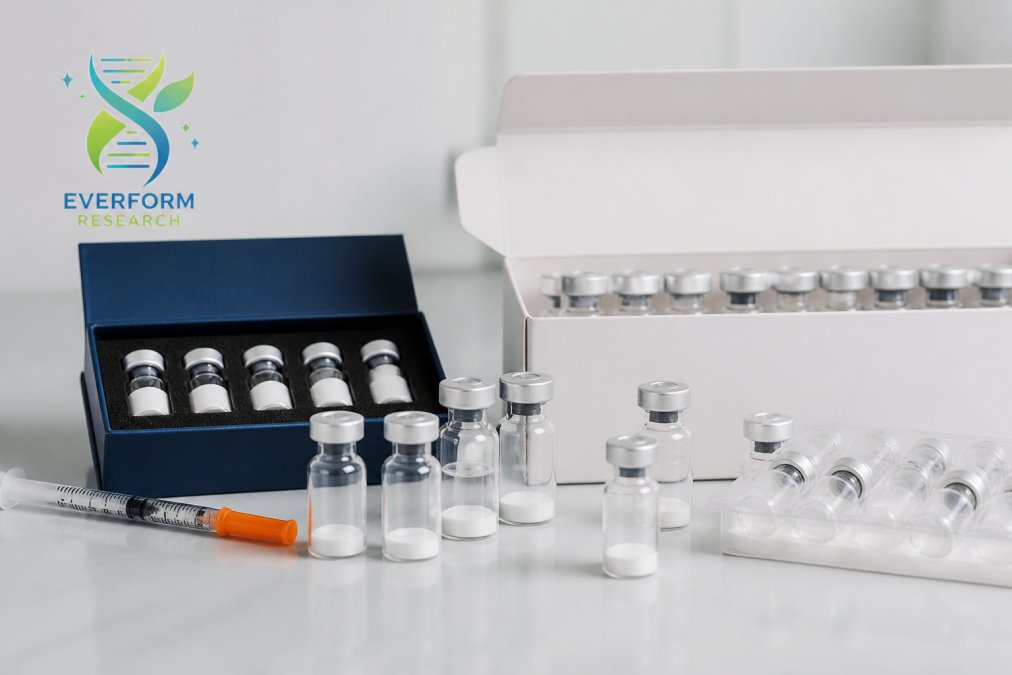
For researchers and practitioners sourcing peptide products for controlled studies or protocol development, quality verification matters more than brand recognition. Everform Research provides premium peptide products with rigorous third-party testing, cGMP-compliant manufacturing, and transparent documentation across batches. That consistency is essential when you need reproducible results across experiments. Use code EVER15 for 15% off your order, and browse the full range on our compounds page.
Frequently Asked Questions
What is the best peptide for cellular repair?
Research highlights several peptides with strong cellular repair properties. For topical skin application, GHK-Cu (copper peptide) is widely cited for its tissue regeneration benefits. For systemic recovery, BPC-157 and TB-500 are often researched for their roles in tissue repair. The best choice depends on your specific goal; a topical peptide product like Eighth Day The Regenerative Serum targets skin-level regeneration, while injectable research peptides are used for broader recovery protocols.
How do peptide products support cellular regeneration?
Peptides are short chains of amino acids that act as signaling molecules. They can stimulate fibroblasts to produce collagen, support the dermal matrix, and promote cellular turnover. Research published in PMC (2025) confirms specific cosmetic peptides encourage tissue repair through cellular signaling pathways. Different peptides work through distinct mechanisms: some are carrier peptides that deliver trace elements, while others inhibit enzymes that break down collagen, contributing to skin elasticity and wrinkle reduction.
What should I look for when buying peptide products?
Prioritise products with clear documentation of third-party testing and cGMP-compliant manufacturing. Look for the specific peptide type and concentration on the label, and check for batch-specific Certificates of Analysis (COA). For research-grade peptides, verify the supplier's quality control standards and batch consistency. For cosmetic products, consider the delivery system and whether it includes synergistic ingredients that enhance transdermal absorption.
Are there FDA-approved peptides for cellular health?
The FDA regulates peptides differently depending on their intended use. Some synthetic peptides are approved as drugs for specific medical conditions, but most cosmetic peptides are classified as cosmetic ingredients and are not FDA-approved in the same way. Research peptides intended for laboratory use are not approved for human consumption. Always source products from reputable suppliers who follow cGMP standards and provide transparent quality documentation.