 how-to
How to Read a Peptide COA: A Step-by-Step Guide
Table of Contents
- What Is a Certificate of Analysis (COA)?
- Key Components of a Peptide COA
- Understanding HPLC vs Mass Spectrometry for Peptides
- Common Signs of Fake Peptide COAs
- How to Verify Peptide Lab Results
- Step-by-Step: Reading Your Peptide COA
- Conclusion
Last Updated: August 6, 2026
What Is a Certificate of Analysis (COA)?
A Certificate of Analysis is a detailed laboratory report documenting the composition, purity, and quality of a peptide compound. It serves as third-party verification that your purchase matches the label specification and is safe for your intended use.
Think of a COA as a peptide's credential. When you buy a high-purity compound for research, you're not trusting the supplier's word alone, you're getting independent analytical data proving the batch meets published standards. For academic researchers, biotech labs, and serious athletes, this document is essential.
The COA includes multiple analytical tests answering specific questions: Is this peptide actually 98% pure? Does it contain the correct molecular weight? Are dangerous contaminants present? At Everform Research, we believe transparency in this documentation separates trustworthy suppliers from those cutting corners. Without a COA, you cannot verify what's in the vial. With one, you have measurable proof.
Key Components of a Peptide COA
A complete peptide COA contains several critical sections. Understanding what each tells you is fundamental to reading these documents correctly.
Batch and Lot Information
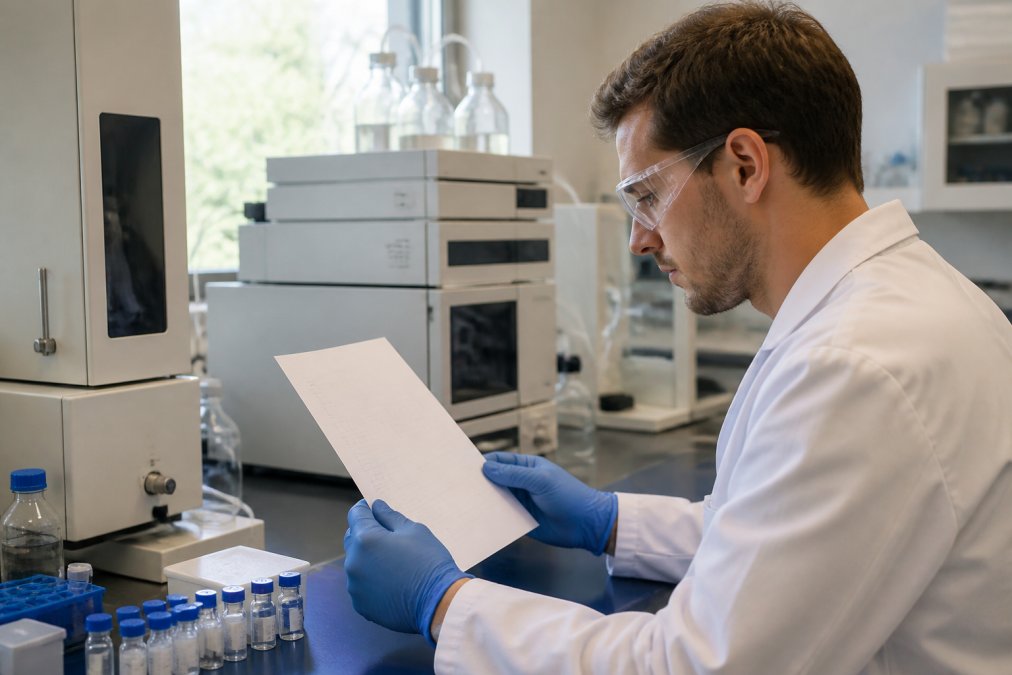
Every COA begins with identifying information tying the document to a specific production run. The batch number (or lot number) is a unique identifier assigned during manufacture, essential for tracking issues or tracing problems.
The manufacture date and expiration date indicate the peptide's shelf life. Most lyophilised peptides remain stable for years when stored properly, though this varies by compound. The testing date is equally important, it should reflect testing performed shortly after manufacture, not months later. If these dates are far apart, ask why. Peptides degrade over time, and stale test results don't guarantee current quality.
The laboratory name and accreditation status appear here too, providing your first chance to verify the testing facility is legitimate.
Purity Percentage and Molecular Weight
The purity percentage tells you what proportion of the compound is the actual peptide you ordered versus impurities or byproducts. A 98% pure peptide means 98% is the target compound; the remaining 2% is other material. This number comes from High-Performance Liquid Chromatography (HPLC). Higher purity usually means better experimental results because there's less noise in the data.
Molecular weight is the mass of a single peptide molecule, measured in Daltons. Your COA should list both the theoretical molecular weight (what the formula predicts) and the observed molecular weight (what testing found). These should match closely. A difference of more than 10 Daltons is a red flag suggesting either a labelling error or genuine quality problem.
Understanding HPLC vs Mass Spectrometry for Peptides
Two main analytical techniques appear on peptide COAs, each answering different questions about your compound.
What HPLC Results Tell You
High-Performance Liquid Chromatography (HPLC) is the primary peptide testing method. It separates sample components by pushing them through a column under pressure, then measures what emerges.
HPLC answers the purity question directly. As the peptide solution passes through the column, different molecules separate based on their chemical properties. The instrument detects each component and creates a chromatogram, a graph showing peaks for each substance present. The largest peak is your target peptide; smaller peaks are impurities.
The retention time is how long each component takes to travel through the column. Your target peptide has a specific retention time. Peaks at different times represent different molecules. Peak integration measures the area under each peak. If your target peptide's peak represents 98% of total area, the batch is 98% pure.
HPLC doesn't identify what impurities are present, only that they exist. That's where Mass Spectrometry comes in.
What Mass Spectrometry Results Tell You
Mass Spectrometry (MS) ionises molecules and measures their mass with extreme precision, confirming molecular weight and identifying impurities.
MS is the identity check. While HPLC shows "there's a peak here," MS says "that peak is a molecule with mass 1,234.5 Daltons, matching peptide X." For peptides, trifluoroacetic acid (TFA) and acetate content often appear in MS data as common counterions from synthesis and purification. Knowing their levels helps you understand how to handle the peptide.
MS also detects contaminants HPLC might miss, such as heavy metals or residual solvents. Together, HPLC and MS create a complete picture: HPLC proves purity and consistency; MS proves identity and reveals actual sample contents.
Common Signs of Fake Peptide COAs
Not every document resembling a COA is legitimate. Fraudulent or doctored COAs are common in the peptide market.
Missing or vague laboratory information is the first warning sign. A real COA names the specific testing facility, includes contact details, and often displays accreditation marks. If the lab name is generic or the document lacks verification methods, that's suspicious.
Rounded purity numbers are another tell. Real HPLC results produce precise percentages like 97.3% or 98.7%. If a COA lists "98%" or "99%" with no decimal places across multiple batches, someone likely fabricated the number.
Missing chromatograms or mass spectra are major red flags. A legitimate COA includes actual analytical data, the graphs showing HPLC peaks or MS results. Without these visuals, you're reading someone's interpretation, not seeing the data itself.
Inconsistent formatting or typos suggest hasty creation. Professional laboratory reports follow strict formatting standards. Spelling errors, inconsistent fonts, or misaligned tables indicate the COA wasn't generated by actual laboratory software.
Suspiciously perfect results across all parameters are unrealistic. Real batches vary slightly. If a COA shows 99.9% purity, perfect molecular weight match, and zero contaminants, someone is lying.
The most reliable verification method is contacting the testing laboratory directly. Give them the batch number and ask if they performed testing on that sample. A legitimate lab will have records; a fake document will fail immediately.
How to Verify Peptide Lab Results
Reading a COA is only half the battle. You must also verify that the laboratory is real, accredited, and actually performed the work.
Checking Laboratory Accreditation
A credible testing laboratory holds accreditations proving it meets industry standards. The most important accreditation for peptide testing is ISO/IEC 17025, certifying that a lab's testing methods are accurate and reliable.
You can verify accreditation by visiting the accrediting body's website. In the United States, the American Association for Laboratory Accreditation (A2LA) maintains a searchable database of accredited laboratories. Search for the lab name and check whether their accreditation covers peptide analysis.
Some laboratories hold additional certifications like cGMP compliance, meaning they follow current Good Manufacturing Practice standards. This is especially important if you're using peptides for applications with regulatory oversight. Everform Research ensures all our testing partners maintain cGMP standards, adding a layer of quality assurance beyond basic accreditation.
Ask the laboratory directly for accreditation certificates. Legitimate labs provide these without hesitation. If a supplier says "the lab doesn't share that information," that's a red flag.
The Third-Party Verification Difference
True third-party testing means an unaffiliated laboratory, one with no financial relationship to the supplier, performs the analysis. The lab receives a blind sample, tests it without knowing who ordered it, and reports results to both supplier and customer. This independence makes results trustworthy.
False third-party claims occur when a supplier uses a lab they own or have financial stakes in, then markets it as "independent." Real independence means the lab has no incentive to produce favourable results. At Everform Research, we use laboratories with zero financial relationship to our company. Our customers can verify this directly with the testing facility.
Step-by-Step: Reading Your Peptide COA
Now that you understand what a COA contains, let's walk through reading one in practice.
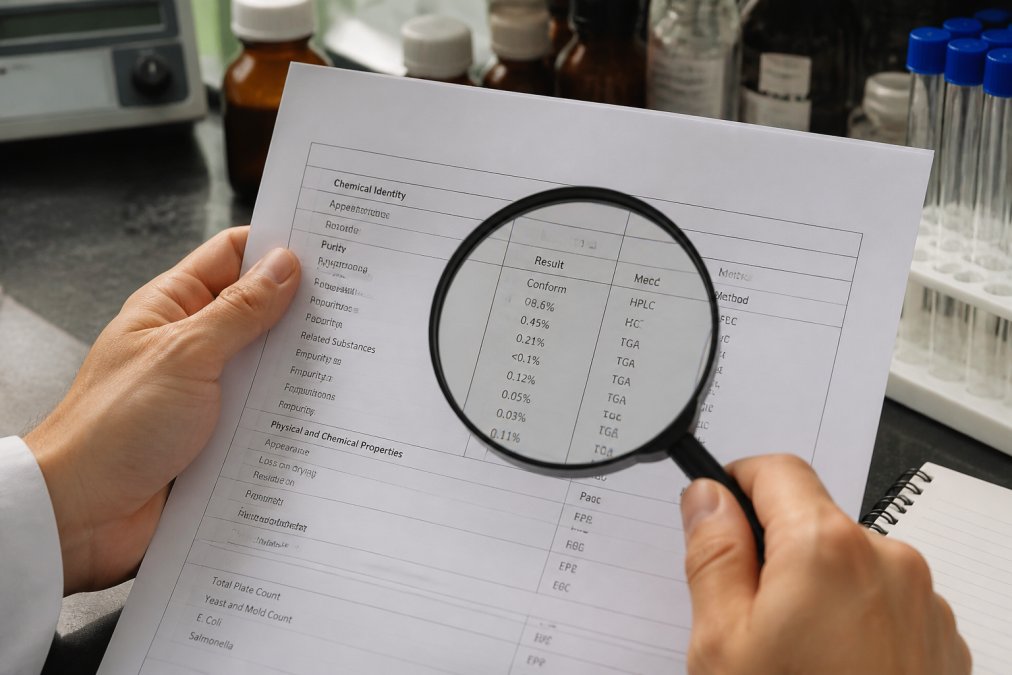
Step 1: Verify the Laboratory Information
Start at the top of the document. Find the laboratory name and contact information.
Visit the lab's website. Does it look professional? Can you find information about their accreditations and testing methods? Call the lab and confirm they perform peptide analysis. Ask for their ISO/IEC 17025 accreditation number.
Visit the A2LA accreditation database and search for the lab name. If they claim ISO/IEC 17025 accreditation, you should find them with their specific scope listed. Peptide analysis should be included. If the lab doesn't appear or their accreditation doesn't cover peptide testing, don't proceed with that batch.
Step 2: Check the Batch Number and Date
Note the batch number and manufacture date as your reference points.
Check that the manufacture date is recent, ideally within the last six months for lyophilised peptides. Older batches may have degraded, especially with uncontrolled storage.
The testing date should be within a few weeks of manufacture. If testing happened months later, ask why. Verify the expiration date makes sense, most peptides remain stable for 1-2 years at -20°C. Unrealistically distant expiration dates warrant questioning.
Step 3: Review Purity and Molecular Weight Data
Find the purity percentage, usually listed prominently in the HPLC results section. Note the exact number including decimal places.
Compare this to what the supplier promised. If you ordered 98% pure and the COA shows 96%, you have a legitimate complaint. Small variations (±1-2%) are normal; larger gaps indicate a problem.
Locate the molecular weight section. Find both theoretical and observed molecular weight, they should match within a few Daltons. If the difference exceeds 10 Daltons, investigate. Calculate the percentage difference: (Observed - Theoretical) / Theoretical × 100. If this exceeds 0.5%, ask the supplier for clarification.
Step 4: Interpret the Chromatogram and Peak Integration
Find the HPLC chromatogram. Your target peptide should be the largest peak by far, accounting for the stated purity percentage.
Examine peak shape. A well-resolved peak is sharp and symmetrical. Broad or irregular peaks can indicate contamination or degradation. Check that peak integration values align with the stated purity percentage.
Step 5: Assess Impurity Profile and Contaminants
Review the impurity profile section, which lists other substances present and their amounts.
Common impurities include residual trifluoroacetic acid (TFA) from synthesis, acetate from purification, incomplete peptides, and oxidised forms. Each impurity should be quantified. If the COA just says "impurities present" without amounts, that's unhelpful.
Check whether any impurity exceeds acceptable levels for your use case. Different applications have different tolerances. If the COA lists unknown impurities without identification, ask the supplier what they are.
Peptide quality hinges on transparent, accurate documentation. Reading a COA correctly protects your research, training, or health protocols from wasted effort and unreliable results.
At Everform Research, we understand that peptide sourcing requires confidence. Every batch we supply includes a comprehensive COA from an accredited, independent laboratory. Our commitment to third-party testing and transparent documentation means you're never guessing about what you're getting. When you're ready to source peptides backed by rigorous quality standards, explore our selection with the confidence that every product has been independently verified. Use discount code EVER15 for 15% off your first order.
Frequently Asked Questions
What are the essential components of a legitimate peptide COA?
A legitimate peptide COA must include the laboratory name and accreditation details, batch or lot number with testing date, peptide name and amino acid sequence, purity percentage (typically shown as HPLC or MS data), theoretical and observed molecular weight, impurity profile, appearance and solubility notes, and the signature or authorisation of the testing analyst. The document should also list any contaminants detected and reference standards used. Missing any of these elements is a red flag.
How can you tell if a peptide COA has been falsified?
Watch for visual inconsistencies such as mismatched fonts, poor image quality, or obvious edits. Check whether the laboratory actually exists and holds proper accreditation, contact them directly to verify. Purity figures that seem unrealistically high (99.9%+ for complex peptides) should raise suspicion. Compare the batch number format with the supplier's standard practice. Fake COAs often lack specific technical data like chromatogram details, retention times, or peak integration values. Finally, if the document lacks a date or shows a date older than your purchase, it may be recycled from another batch.
What is the difference between HPLC and Mass Spectrometry results on a COA?
HPLC (High-Performance Liquid Chromatography) separates peptide components and measures purity by showing the percentage of the target peptide versus impurities in the sample. It provides a chromatogram with peak integration data and retention times. Mass Spectrometry (MS) identifies the exact molecular weight of the peptide by ionising molecules and measuring their mass-to-charge ratio. It confirms the peptide's chemical identity and detects structural variations. Many COAs include both: HPLC for purity percentage and MS for molecular weight verification. Together, they provide comprehensive quality assurance.
Why is the batch number critical when reviewing a peptide COA?
The batch number links the COA to the specific vial you received, ensuring the test results match your product. Different batches from the same supplier may have slightly different purity levels or impurity profiles due to manufacturing variables. The batch number also allows you to track consistency over time and identify any patterns of quality issues. Always match the batch number on the COA to the label on your peptide vial before proceeding with your research. A COA without a batch number or one that doesn't match your product is not valid for your purchase.
This article was written using GrandRanker