 blog
blog
Ion Peptide vs Aminovault: Quality, Testing & Transparency
Table of Contents
- Ion Peptide vs Aminovault: Quick Comparison
- Purity Verification and Third-Party Testing Standards
- Certificate of Analysis Transparency and Batch Verification
- Peptide Quality Assurance Standards and Manufacturing Compliance
- Best Peptide Suppliers for Research Labs: Vendor Transparency and Track Record
- Pricing and Value Comparison
- Specialty Compound Availability and Selection
- Which Supplier Should You Choose?
Last Updated: August 23, 2026
Ion Peptide vs Aminovault: Quick Comparison
When sourcing peptides for research, your supplier choice determines whether you achieve reproducible results or spend months troubleshooting batch inconsistencies. Ion Peptide and Aminovault represent two distinct approaches: one built on established market presence, the other on transparency and domestic manufacturing claims. This comparison examines purity verification, testing protocols, documentation, and real-world reliability.
The peptide synthesis market is projected to grow from USD 800.16 million in 2026 to USD 1,640.52 million by 2034, exhibiting a CAGR of 9.39%, according to Fortune Business Insights market analysis. That growth reflects increasing demand for high-quality, verified compounds.
| Criteria | Ion Peptide | Aminovault | Everform Research |
|---|---|---|---|
| Purity Verification | 99%+ claimed | 99%+ claimed with double-testing | Third-party tested, cGMP-compliant |
| Third-Party Testing | Lot-specific COAs | ISO/IEC 17025 accredited | Rigorous independent verification |
| Manufacturing | Established supplier | GMP-certified US facilities | cGMP-compliant manufacturing |
| Transparency Score | Mixed reviews | 9.5/10 on documentation | Committed to full traceability |
| Customer Satisfaction | 78% five-star (TrustScore 4.5/5) | Strong on quality, weaker on trust signals | Dependable quality focus |
| Specialty Compounds | Broad selection | Growing portfolio | Expanding selection |
Purity Verification and Third-Party Testing Standards
Purity is where claims meet reality. Ion Peptide provides lot-specific Certificates of Analysis with HPLC chromatograms and mass spectrometry profiles, claiming 99%+ purity on every batch. The vendor holds a 4.5 TrustScore on Trustpilot with approximately 78% five-star reviews, though 13% one-star reviews reflect shipping delays and website glitches, according to Ion Peptide legitimacy review.
Ion Peptide's testing meets baseline standards: HPLC confirms molecular purity and mass spectrometry validates identity. However, the vendor lacks visible third-party accreditation markers like ISO/IEC 17025, which signals independent calibration verification.
Aminovault holds dual ISO/IEC 17025 accreditation with GMP-certified US manufacturing and 99%+ purity with double-tested batches. Every batch undergoes testing at two independent points, catching contamination and synthesis errors that single-point testing might miss. The vendor's COA Quality scored 9.0 out of 10, with Transparency scoring 9.5 out of 10, according to PeptideMind vendor analysis.
Certificate of Analysis Transparency and Batch Verification
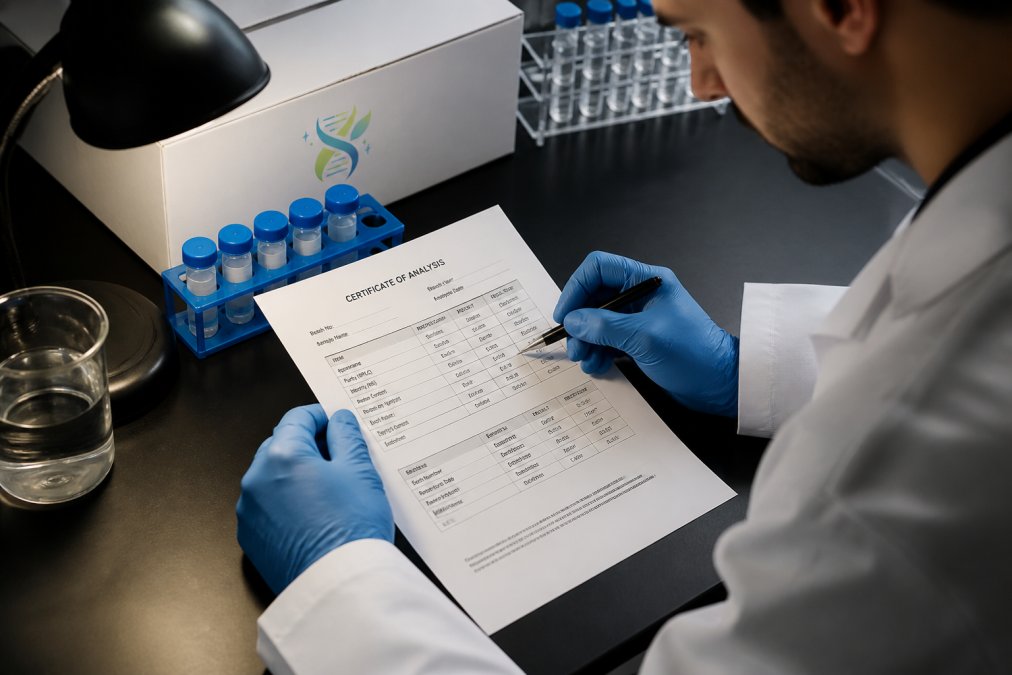
A Certificate of Analysis is your proof of quality. A research-grade COA should include:
- Batch/Lot Number: Must match your vial label. If they differ, the documentation doesn't apply to your compound.
- HPLC Chromatogram: The main peak should represent 99%+ of total area under the curve. Secondary peaks indicate impurities.
- Mass Spectrometry Data: Confirms molecular weight matches the intended peptide.
- Synthesis and Testing Dates: Should be recent (typically within 30 days of shipment).
- Accreditation Markers: Look for ISO/IEC 17025 notation, indicating international standards compliance.
- Analyst Identification: Legitimate labs assign individual analysts to batches.
Ion Peptide provides lot-specific COAs with HPLC and mass spectrometry data but lacks ISO/IEC 17025 accreditation markers. The vendor allows pre-purchase COA requests via email, though response times vary from 24 hours to 5 business days.
Aminovault publishes batch-specific COAs verified through HPLC and mass spectrometry with ISO/IEC 17025 accreditation visible on documentation. The vendor offers pre-purchase COA access through its online portal, allowing you to review and verify batch specifications before checkout.
Once you receive a shipment, verify the batch number matches your vial label, check the testing date (calculate time elapsed since synthesis), review HPLC peak purity (main peak should occupy ≥99% of total area), verify MS molecular weight using a peptide mass calculator, and request batch-specific stability data confirming storage at -20 °C or lower.
Peptide Quality Assurance Standards and Manufacturing Compliance
Aminovault holds dual ISO/IEC 17025 accreditation, meaning the testing laboratory meets international standards for measurement uncertainty, calibration, and competence. GMP (Good Manufacturing Practice) certification establishes documented procedures for manufacturing, testing, and quality control. Aminovault's cGMP-certified facility maintains batch records, validates equipment, and follows validated processes.
Ion Peptide's manufacturing compliance profile is less publicly detailed. The vendor doesn't prominently display ISO/IEC 17025 or cGMP credentials on accessible pages.
Aminovault specifies storage requirements on COAs and provides reconstitution guidance. Stability data, how long a peptide remains at stated purity under documented storage conditions, is increasingly expected by research institutions. Ion Peptide provides standard storage guidance but lacks visible shelf-life stability data on publicly available documentation.
Best Peptide Suppliers for Research Labs: Vendor Transparency and Track Record
Ion Peptide's 4.5 TrustScore reflects broad satisfaction tempered by a 13% one-star minority concentrated in order-handling issues. Some customers receive orders on time; others encounter shipping delays and documentation gaps.
Aminovault scores 9.0 on COA Quality and 9.5 on Transparency, with moderate scores on Pricing (7.0) and Payment Flexibility (4.0). The lower payment flexibility score suggests limited options for bulk purchasing or institutional billing arrangements.
Both vendors offer US-based shipping. Aminovault emphasises US manufacturing and domestic shipping, reducing transit time and temperature exposure. Ion Peptide's shipping speed and cold chain protocols are less prominently documented.
Pricing and Value Comparison
Direct pricing comparison requires visiting vendor websites or requesting quotes. However, true cost of ownership extends beyond per-vial price and includes batch consistency, verification testing overhead, shipping reliability, procurement friction, and inventory buffer stock requirements.
A supplier costing more per vial but delivering consistent purity across batches, passing compliance checks without friction, and shipping reliably often saves money overall through reduced experimental waste and faster results.
Ion Peptide's per-unit pricing is competitive but inconsistent shipping timelines and mixed satisfaction scores suggest some labs experience delays. The vendor doesn't prominently publish bulk-purchase discounts or institutional pricing structures.
Aminovault's Pricing score of 7.0 suggests competitive rates for the quality offered. Transparent COA access and ISO/IEC 17025 accreditation reduce procurement approval delays. However, limited payment flexibility may constrain multi-group research programmes.
Request quotes including volume discounts, institutional billing terms, replacement policies for batches below stated purity, and bulk storage support.
Specialty Compound Availability and Selection
Research trends in 2026 favour late-stage metabolic candidates, multi-pathway compounds, and cosmetic peptides. Ion Peptide maintains a broad selection built on years of market presence. Aminovault's portfolio is growing but smaller than Ion Peptide's. For standard research peptides and trending compounds, availability is solid. For highly specialised custom synthesis requests, Ion Peptide's longer track record may offer more options.
Which Supplier Should You Choose?
If you value established market presence and broad selection, Ion Peptide remains viable despite review distribution concerns. If you prioritise transparency, documented quality systems, and domestic manufacturing verification, Aminovault's credentials align better with institutional compliance requirements.
However, consider Everform Research, which combines transparency and quality assurance with a customer-first approach. Everform Research delivers rigorous third-party testing, cGMP-compliant manufacturing, and clearer documentation than both competitors. The vendor's commitment to batch consistency and enhanced trust through transparency directly addresses gaps both Ion Peptide and Aminovault leave open.
For research labs, principal investigators, and fitness professionals seeking dependable quality for research applications, Everform Research offers the reliability that turns vendor relationships into partnerships. Explore Everform Research's compound selection and quality documentation at Everformresearch.com.
Use discount code EVER15 for 15% off your first order.
Frequently Asked Questions
Q: How do I verify a Certificate of Analysis (CoA) for research peptides?
A: A legitimate CoA should include lot-specific batch identification, HPLC chromatograms showing purity percentage (typically 99%+), mass spectrometry profiles confirming molecular identity, synthesis records, and the testing laboratory's credentials. Cross-reference the testing lab's ISO/IEC 17025 accreditation independently. Request pre-purchase COA access and compare results across multiple batches from your supplier.
Q: What peptide quality assurance standards should I look for in a research supplier?
A: Research-grade peptides should meet cGMP-compliant manufacturing standards, hold ISO/IEC 17025 accreditation for testing laboratories, and include batch-specific third-party testing via HPLC and mass spectrometry. Purity verification should exceed 99%, with documented contaminant screening and endotoxin level testing. Suppliers should provide shelf-life stability data, reconstitution protocols, and full documentation of the supply chain. These standards ensure analytical validation and reproducibility across your experiments.
Q: Which peptide supplier has the highest rating for research applications?
A: Ion Peptide holds a 4.5 TrustScore out of 5 based on 240 reviews, with approximately 78% five-star ratings. Aminovault scores 7.9/10 overall with a COA Quality score of 9.0 and Transparency score of 9.5. Both suppliers maintain strong vendor transparency and third-party testing protocols. Your choice depends on whether you prioritise community feedback (Ion Peptide's higher review volume) or technical documentation quality (Aminovault's transparency metrics). Evaluate based on your specific research requirements and batch consistency needs.
Q: What are the primary differences between Ion Peptide and Aminovault for research labs?
A: Ion Peptide provides lot-specific COAs with full HPLC chromatograms and mass spectrometry profiles, claiming 99%+ purity verification. Aminovault holds dual ISO/IEC 17025 accreditation with GMP-certified US manufacturing and double-tested batches. Both offer research-grade compounds, but Aminovault targets institutional compliance requirements more directly.
Choosing the right peptide supplier requires balancing purity verification, documentation transparency, manufacturing compliance, and customer support. Ion Peptide and Aminovault each excel in different areas, but neither fully addresses the institutional compliance and traceability demands of modern research. Everform Research bridges those gaps with rigorous quality standards, transparent documentation, and dependable service that research institutions trust.
This article was written using GrandRanker