 listicle
Premium Research Peptides for Sale: Top 7 Vendors Ranked
Table of Contents
- How We Evaluated Premium Research Peptides for Sale
- Quick Comparison: Best Research Peptide Vendors at a Glance
- 1. Everform Research, cGMP-Compliant, Third-Party Verified
- 2. PureRawz, Wide Catalog with Batch-Specific COAs
- 3. PSPeptides, US-Made, 99%+ Purity Guarantee
- 4. American Peptides, Domestic Synthesis with Lot-Level Documentation
- 5. BioEdge Research Labs, cGMP-Aligned US Manufacturing
- 6. Biotech Peptides, Custom Synthesis and Broad Catalog
Last Updated: July 30, 2026
The quality of research compounds directly determines data reproducibility. For principal investigators and biotech labs sourcing premium research peptides for sale, choosing the wrong vendor wastes budget and invalidates experimental runs. At Everform Research, every vial should perform exactly as documented, batch after batch. Below, we rank the top seven vendors by purity verification, documentation transparency, manufacturing standards, and batch consistency.
A critical distinction: vendors claiming 99% purity and vendors proving it through independent HPLC and mass spectrometry are not equivalent.
How We Evaluated Premium Research Peptides for Sale
Selection Criteria: Purity, Documentation, and Batch Consistency
Our ranking assessed each supplier across five criteria:
- Third-party testing: Is the Certificate of Analysis issued by an independent laboratory?
- Lot-level documentation: Does the CoA reference a specific lot number traceable to a discrete synthesis batch?
- Manufacturing standards: Does the facility follow cGMP-aligned or cGMP-compliant protocols?
- Purity method: Are HPLC and mass spectrometry both used?
- Shipping and stability: Are lyophilized vials shipped with appropriate cold-chain handling?
A common mistake is accepting a CoA without verifying the testing laboratory's independence. If the lab name matches the vendor, that document carries no independent weight. According to FDA guidance on laboratory practices and GMP compliance, manufacturing documentation must support traceability back to specific production batches.
Quick Comparison: Best Research Peptide Vendors at a Glance
Quick Picks:
- Best Overall: Everform Research, cGMP-compliant, rigorously third-party tested, batch-specific documentation
- Best for Wide Catalog: PureRawz, broad compound selection with accessible batch-specific CoAs
- Best for US-Made 99%+ Purity: PSPeptides, domestic synthesis with same-day shipping
- Best for Institutional Documentation: American Peptides, lot-level CoAs, solid-phase synthesis verified by mass spectrometry
- Best for cGMP-Aligned US Manufacturing: BioEdge Research Labs, independent lab verification with fast fulfillment
- Best for Custom Synthesis: Biotech Peptides, USA-based lyophilization and custom peptide requests
| Vendor | Manufacturing | Purity Standard | Third-Party Testing | CoA Type | Best For |
|---|---|---|---|---|---|
| Everform Research | cGMP-compliant | Research-grade | Independent, rigorous | Batch-specific | Researchers needing verified consistency |
| PureRawz | US-based | 98%+ claimed | MZ Biolabs | Batch-specific | Broad catalog access |
| PSPeptides | US-made | 99%+ guaranteed | Independent labs | Per vial | Fast delivery, high purity |
| American Peptides | US synthesis | 99%+ | Mass spectrometry | Lot-level | Institutional documentation |
| BioEdge Research Labs | cGMP-aligned US | Research-grade | Independent lab | HPLC + CoA | Blends and custom formulations |
| Biotech Peptides | USA lyophilized | Research-grade | Varies | Per product | Custom synthesis requests |
1. Everform Research, cGMP-Compliant, Third-Party Verified
Everform Research is the top pick for researchers needing uncompromising documentation alongside accessible pricing. Every compound is backed by rigorous third-party testing, cGMP-compliant manufacturing, and documentation designed for institutional compliance. Everform's third-party verification is genuinely external, not internally rubber-stamped, a distinction that matters when running high-throughput screening where purity drift between batches cannot be tolerated.
Pros:
- Rigorous independent third-party testing
- cGMP-compliant manufacturing with clear documentation
- Enhanced batch-to-batch consistency
- Accessible pricing for premium-grade compounds
- Documentation supports institutional procurement compliance
Cons:
- Curated catalog rather than exhaustive; verify availability before committing
Visit the Everform Research pricing page for current compound pricing and available catalog peptides.
2. PureRawz, Wide Catalog with Batch-Specific CoAs
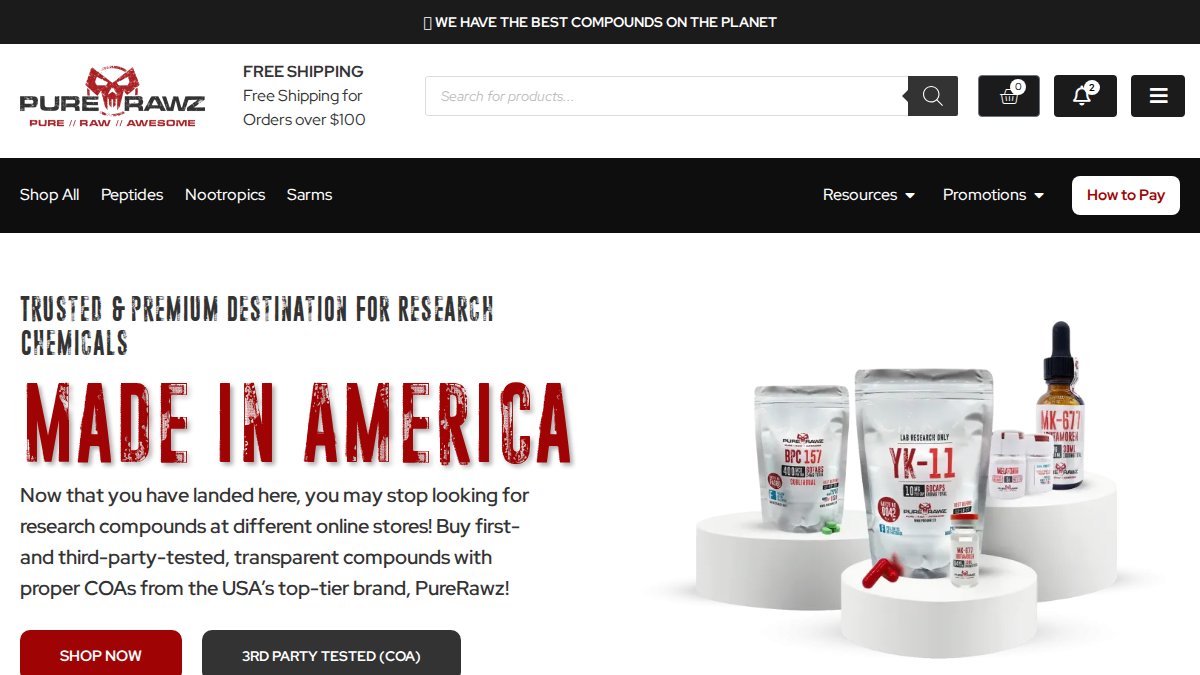
PureRawz offers a strong position for researchers needing variety. Their catalog spans peptides, SARMs, GLP-1 compounds, nootropics, and amino acid derivatives in multiple formats. PureRawz posts batch-specific Certificates of Analysis from MZ Biolabs directly on product pages, with claimed purity at 98%+, acceptable for most research applications.
Before ordering, check the CoA date against the lot number. If the report is more than 12 months old and the product has been restocked, request a current document.
Pros:
- Extensive catalog covering diverse research compound categories
- Batch-specific CoAs from named third-party lab are publicly accessible
- Multiple product formats support varied experimental protocols
Cons:
- Shipping speed has drawn recurring criticism in customer reviews
- Some product pages carry outdated CoA documents
3. PSPeptides, US-Made, 99%+ Purity Guarantee
PSPeptides guarantees every peptide meets 99%+ purity, confirmed by both HPLC and mass spectrometry from independent laboratories. That dual-method verification is significant: HPLC identifies purity by separation while mass spectrometry confirms molecular identity, eliminating quality failures that single-method testing can miss.
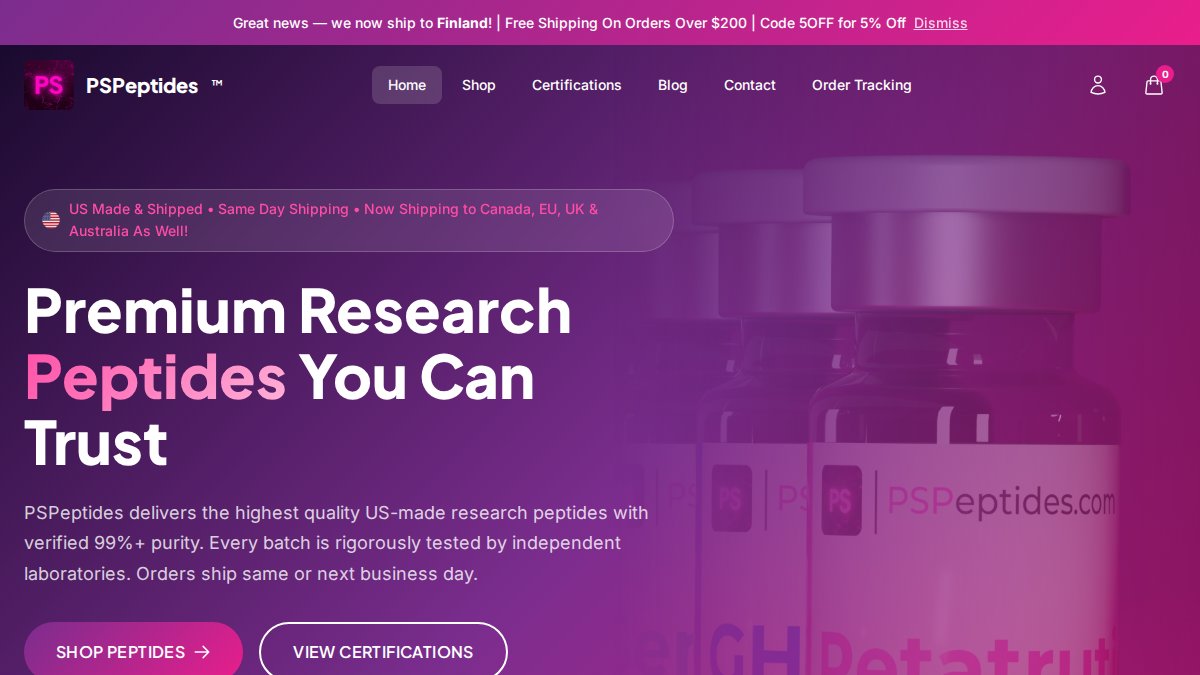
Domestic synthesis reduces supply chain variables and degradation risk. Same-day shipping for orders placed before 2 PM EST supports tight experimental timelines.
Pros:
- 99%+ purity guaranteed with dual HPLC and mass spectrometry verification
- US-made synthesis reduces international supply chain risk
- Same-day shipping and seven-day support
Cons:
- Pricing requires browsing individual product pages
- Limited published detail on manufacturing facility specifics
4. American Peptides, Domestic Synthesis with Lot-Level Documentation
Institutional researchers will find American Peptides' documentation approach compatible with formal procurement requirements. Peptides are synthesized via solid-phase synthesis, verified to 99%+ purity by mass spectrometry, and each batch ships with a downloadable CoA tied to a specific lot number. That lot-level traceability satisfies compliance audit requirements.
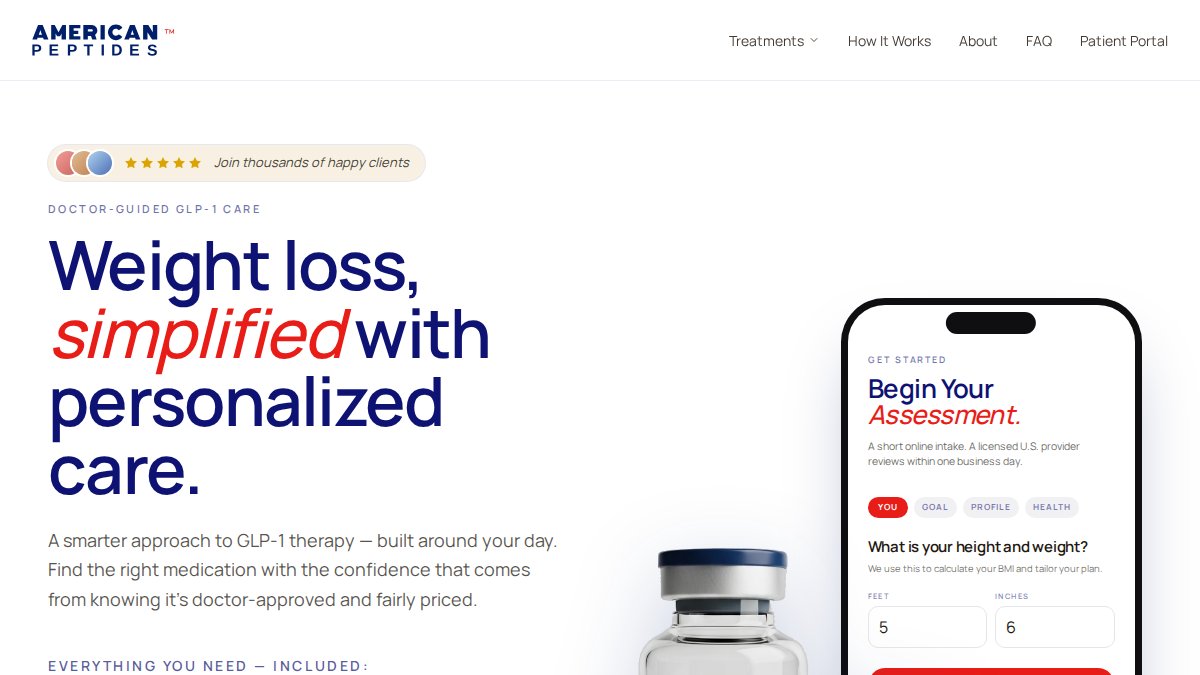
The catalog covers GLP-1 and metabolic compounds, standard research peptides, peptide blends, and bioregulators. Same-day shipping for orders placed by 2 PM EST matches active lab timelines.
Per-unit pricing on some compounds runs higher than competitors. For bulk purchasing, compare per-vial costs carefully.
Pros:
- Lot-level CoA documentation supports institutional audit requirements
- Solid-phase synthesis with mass spectrometry verification
- Fast domestic shipping
Cons:
- Some compound prices are higher than competing vendors
- Website interface is functional but not optimized for quick navigation
5. BioEdge Research Labs, cGMP-Aligned US Manufacturing
BioEdge Research Labs combines manufacturing rigor with catalog breadth. Peptides are produced in US facilities following cGMP-aligned protocols, tested by independent laboratory, and shipped with CoA documentation and HPLC data. The availability of raw HPLC chromatograms signals meaningful transparency.
Their catalog includes single compounds, multi-peptide blends, and custom formulations. For research programs relying on specific blend ratios, custom formulation capability reduces the need to source components separately. Most orders fulfill within 24 hours with free delivery above a stated threshold.
Pros:
- cGMP-aligned US manufacturing with HPLC data provided alongside CoAs
- Custom formulation capability for specialized protocols
- Fast order fulfillment with free shipping threshold
Cons:
- Fewer published customer reviews than competing vendors
- Pricing requires catalog browsing
6. Biotech Peptides, Custom Synthesis and Broad Catalog
Biotech Peptides fills a specific gap: custom peptide synthesis for researchers needing sequences not available through standard catalogs. All synthesis and lyophilization occur in the USA, maintaining domestic supply chain integrity. Their pre-made catalog includes commonly researched compounds alongside peptide blends.
Third-party testing information is less prominently displayed on product pages compared to PSPeptides or PureRawz. Researchers with strict documentation requirements should request CoA and testing methodology details directly before ordering. According to NIH guidelines on research reagent quality and reproducibility, documentation of reagent purity and source is fundamental for reproducible biomedical research.
Pros:
- Custom peptide synthesis for non-catalog sequences
- US-based synthesis and lyophilization
- Broad pre-made catalog including blends
Cons:
- Third-party testing transparency is less prominently documented
- Lower customer review volume limits independent quality verification
Peptide Purity Testing: What HPLC and Mass Spectrometry Actually Tell You
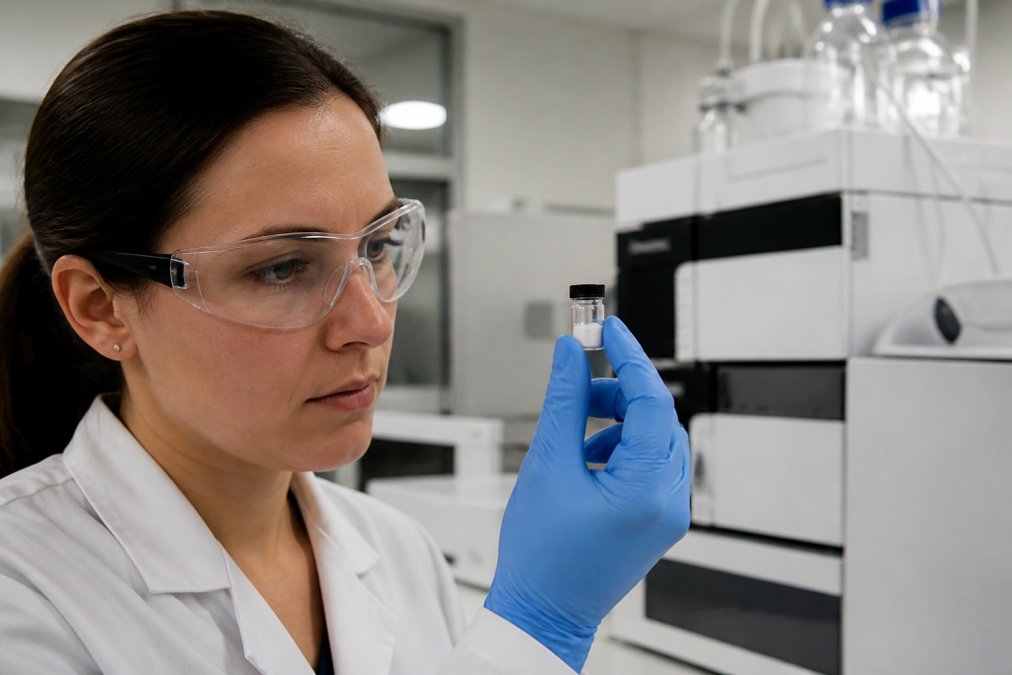
HPLC measures purity by separation: the compound passes through a column, and the detector measures what percentage of total signal corresponds to the target peptide versus impurities. A 99%+ result means 99% or more of detectable material is the target compound. HPLC does not confirm whether that target has the correct molecular structure.
Mass spectrometry fills that gap by confirming molecular identity through mass-to-charge ratio measurement, verifying the compound is actually the peptide you ordered, not a structurally similar impurity.
Vendors providing both HPLC and mass spectrometry data for each lot offer meaningfully stronger quality assurance than those providing only one method.
According to USP guidelines on peptide identity and purity testing, mass spectrometry is a recognized standard for confirming synthetic peptide identity in quality control workflows.
Storage, Handling, and Reconstitution: What Vendors Do Not Always Tell You
Most guides cover what to buy, fewer address what happens after arrival, where significant experimental failures originate.
Lyophilized peptides are stable at room temperature short-term but should be kept at -20°C or -80°C long-term, depending on amino acid composition. Peptides containing methionine, cysteine, or tryptophan are particularly susceptible to oxidative degradation.
Reconstitution introduces the most common handling error: using water alone. Many lyophilized peptides require aqueous solution with specific pH or co-solvent such as DMSO or acetic acid to dissolve completely without aggregation. Incomplete dissolution is not always visible; a clear solution can still contain undissolved aggregates reducing effective concentration.
Batch-specific verification before reconstitution is a protocol step many labs skip. Confirming the lot number on the vial against the CoA takes less than two minutes and catches occasional mislabeling errors before contaminating an entire run.
Regulatory Compliance and Legal Status of Research Peptides in the US
Research peptides occupy a defined regulatory space in the United States. Peptides sold for research use only are not FDA-approved drug products; they are research reagents. Their sale and purchase for legitimate scientific research is legal within that classification.
The critical boundary is intended use. Compounds labeled "for research use only" or "not for human consumption" must be used in that context. Purchasing research peptides for human administration falls outside the legal framework and exposes both vendor and purchaser to regulatory liability.
For institutional researchers, this distinction is straightforward; compounds are used in controlled laboratory settings. Vendors maintaining cGMP-compliant manufacturing records, providing lot-traceable CoAs, and operating with transparent third-party testing better support institutional compliance reviews.
Batch-Specific Verification: A Pre-Order Checklist
Before placing any order, use this checklist to verify vendor documentation quality:
- CoA references a specific lot number matching the product listing
- Testing laboratory is an independent third party, not the vendor
- HPLC purity result is stated as a percentage with chromatogram available on request
- Mass spectrometry data confirms molecular identity
- CoA date is recent relative to current stock batch
- Vendor can provide lot-specific documentation for institutional procurement records
- Shipping method is appropriate for lyophilized peptide stability
- Storage conditions are clearly stated on product documentation
This checklist applies regardless of vendor. The difference between reliable and unreliable suppliers often comes down to how many boxes they check without hesitation.
Frequently Asked Questions
Are research peptides legal to buy in the US?
Research peptides occupy a specific legal category in the United States. They are legal to purchase and possess for legitimate laboratory and research purposes, but they are not approved by the FDA for human use, consumption, or clinical application. Vendors are required to sell them explicitly as research-use-only compounds. Buyers should ensure any supplier clearly labels products accordingly and maintains compliant documentation. Always verify your institution's procurement policies before placing an order.
What should I look for when buying premium research peptides?
When sourcing premium research peptides for sale, prioritize vendors that provide batch-specific Certificates of Analysis from independent third-party laboratories. Look for HPLC and mass spectrometry data confirming purity at 98% or above. cGMP-compliant or cGMP-aligned manufacturing is a strong quality signal. Also evaluate lot number traceability, shipping and storage protocols for lyophilized compounds, and whether the vendor's documentation is sufficient for your institution's compliance requirements.
What is the difference between medical peptides and research peptides?
Medical peptides are FDA-approved pharmaceutical compounds prescribed and administered under clinical supervision for specific indications. Research peptides are synthesized compounds sold strictly for laboratory and scientific investigation, they carry a 'research use only' designation and have not completed the regulatory pathway required for human therapeutic use. This distinction affects labeling, documentation requirements, and how vendors may legally market and sell them in the United States.
How do I reconstitute and store research peptides properly?
Most research peptides arrive as lyophilized powder in sealed vials. Reconstitution typically involves adding bacteriostatic water or sterile water using a clean syringe, then gently swirling, never shaking, to dissolve. For storage, unreconstituted lyophilized peptides should be kept at -20°C away from light and moisture. Once reconstituted, store at 4°C and use within a timeframe consistent with the vendor's stability data. Always consult the product-specific CoA and handling guidelines provided by your supplier.
How can I verify that a supplier's third-party testing is genuinely independent?
Look for COAs that name a specific, identifiable external laboratory, not a generic internal quality report. The COA should include the lot number, test date, analytical method (HPLC, mass spectrometry), and measured purity result. Cross-reference the lot number on the vial with the COA provided. Reputable vendors make batch-specific COAs publicly accessible on their online portal or available on request. If a vendor cannot provide traceable, lot-specific documentation from a named third-party lab, treat that as a significant quality signal concern.
This article was written using GrandRanker