 listicle
Research Peptide Source: 2026 Buying Guide
Table of Contents
- What Defines a Reliable Research Peptide Source in 2026?
- Why Third-Party Peptide Testing Is Non-Negotiable
- How to Read a Peptide Certificate of Analysis
- Everform Research: A Direct Sourcing Option
- Evaluating Vendor Verification and Quality Signals
- Red Flags: What to Avoid in a Peptide Supplier
- Final Recommendations for Sourcing Peptides
- Frequently Asked Questions
Last Updated: September 7, 2026
The peptide supply industry just went through a major shakeout. In late 2025 and early 2026, several prominent online vendors shut down, including Peptide Sciences, which had been moving roughly $7.4 million in monthly online sales as of December 2025 LinkedIn Pulse analysis of the 2026 peptide industry shakeout. That consolidation left many researchers scrambling to identify a dependable research peptide source that can survive market instability while maintaining rigorous quality standards.
At Everform Research, we've tracked this landscape closely. The market itself is substantial: the global peptide therapeutics market reached approximately $140.86 billion in 2025 Koi Peptides 2026 Industry Report, with over 1,000 peptides currently in active clinical development worldwide OneTwenty Peptide Statistics 2026. More than 80 peptides have received FDA approval Koi Peptides 2026 Industry Report, and an analysis identified 4,734 active peptide therapy clinics operating across the country My Peptide Match 2026 Data Report. Yet none of that growth matters if your supplier cuts corners on purity.
Below, we'll walk through what separates a trustworthy research peptide source from a risky one, how to verify quality claims, and what red flags should send you elsewhere. Use code EVER15 for 15% off your first order.
What Defines a Reliable Research Peptide Source in 2026?
A reliable research peptide source is a supplier that provides batch-specific documentation, third-party analytical verification, and consistent manufacturing standards for every compound it ships. That definition matters more now than ever, given the recent market consolidation and the corresponding rise in unregulated sellers filling the gap.
The 45th Sermo Barometer survey flagged a worrying trend: unregulated peptide use is increasingly showing up in clinical settings, driven by digital promotion and DIY medicine culture HCPLive coverage of the Sermo Barometer survey. For laboratory researchers, this means the burden of verification has shifted entirely onto the buyer. You can no longer assume a vendor's reputation guarantees quality.
What should you look for? Start with manufacturing compliance. Suppliers that produce compounds in cGMP-compliant facilities demonstrate adherence to established quality control protocols. Every batch should trace back to a specific production run with its own documentation. A vendor that cannot articulate its manufacturing chain is not a vendor you want funding your experiments.
Why Third-Party Peptide Testing Is Non-Negotiable
Third-party peptide testing is the process of sending finished peptide batches to an independent laboratory for analytical verification, rather than relying solely on the manufacturer's own quality claims. This separation matters because in-house testing can be rubber-stamped. An independent lab has no commercial interest in your batch passing.
The industry is moving in this direction. Community-led vetting processes now prioritize batch-specific Certificates of Analysis from independent labs over manufacturer-issued documentation Reddit ScienceBioTechnology community standards 2026. Researchers are effectively voting with their wallets for transparency.
Two analytical methods should appear on any legitimate third-party report: High-Performance Liquid Chromatography (HPLC) and Mass Spectrometry. HPLC verifies purity by separating peptide components, while mass spectrometry confirms the molecular weight matches the expected peptide sequence. A report showing only one method, or no method at all, tells you the vendor is hiding something. A genuine certificate will state the percentage purity, the analytical method used, and the specific batch number tested. If any of those elements are missing, treat the certificate as incomplete.
How to Read a Peptide Certificate of Analysis
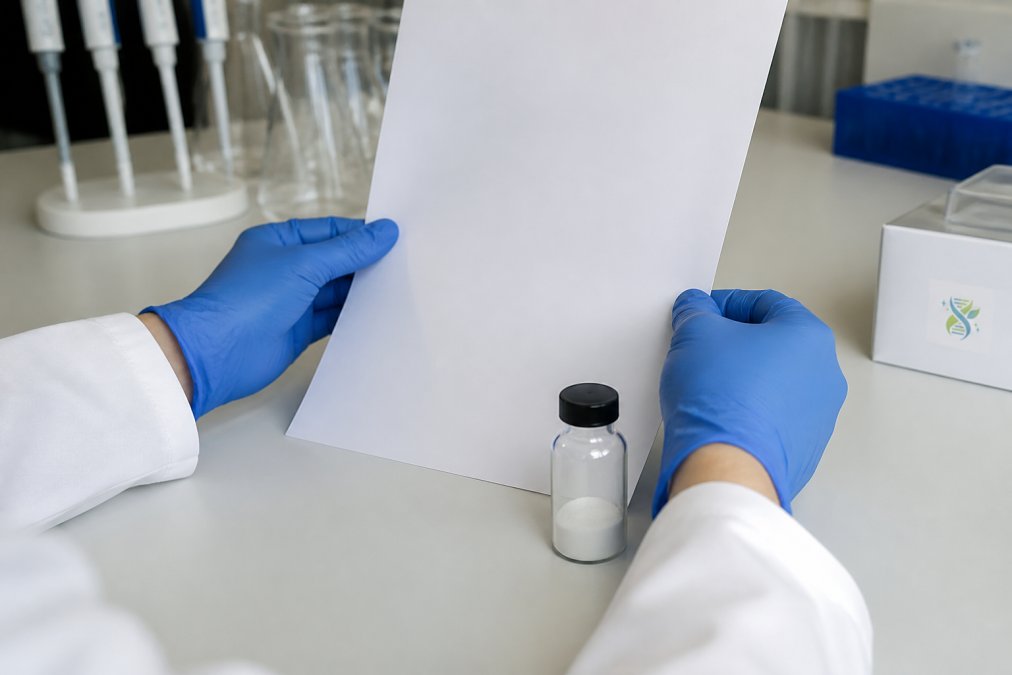
A peptide Certificate of Analysis (CoA) is a lot-specific document that records the purity, identity, and analytical test results for a single production batch. Reading one correctly is the single most valuable skill in peptide procurement, but it requires more than just glancing at a purity percentage. To truly vet a source, you need to understand the analytical methods behind the numbers.
Start by verifying the batch number on the CoA matches the batch number printed on your vial. This sounds obvious, but mismatched documentation is surprisingly common. Next, locate the purity percentage. Research-grade peptides should typically show purity of 98% or higher when tested by HPLC. Anything below that introduces variables that can compromise experimental reproducibility.
The Analytical Method Breakdown: HPLC vs. Mass Spectrometry
Understanding the difference between the two main analytical methods is critical for interpreting a CoA's credibility. Most reputable suppliers will use both, but knowing what each one does helps you spot a weak certificate.
- High-Performance Liquid Chromatography (HPLC): This method separates the components of a sample based on their chemical properties. The resulting chromatogram shows a main peak for the target peptide and smaller peaks for impurities. The purity percentage is calculated by comparing the area of the main peak to the total area of all peaks. A purity of 98% by HPLC means that 98% of the sample's UV-absorbing material is the target peptide. However, HPLC alone cannot confirm that the main peak is actually the peptide you ordered; it only confirms that something is there in high abundance.
- Mass Spectrometry (MS): This method measures the mass-to-charge ratio of ions. For peptide analysis, it confirms the molecular weight of the compound. This is the identity check. If you ordered a peptide with a theoretical molecular weight of 1,234.5 Da, the mass spec result should confirm that the main species in the sample has that exact mass. A mismatch here means the synthesis failed or the wrong peptide was shipped.
A CoA that lists only an HPLC purity percentage without an accompanying mass spec confirmation is telling you that the sample is pure, but not necessarily that it is the correct molecule. Conversely, a mass spec result without HPLC purity data doesn't tell you how much of the sample is the target peptide versus other contaminants. A complete CoA will document both. Some vendors also include amino acid analysis (AAA) to verify the composition of the peptide chain, which is an even more rigorous check.
Finally, look for the testing laboratory's identity. An independent third-party lab name carries more weight than the manufacturer's own letterhead. If the CoA is from a lab you can identify and verify, it adds a layer of trust that an in-house document cannot match.
Everform Research: A Direct Sourcing Option
Everform Research positions itself as a direct sourcing option for researchers who want documented quality without the procurement headaches. The company's stated commitment centers on third-party quality testing and cGMP-compliant manufacturing, with an emphasis on batch-to-batch consistency.
For principal investigators managing multi-experiment workflows, consistency is the metric that matters most. A supplier that delivers 98% purity in one batch and 96% in the next introduces a variable you cannot control for. Everform Research's focus on rigorous third-party testing and transparent documentation is designed to address exactly that concern.
The company also emphasizes educational resources to help buyers make informed decisions, which is a meaningful signal in an industry where opacity is common. Clearer documentation and accessible pricing for premium compounds round out the core value proposition. For research teams that need dependable quality and straightforward sourcing, Everform Research is worth evaluating.
| Vendor Type | Key Strength | Watch Out For | Best For |
|---|---|---|---|
| Direct manufacturer (e.g., Everform Research) | cGMP compliance, batch consistency | Newer market presence | Labs needing documented quality |
| Specialty compound vendor | Hard-to-find peptides, advanced testing | Pricing varies widely | Niche research applications |
| Comparison platforms | Vendor vetting, price tracking | No direct sales | Due diligence and cost analysis |
Evaluating Vendor Verification and Quality Signals
Beyond the Certificate of Analysis, several quality signals separate serious vendors from opportunistic sellers. Look for evidence of a genuine quality management system, such as cGMP-compliant manufacturing. This certification indicates the facility follows standardized procedures for production, testing, and documentation.
Consider the vendor's analytical depth. Some suppliers now combine HPLC with LC-MS verification for added confidence. Custom synthesis capabilities also signal technical competence. Companies like GenScript have implemented microwave technology for custom peptide synthesis, improving reliability for epitope mapping and drug discovery applications GenScript custom peptide synthesis case study. A vendor that offers custom synthesis at scale demonstrates manufacturing expertise that off-the-shelf resellers cannot match.
Industry consolidation has also produced stronger players. Biosynth, for example, unified four specialized firms to centralize peptide expertise into a single service provider Biosynth corporate consolidation overview. When evaluating a vendor, ask whether they manufacture or merely resell. Resellers add a layer of uncertainty to the cold chain and documentation trail.
Red Flags: What to Avoid in a Peptide Supplier
Several warning signs should trigger immediate caution when evaluating a research peptide source. The most obvious is missing or incomplete documentation. If a vendor cannot produce a batch-specific CoA from an independent lab, walk away.
Vague manufacturing claims are another red flag. A supplier that says "high purity" without stating a specific percentage, or that cannot name its analytical methods, is not meeting industry standards. Similarly, be wary of vendors that cannot articulate their storage and handling procedures. Peptides are typically shipped as lyophilized powder requiring cold chain logistics and proper reconstitution protocols. A vendor that mishandles storage undermines product stability before the vial ever reaches your lab.
Price that seems too good to be true is a legitimate concern. High-purity peptide synthesis is not cheap. A vendor undercutting the market by 40% is likely cutting corners on analytical testing or raw materials.
The Regulatory Compliance Landscape: Research Chemicals vs. Pharmaceuticals
A critical red flag that is often overlooked is a vendor's positioning regarding regulatory compliance. There is a clear legal and scientific distinction between a research chemical and a pharmaceutical-grade compound. In the United States, the Food and Drug Administration (FDA) does not approve peptides sold for laboratory research. These products are not intended for human consumption and are exempt from the rigorous clinical trial and manufacturing oversight applied to drugs.
A legitimate research peptide source will explicitly label its products "For Research Use Only" (RUO) and will not make claims about safety, efficacy, or human use. This is not just a legal formality; it is a signal about the manufacturing and quality control standards in place.
- Pharmaceutical-Grade: These compounds are manufactured under strict Current Good Manufacturing Practices (cGMP) and are subject to FDA oversight for purity, potency, and consistency. They are intended for clinical use.
- Research-Grade: These peptides are synthesized for laboratory experimentation. While a reputable supplier will still use cGMP-compliant facilities to ensure consistency, the product is not held to the same regulatory standard as a drug. The vendor's responsibility is to provide a pure, correctly-identified compound, not to prove its safety for human use.
Be cautious of vendors that blur these lines. A supplier that markets peptides for human consumption, weight loss, or muscle building is operating outside research-grade standards and is a major red flag. These products often bypass third-party testing entirely, and their marketing claims are a direct violation of the regulatory framework that governs research chemicals. For laboratory work, restrict sourcing to vendors that explicitly label compounds for research purposes only and maintain the appropriate disclaimers.
Final Recommendations for Sourcing Peptides
Vendor diligence is more important than ever. With some suppliers closing and unregulated sellers moving in, the cost of a poor sourcing decision extends beyond wasted budget to compromised experimental data.
For most research applications, prioritize suppliers that demonstrate three things: cGMP-compliant manufacturing, batch-specific third-party testing with full analytical documentation, and a clear commitment to transparency. Everform Research checks those boxes with its focus on rigorous quality standards and accessible documentation. Use the code EVER15 for 15% off your first order.
Compare any potential vendor against the criteria in this guide before committing. The time spent verifying a Certificate of Analysis or confirming manufacturing standards is negligible compared to the cost of repeating a failed experiment. A dependable research peptide source is not just a vendor; it is a partner in the integrity of your work.
Frequently Asked Questions
What criteria define a reputable research peptide source?
A reputable research peptide source should provide batch-specific Certificates of Analysis from independent, third-party labs. Look for transparent documentation of purity results from HPLC and mass spectrometry testing. The manufacturer should be cGMP-compliant, and the vendor should clearly state that products are for laboratory research only. Consistent quality across batches, clear storage guidance, and responsive customer support also distinguish a dependable source from a casual supplier.
Why is third-party peptide testing essential for research?
Third-party peptide testing provides an unbiased verification of a product's purity, identity, and potency. When a supplier tests its own products, there is a conflict of interest. Independent labs using HPLC and mass spectrometry confirm the peptide sequence and detect contaminants or impurities. This is critical for reproducible experiments, as inconsistent purity between batches can ruin data and waste project budgets.
How do I verify a Certificate of Analysis from a peptide supplier?
First, confirm the CoA is batch-specific and not a generic document. Check that it includes the lot number matching your product. Look for the testing method, such as HPLC, and the purity percentage. Verify the lab performing the test is independent and not affiliated with the vendor. A high-quality CoA will show a clear chromatogram and a molecular weight confirmation from mass spectrometry.
Are research peptides regulated for laboratory use?
Many peptides used in research are not FDA-approved for human consumption. In the United States, they are typically sold for laboratory and research purposes only, falling under regulations that govern research chemicals. A reputable vendor will enforce this by requiring buyers to confirm their intended use is for research. Always check your institution's guidelines and applicable regulations before purchasing.