 how-to
Troubleshooting Common Peptide Synthesis Issues
Table of Contents
- How to Diagnose Peptide Synthesis Problems by Stage
- Solid-Phase Peptide Synthesis Troubleshooting: Where Failures Begin
- Incomplete Coupling in Peptide Synthesis: Detection and Correction
- Side Reactions, Byproducts and Degradation Pathways
- Peptide Purity Analysis: Confirming What Actually Failed
- Peptide Traceability Documentation for Reproducible Batches
- Conclusion
- Frequently Asked Questions
Last Updated: October 16, 2026
How to Diagnose Peptide Synthesis Problems by Stage
Most failed peptide synthesis runs are not mysteries. They are predictable outcomes of a specific stage in the process, and the fastest route to a fix is to work backwards from what you can actually see. At Everform Research, we approach troubleshooting common peptide synthesis issues the same way we approach quality control: identify the symptom first, then trace it to the stage that produced it.
Peptide synthesis is the chemical assembly of amino acids into a chain, and in solid-phase peptide synthesis that assembly happens on a resin support. When a run underperforms, the failure almost always sits in one of four places: the resin, the coupling steps, the side reactions during deprotection and cleavage, or the handling after cleavage.
Below, we'll show you exactly how to narrow a failure to one stage before you change a single reagent.
Start With the Symptom, Not the Suspect
The most common mistake in troubleshooting is guessing. Someone sees a low yield and immediately blames the resin, or sees cloudiness and blames the solvent. That approach wastes material and time.
Instead, write down what you observe. Then match it:
| Symptom | Likely Stage | First Check |
|---|---|---|
| Low crude yield, normal purity | Coupling or cleavage efficiency | Coupling completion test |
| Low purity with many close impurities | Incomplete coupling, deletion sequences | Sequence difficulty review |
| Gel-like resin, poor solvent flow | Resin aggregation | Swelling behavior in solvent |
| Discoloration after cleavage | Oxidation or side reactions | Cleavage cocktail and scavengers |
| Cloudiness after reconstitution | Solubility, not synthesis | Solvent compatibility test |
Solid-Phase Peptide Synthesis Troubleshooting: Where Failures Begin
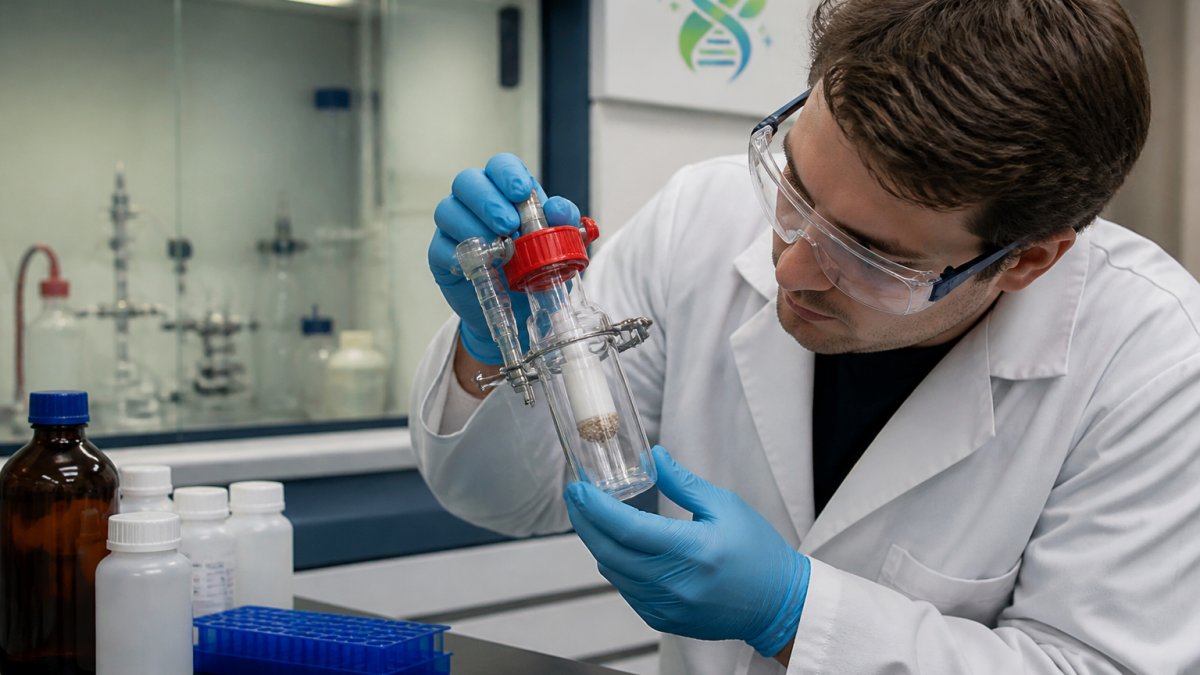
Solid-phase peptide synthesis troubleshooting starts at the resin, because that is where the chain grows and where steric problems compound over every cycle. A 2025 review by F. Bordignon and coauthors in Challenges and Achievements of Peptide Synthesis in Aqueous Media notes that solid-support synthesis may be suboptimal for sequences with difficult coupling steps, and that hydrophobic peptides can be complicated by aggregation.
Resin Aggregation and Steric Hindrance
Resin aggregation is the clumping of peptide chains on the resin bead, which shields reactive sites and blocks reagents from reaching them. The result is incomplete coupling that gets worse with each cycle.
Watch for these signs:
- The resin bed looks compacted or gel-like
- Solvent drains slowly
- Coupling tests show incomplete reaction despite fresh reagent
Steric hindrance is a related but distinct problem. Bulky side-chain protecting groups and crowded sequences physically obstruct the incoming amino acid. The fix is usually a change in coupling strategy, not more reagent.
Incomplete Coupling in Peptide Synthesis: Detection and Correction
Incomplete coupling in peptide synthesis is the single most common cause of a crude product full of deletion sequences. A deletion sequence is the target peptide missing one amino acid, and it is notoriously hard to separate from the full-length product because the two differ by a small mass and similar charge.
Detect it early with a qualitative coupling test after each cycle. If a test stays positive, do not push forward. Stop and recouple.
Correction options, in order of preference:
- Recouple the same residue with fresh reagent
- Switch to a more reactive coupling system
- Double-couple the residue before moving on
- Review the sequence for known difficult regions
Biotage's guidance on failed peptide synthesis recommends using a sequence-predictor tool to flag difficult regions and considering a change to the primary system. That is sound advice: prediction before the run beats repair after it.
Side Reactions, Byproducts and Degradation Pathways
Side reactions and degradation produce byproducts that look like purity problems but originate in chemistry, not handling. The main pathways are oxidation, hydrolysis, deprotection side reactions, and cleavage byproducts. Each has a distinct signature and a different fix.
Oxidation
Methionine, tryptophan, and cysteine are the most oxidation-prone residues. Oxidation adds 16 Da per oxygen atom, so mass spectrometry is the definitive check. Common triggers include residual peroxides in ethers, dissolved oxygen in solvents, and extended exposure to air during cleavage. Corrective action: use fresh, peroxide-free solvents, sparge with inert gas where practical, and consider adding a sacrificial thioether scavenger during cleavage.
Hydrolysis
Backbone hydrolysis cleaves the peptide chain at aspartic acid and asparagine residues, especially under acidic cleavage conditions with prolonged exposure. The result is a ladder of truncated fragments visible as closely eluting peaks on RP-HPLC. Corrective action: keep cleavage time within the validated window for your sequence, and avoid excessive TFA concentrations when the sequence contains acid-sensitive motifs.
Deprotection Side Reactions
Incomplete removal of side-chain protecting groups leaves residual mass adducts that are hard to separate. Common culprits include incomplete piperidine deprotection cycles and sterically hindered protecting groups on branched residues. Corrective action: verify deprotection efficiency with a qualitative test, extend deprotection time for hindered sequences, and use fresh piperidine solutions.
Cleavage Byproducts
Scavenger imbalance during cleavage produces alkylated or rearranged byproducts. The classic example is the formation of tert-butyl adducts on tryptophan or methionine when scavenger ratios are wrong. Corrective action: match the scavenger cocktail to the sequence's sensitive residues, and follow a validated cleavage recipe rather than a generic one.
A common pattern is to see a single oxidation peak appear only after the vial has been opened several times. That points to handling, not synthesis. Document the date opened and the number of freeze-thaw cycles so you can distinguish the two.
Peptide Purity Analysis: Confirming What Actually Failed
Peptide purity analysis tells you what is in the vial, and it is the step most labs skip when troubleshooting. Without analytical confirmation, you are guessing. This section gives you a decision framework for using analytical methods to confirm synthesis failure rather than relying on appearance alone.
When to Use Each Method
- RP-HPLC is your first-line purity check. It separates the target peptide from deletion sequences, truncated fragments, and oxidation products. A single main peak with a clean baseline suggests the synthesis succeeded. Multiple close peaks suggest deletion sequences or incomplete coupling. A broad main peak suggests aggregation or partial degradation.
- Mass spectrometry (LC-MS or MALDI-TOF) confirms identity. If HPLC shows one main peak but mass spec shows the wrong mass, you have an identity problem, not a purity problem. The mass difference tells you what is missing: a deletion sequence will be lighter by the mass of one residue, an oxidation product will be heavier by 16 Da, and a residual protecting group will add a specific adduct mass.
- Amino acid analysis is useful when you need to confirm composition rather than just purity. It is slower but catches cases where the sequence is correct by mass but built from the wrong residues.
Decision Logic
- Run RP-HPLC first. If purity is high and the main peak is sharp, the synthesis likely succeeded. Move to mass spec for identity confirmation.
- If HPLC shows many close peaks, suspect deletion sequences. Check your coupling test records for any cycle that stayed positive.
- If the main peak is broad, suspect aggregation or partial degradation. Compare against a fresh batch of the same sequence to see whether the broadening is sequence-specific or handling-related.
- If mass spec shows the wrong mass, use the mass difference to identify the likely failure: missing residue, oxidation, or residual protecting group.
Documenting the Result
Record the HPLC method, column, gradient, and retention time alongside the result. A purity number without the method is not reproducible. Compare your result against the certificate of analysis. A gap between the COA and your own result is a red flag worth raising with your supplier, but first confirm that your method is appropriate for the sequence.
This analytical confirmation step is what separates a lab that troubleshoots from a lab that guesses. It also gives you the evidence you need when discussing a batch with your supplier.
Peptide Traceability Documentation for Reproducible Batches
Peptide traceability documentation is the record that lets you reproduce a batch or explain why you cannot. It is also the difference between a lab that troubleshoots and a lab that guesses twice.
For every batch, record:
- Sequence and any difficult regions flagged before synthesis
- Resin type, loading, and swelling solvent
- Coupling reagent and cycle times
- Coupling test results per cycle
- Cleavage cocktail and scavenger ratios
- Purification method and fractions pooled
- Analytical results (HPLC, mass spec)
- Storage conditions and date opened
This record is what makes root-cause analysis possible. When a batch fails, you compare it against a passing batch of the same sequence and the difference usually jumps out.
At Everform Research, we build this documentation into every compound we supply, with third-party COA verification and cGMP-compliant manufacturing behind it. That matters when a principal investigator needs to show a compliance team that a vendor's quality claims are real and independently checked.
Conclusion
Troubleshooting peptide synthesis is a discipline, not a talent. Match the symptom to the stage, confirm with analytics, and document everything so the next run is better than the last.
If the bottleneck is not your protocol but your supply, Everform Research supplies research peptides with rigorous third-party testing, cGMP-compliant manufacturing, and clearer documentation so your results hold up batch after batch. Our catalog covers a growing range of compounds at accessible pricing, and every order ships with the quality signals your lab needs to defend its data.
Use code EVER15 for 15% off your order and see how consistent sourcing changes your troubleshooting burden.
Frequently Asked Questions
What are the most common problems in peptide synthesis?
The most frequent failures are incomplete coupling, resin aggregation and steric hindrance, side reactions that create unwanted byproducts, and degradation through oxidation or hydrolysis. A 2025 review by Bordignon and coauthors also notes that hydrophobic sequences are complicated by aggregation, and that solid-support synthesis may be suboptimal for sequences with difficult coupling steps. Most problems trace back to a specific stage, so identifying where the failure occurred matters more than guessing at the cause.
How can you identify incomplete coupling during peptide synthesis?
Incomplete coupling shows up as a truncated sequence in peptide purity analysis, usually as a cluster of closely eluting impurities rather than a single peak. Confirm it with a Kaiser or chloranil test after each coupling step, and check the amino acid sequence for known difficult regions. Biotage recommends running a sequence-predictor tool to flag those regions before synthesis starts. If the same step fails twice, change the coupling conditions rather than repeating the identical cycle.
What causes low yield in solid-phase peptide synthesis?
Low yield usually comes from cumulative incomplete coupling, aggregation that hides reactive sites, or loss during cleavage and purification. Track yield after each stage to see where material disappears. If yield drops sharply at cleavage, the problem is in the cleavage cocktail or workup, not the synthesis itself.
How should synthesis and analytical records support peptide traceability?
Peptide traceability documentation should link each batch to its amino acid sequence, resin lot, reagent lots, coupling and deprotection conditions, and the analytical results that confirmed identity and purity. Record deviations as they happen, not afterward. This matters when a batch underperforms: you can compare it against a passing batch and isolate the variable that changed. Everform Research publishes third-party COA verification and cGMP-compliant manufacturing records to support this kind of documentation.