 how-to
7 Cleaning Validation Steps for Peptide Equipment
Last Updated: October 25, 2026
Quick Summary
Cleaning validation for peptide equipment confirms that shared surfaces are free of peptide residue before the next batch runs. You set a residue limit from a health-based carryover calculation, then prove it with validated swab and rinse sampling and a peptide-specific analytical method. Document everything and keep monitoring after the report is signed.
- Peptide residues adsorb to product-contact surfaces and can sit in crevices a simple rinse never reaches.
- Calculate your residue limit by multiplying the permitted daily exposure by the smallest batch size, then dividing by a safety factor of 1,000 and the shared surface area.
- Swab the worst-case locations such as corners, baffles, bottom outlets and any surface the spray cannot reach.
- Prove swab recovery from the same surface material before trusting results; recovery below about 70% is a common finding.
- Revalidate when you change the cleaning agent, procedure or equipment, add a new product, or see adverse monitoring trends.
Table of Contents
- Why Peptide Residues Are Harder to Clean Than Small-Molecule Residues
- Building a Cleaning Validation Protocol for Shared Equipment
- Setting Cleaning Validation Acceptance Criteria with a Worked Carryover Example
- Designing a Cleaning Validation Swab Sampling Plan for Complex Surfaces
- Choosing Analytical Methods That Detect Peptide Residue
- Cleaning Validation Documentation That Survives an Audit
- Lifecycle Monitoring and Revalidation for Peptide Equipment
- Sourcing Peptides That Support Your Validated Cleaning Program
- Frequently Asked Questions
Why Peptide Residues Are Harder to Clean Than Small-Molecule Residues
Peptide residues cling to manufacturing equipment in ways small-molecule residues do not.
The stakes are real. BioPharm International's 2024 analysis of cleaning process design for peptide therapeutics describes cleaning validation as continued monitoring of the cleaning process, including residue testing to confirm cleanliness.
At Everform Research, we see the downstream effect: a poorly cleaned shared vessel contaminates the next batch, and the data from that batch is worthless.
Building a Cleaning Validation Protocol for Shared Equipment
A cleaning validation protocol is a written, pre-approved plan that states what you will clean, how you will clean it, what you will measure, and what counts as a pass. For shared equipment, the protocol must name every product that touches the surface and justify the worst case.
Start with these elements:
- A map of product-contact surfaces, including hard-to-clean areas
- The cleaning procedure and cleaning agent for each equipment train
- Sampling locations and sampling methods
Drafting that framework from scratch is slow. Readers who want the broader process validation framework that this protocol only summarises can find it in our companion article.
Setting Cleaning Validation Acceptance Criteria with a Worked Carryover Example
Acceptance criteria are the residue limits that define a clean surface. For peptide equipment, the limit must account for the molecule's tendency to adsorb, aggregate, and fragment, not just its mass. A limit that works for a small molecule can be too permissive for a peptide that binds tightly to stainless steel and releases slowly into the next batch.
The most common basis is maximum allowable carryover, or MACO: the most residue that can pass into the next batch without affecting patient safety. Regulators expect the rationale to be documented, and the FDA's guidance on validation of cleaning processes remains the reference point most auditors cite for the general framework, while ICH Q7 and Q9 supply the GMP and risk-assessment expectations that sit underneath it.
A worked example using a health-based exposure limit
Say the previous peptide has a permitted daily exposure of 0.15 mg/day, the next product runs in batches of 50 kg, and the shared equipment has 2.0 m² of product-contact surface.
- Multiply the exposure limit by the smallest batch size: 0.15 mg × 50,000,000 mg = 7,500,000 mg·units.
- Divide by a safety factor of 1,000: 7,500 mg total carryover allowed.
- Divide by the shared surface area of 20,000 cm²: 0.375 mg/cm².
That figure becomes your residue limit for the swab and rinse results. Note the units carefully: a limit expressed per cm² is only meaningful if your sampling recovery is validated for that same surface material and peptide.
Why peptide limits need a second look
Three peptide-specific factors can tighten or complicate the number above:
- Adsorption and slow release. A peptide that binds to passivated stainless steel may not rinse away at the same rate as a small molecule, so the residue you measure on a swab may under-represent what elutes into the next batch over a full process cycle.
- Aggregation and fragments. A degraded or aggregated peptide may be more immunogenic than the parent molecule, so the acceptance limit should be justified against the worst-case species, not only the intact peptide.
- Cleaning-agent interference. Some detergents and buffers co-elute with peptide fragments in nonspecific assays, which can mask a failing surface or force an artificially low limit.
A3P notes that acceptance criteria for biotechnological substances remain unclear in existing guidance, so document your rationale carefully and state explicitly which species your limit protects against.
Visual and functional criteria still count
A numerical limit is necessary but not sufficient. Auditors also expect visible-clean and functional criteria, no film, no odor, no discoloration at weld seams and dead legs, recorded alongside the analytical result.
Once the limit is set, the next question is how you prove the surface meets it. That is where sampling and analytical method design take over.
Here is the carryover calculation from the worked example, step by step.
| Step | What to do | Result |
|---|---|---|
| 1 | Multiply exposure limit by smallest batch size | 7,500,000 mg·units |
| 2 | Divide by a safety factor of 1,000 | 7,500 mg total carryover allowed |
| 3 | Divide by shared surface area of 20,000 cm² | 0.375 mg/cm² residue limit |
Designing a Cleaning Validation Swab Sampling Plan for Complex Surfaces
Swab sampling is the direct method: you physically wipe a defined area and extract the residue for analysis. It is the only reliable way to prove cleaning on valves, weld seams, and dead legs.
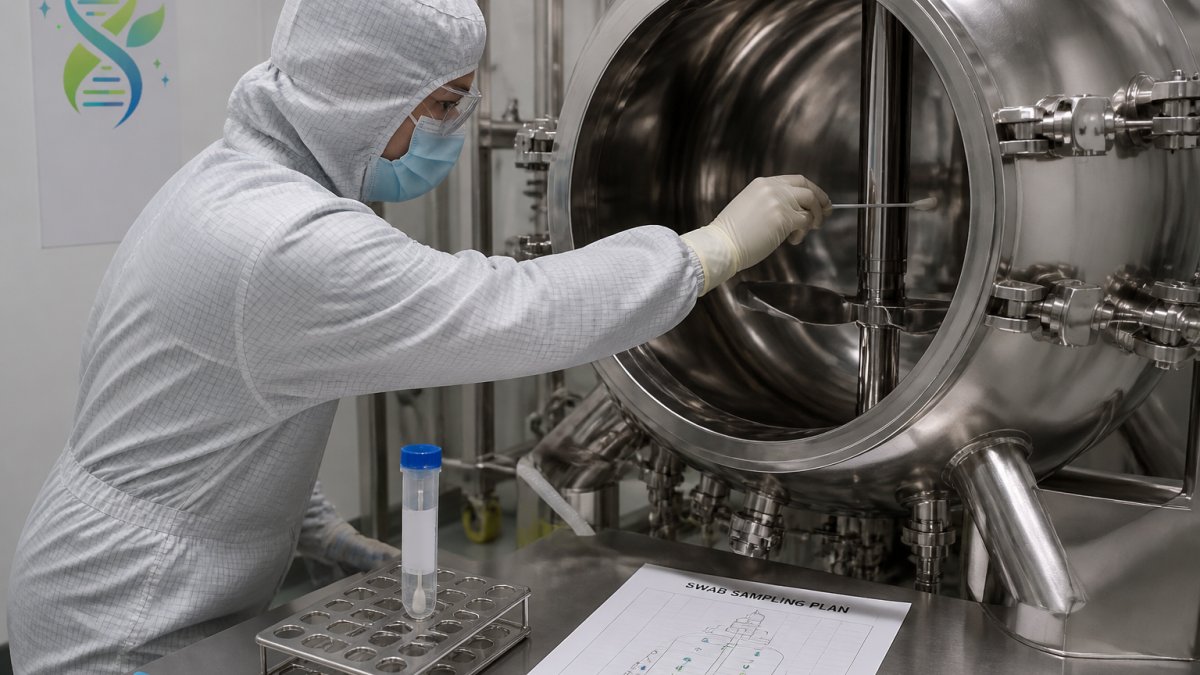
Build the plan around these decisions:
- Worst-case locations: corners, baffles, bottom outlets, and any surface the cleaning spray cannot reach directly.
- Sampling recovery: prove your swab recovers a known spike of peptide from the same material before you trust the result.
- Rinse sampling as a partner: use it for large vessels and pipework the swab cannot reach.
Choosing Analytical Methods That Detect Peptide Residue
Residue detection for peptides usually needs a method built for the molecule. Nonspecific tests like total organic carbon can confirm a surface is generally clean, but they cannot tell you which peptide is present, whether it has degraded, or whether a fragment is the species that matters.
Waters' 2020 application note on an LC-MS/MS cleaning validation method describes a simultaneous, sensitive method for quantifying therapeutic peptides. That specificity matters when several peptides share one equipment train.
Matching the method to the residue
Most practitioners choose between three families, and the right choice depends on what you need to prove:
- Nonspecific methods (TOC, conductivity, UV absorbance). Fast and cheap for routine monitoring, but they cannot distinguish a peptide from a cleaning-agent residue or a buffer salt. Use them as a screen, not as the sole evidence for a peptide-specific limit.
- Ligand-binding or immunoassays. Sensitive for a known peptide, but cross-reactivity with fragments and aggregates can inflate or deflate results. They are best when the target epitope is stable under cleaning conditions.
- Chromatographic and mass-spectrometric methods (LC-UV, LC-MS/MS). The default for specificity. LC-MS/MS can quantify the intact peptide and, with the right transitions, distinguish it from common degradation products. For deeper detail, see our mass spectrometry guide to peptide degradation.
Method validation is the gap most guides skip
A method that detects peptide in a clean standard is not the same as a method that detects peptide on a swab extracted from stainless steel after a cleaning cycle. Before you trust a result, validate these parameters in the presence of your cleaning agent and your surface material:
- Specificity. Prove the method separates the peptide from detergent, buffer salts, and known fragments. Run a blank swab from a cleaned surface and a placebo swab spiked with cleaning agent.
- Recovery. Spike a known amount of peptide onto the same surface material, dry it under the same conditions as the process residue, then swab and extract. Recovery below about 70% is a common finding and should drive either a correction factor or a sampling-procedure change.
- Linearity and range. Confirm the calibration covers the acceptance limit with margin on both sides, not just at the limit itself.
Peptide-specific complications to plan for
Three behaviors make peptide residue analysis harder than small-molecule work:
- Adsorption to labware. Peptides can stick to pipette tips, sample vials, and filter membranes, lowering recovery in a way that looks like a clean surface. Use low-binding labware and include a recovery control in every analytical run.
- Aggregation and precipitation. A peptide that aggregates during drying or extraction may not redissolve completely, so the measured residue under-reports the surface load. Sonication and solvent choice should be part of the validated extraction procedure.
- Degradation during cleaning. Harsh alkaline or oxidizing cleaning agents can fragment the peptide into species the parent-molecule method will not see. If your cleaning agent degrades the peptide, the method should either quantify the fragments or the acceptance limit should be justified against the parent only with a documented rationale.
Once the method is validated and the sampling plan is fixed, the remaining work is documentation and lifecycle control, the subjects of the next two sections.
Cleaning Validation Documentation That Survives an Audit
Documentation is where good cleaning programs fail. An auditor wants to see the protocol, the executed records, deviations, and the final validation report, all traceable to the batch.
Keep these audit-ready:
- Signed protocol with pre-defined acceptance criteria
- Raw data from every swab and rinse sample
- Deviation and investigation records
Lifecycle Monitoring and Revalidation for Peptide Equipment
Cleaning validation does not end at the report. Continued monitoring of residue levels catches drift before it becomes a contamination event.
Revalidation triggers include:
- A change in cleaning agent, procedure, or equipment
- A new product added to a shared train
- Adverse trends in routine monitoring
The underlying cGMP standards for research peptides set the baseline these triggers rest on.
Sourcing Peptides That Support Your Validated Cleaning Program
Your cleaning program is only as good as the material entering it. A supplier whose certificate of analysis does not match the vial undermines every residue limit you set.
Ask for independent third-party testing, not a self-issued document. Everform Research provides third-party COA verification and cGMP-compliant manufacturing, so incoming material supports your validated cleaning controls.
Frequently Asked Questions
What is cleaning validation for peptide equipment?
It is the documented proof that a cleaning procedure removes peptide residue from product-contact surfaces to a level that protects the next batch. A 2024 BioPharm International article describes it as continued monitoring of the cleaning process, including residue-level testing, rather than a one-time demonstration. For peptide equipment this means swab and rinse sampling, an analytical method sensitive enough to detect therapeutic peptides, and a written rationale for every acceptance limit you set.
How do you set residue limits for peptide equipment?
Start from a health-based exposure limit for the peptide, then calculate maximum allowable carryover into the next batch based on shared equipment surface area and minimum batch size. A3P notes that published guidance does not give clear acceptance criteria for therapeutic macromolecules, so your scientific rationale carries more weight. Document the calculation, the surface area map, and the analytical method's limit of detection alongside the final limit so an auditor can follow the logic.
Which sampling methods are used in cleaning validation?
Swab sampling covers defined areas of product-contact surfaces and is the primary tool for hard-to-clean locations such as seams, valves, and impeller undersides. Rinse sampling captures the whole wetted surface and suits large vessels where swabbing every area is impractical. Most programs combine both and measure sampling recovery for each, since a swab that recovers only part of the residue will understate what remains on the equipment.
How often should cleaning validation be repeated?
Revalidation is triggered by change, not by the calendar alone. Reassess when you switch to a new peptide, alter the cleaning agent or cycle, modify equipment, or see a trend of rising residue results. The 2024 BioPharm International article frames validation as ongoing monitoring, so periodic residue testing between formal revalidations gives you early warning. Keep the trigger list in your validation report so the decision is documented rather than ad hoc.
Cleaning validation for peptide equipment rewards preparation over reaction. Build the protocol, prove the method, and document everything. Everform Research supplies third-party tested, cGMP-compliant peptides with clear documentation, consistent batches, and accessible pricing so your cleaning controls start from a known baseline. Use code EVER15 for 15% off your first order and get started with Everform Research today.