 how-to
How to Validate cGMP Peptide Manufacturing Processes
Table of Contents
- What Process Validation Means for cGMP Peptide Manufacturing
- Prerequisites and What You'll Need Before You Start
- Step 1: Define Critical Process Parameters and Quality Attributes
- Step 2: Design the Process and Run Process Qualification
- Step 3: Validate Peptide Analytical Methods
- Step 4: Perform Peptide Cleaning Validation
- Step 5: Build Audit-Ready cGMP Peptide Batch Records
- Step 6: Handle Deviations, CAPA, and Change Control
- Frequently Asked Questions
Last Updated: October 4, 2026
What Process Validation Means for cGMP Peptide Manufacturing
Learning how to validate cGMP peptide manufacturing processes starts with one fact: validation is documented proof, collected before and during commercial supply, that your process consistently makes a peptide meeting its quality targets. It is not a single test or a one-off report. It is evidence.
At Everform Research, we see this misunderstanding constantly. Teams treat validation like a finish line when it is really a lifecycle. Regulators treat it the same way.
The FDA expects a three-stage lifecycle: process design, process qualification, and continued process verification. Skipping stage three is the most common mistake we see.
The Three Stages of the Validation Lifecycle
- Stage 1: Process Design. You map the process, find critical parameters, and set limits.
- Stage 2: Process Qualification. You prove the process works at commercial scale, usually across three or more lots.
- Stage 3: Continued Process Verification. You keep monitoring after launch to catch drift.
Stage 2 gets all the attention. Stage 3 is where most programs quietly fail.
Prerequisites and What You'll Need Before You Start
You cannot validate a process you have not qualified the equipment for. Prerequisites come first, and auditors check them before they look at your data.
Equipment Qualification and Facility Controls
Equipment qualification has three parts: installation, operational, and performance qualification. Each one needs its own protocol and sign-off. Facility controls matter too. Cleanroom classification, air handling, and contamination control all feed into the validation package.
- Installation qualification confirms the equipment is installed as designed
- Operational qualification confirms it runs within specified ranges
- Performance qualification confirms it works for your actual peptide process
Supplier Qualification for Raw Materials
Raw materials decide your impurity profile before synthesis even starts. Qualify every supplier, not just the first one. Resin, amino acids, and solvents all need documented specs, certificates of analysis, and audit trails.
According to BOC Sciences' overview of cGMP peptide manufacturing services, pilot-scale trials under cGMP conditions are used to check whether lab processes hold up at larger scale. That logic applies to suppliers too.
Step 1: Define Critical Process Parameters and Quality Attributes
Critical process parameters are the inputs you control. Critical quality attributes are the outputs you measure. For peptides, the link between the two is tighter than in many small-molecule processes because the product is built residue by residue, and a single missed coupling can shift the impurity profile in ways that are hard to correct downstream.
Start with a risk assessment. Ask which parameters, if they drift, would change the final peptide. Those become your critical process parameters. Then map each one to a measurable attribute so your validation protocol has a defensible cause-and-effect story.
Peptide-Specific Parameter and Attribute Map
| Stage | Critical Process Parameter | Linked Critical Quality Attribute | Typical Control Approach |
|---|---|---|---|
| Synthesis | Coupling time, activator choice, temperature | Coupling completeness, deletion sequence impurities | In-process ninhydrin or conductivity monitoring |
| Synthesis | Reagent equivalents and molar ratios | Racemization, truncated sequences | Fixed stoichiometry with verified lot assays |
| Cleavage | Cleavage cocktail composition, time, temperature | Side-chain modification, aggregation | Timed quench with temperature control |
| Purification | Gradient slope, column load, flow rate | Purity, resolution of closely related impurities | Validated chromatography method with system suitability |
| Formulation | pH, buffer strength, fill volume | Potency, stability, subvisible particles | In-line pH and fill-weight checks |
| Lyophilization | Shelf temperature, chamber pressure, cycle time | Cake appearance, reconstitution time, residual moisture | Cycle monitoring with probe data |
Setting Acceptance Criteria Without Inventing Universal Limits
There is no single purity threshold that fits every peptide. A common pattern is to set acceptance criteria from your own process capability data rather than borrowing a number from a different product. Run small-scale or engineering batches, measure variability, and set limits that your process can meet consistently. Then confirm those limits are tight enough to protect safety and efficacy.
A practical framework looks like this:
- Identify the attribute that matters most for your peptide (often purity or a specific impurity).
- Collect data from at least three representative runs.
- Calculate the mean and standard deviation.
- Set a provisional limit that accounts for normal variability.
- Confirm the limit is clinically and regulatory acceptable.
Sampling Plans and Statistical Methods
Your sampling plan should be representative, not convenient. For peptides, that often means sampling at multiple points: after synthesis, after cleavage, after purification, and after formulation. The number of samples depends on the attribute and the variability you observe.
Most practitioners find that a combination of in-process controls and final release testing gives the strongest evidence. In-process controls catch drift early. Final release testing confirms the batch meets its specification. Statistical methods such as control charts and capability indices help you decide whether a process is stable enough to validate.
| Element | Example | Why It Matters |
|---|---|---|
| Critical process parameter | Coupling time, temperature | Drives reaction completeness |
| Critical quality attribute | Purity, identity, potency | Defines batch acceptance |
| Acceptance criteria | Purity threshold, impurity cap | Sets pass/fail lines |
| Sampling plan | Frequency, sample size | Proves the data is representative |
| Statistical method | Control chart, capability index | Shows whether the process is stable |
Step 2: Design the Process and Run Process Qualification
Process design and qualification turn your defined parameters into proven, repeatable runs. You run the process at commercial scale, typically across at least three validation lots, and confirm every lot meets its acceptance criteria.
The peer-reviewed work on commercial cGMP peptide manufacturing describes validation showing that a properly set-up synthesizer yields the intended peptide with suitable purity, referencing three or more validation lots and validated test methods. That is the standard to aim for.
A common mistake is running three lots and stopping there. Design space matters more than lot count.
Step 3: Validate Peptide Analytical Methods
Analytical method validation proves your tests measure what they claim to measure. Purity, identity, potency, and impurity profile each need their own validated method.
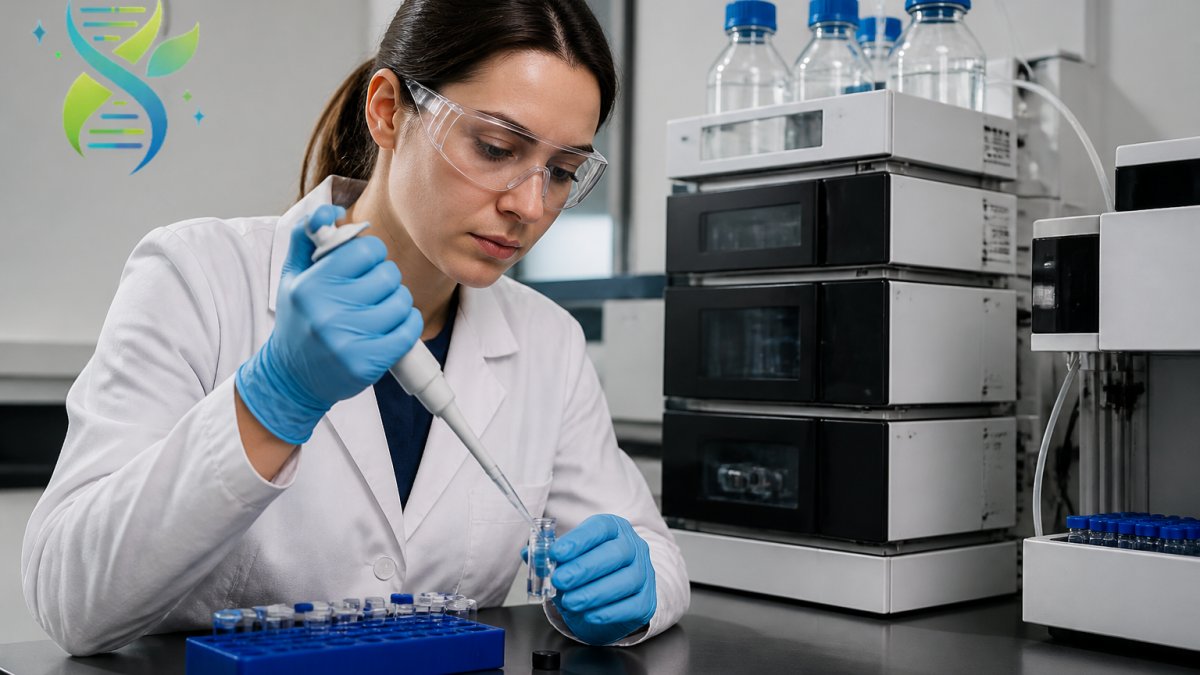
For peptides, this means checking accuracy, precision, specificity, linearity, and range. Chromatography methods for purity need particular attention because small changes in gradient or column condition shift results.
If your method is not validated, your batch release data means nothing to an auditor.
Step 4: Perform Peptide Cleaning Validation
Cleaning validation confirms that equipment is free of residue from the previous batch before the next one starts. For peptides, this is not optional. Carryover between batches can ruin purity data and contaminate product.
- Identify worst-case residues, usually the hardest peptide to remove
- Set acceptance criteria for residual levels
- Sample at the hardest-to-clean locations
- Document the method and the results
Global Biotech Laboratories describes process validation and continued verification as underpinning dependable commercial supply, and cleaning sits squarely inside that chain.
Step 5: Build Audit-Ready cGMP Peptide Batch Records
Batch records are the paper trail that proves every step happened as written. An auditor should be able to reconstruct a batch from the record alone, without asking you a single question. For peptides, that means capturing the synthesis, cleavage, purification, and formulation steps in enough detail that a reviewer can follow the logic from raw material to released product.
What an Audit-Ready Batch Record Contains
A complete batch record for a cGMP peptide process typically includes:
- Master batch record with the approved process description, critical parameters, and acceptance criteria.
- Executed batch record with actual values, times, and initials for every critical step.
- Material traceability linking every resin, amino acid, solvent, and reagent lot to its certificate of analysis and supplier qualification record.
- Equipment log showing the synthesizer, chromatography system, and lyophilizer used, with their qualification status.
- In-process control results with the method used and the analyst who performed it.
- Deviation records with root cause, impact assessment, and corrective action.
- Change control records for any process change made during or after the campaign.
- Final release testing with validated methods and specification comparison.
- Review and approval signatures from quality control and quality assurance.
Traceability and Data Integrity
Traceability is not just lot numbers. It is the ability to connect a finished peptide vial back to the exact raw material lots, equipment, and personnel involved. Data integrity matters too. Audit trails, controlled access, and secure record retention are standard expectations. If a record can be edited without a trace, an auditor will question the entire dataset.
Documentation Checklist for Validation Protocols and Reports
Before you claim a process is validated, confirm you have:
- A written validation protocol approved before execution.
- A validation report summarizing results against acceptance criteria.
- A deviation log with documented dispositions.
- A change control log showing any post-validation changes and their impact assessment.
- A continued process verification plan describing ongoing monitoring.
- A training record showing personnel were qualified for the steps they performed.
Documentation is not paperwork for its own sake. It is the evidence that your validation claim is true. When your records are complete, traceable, and approved, your validation status is defensible. When they are not, no amount of clean data will convince an auditor.
Step 6: Handle Deviations, CAPA, and Change Control
Deviations will happen. What matters is how you handle them. A deviation log with no corrective action is a red flag to any auditor.
Use CAPA, corrective and preventive action, to fix the root cause, not just the symptom.
Validating cGMP peptide manufacturing processes takes discipline, documentation, and patience. Most teams underestimate the ongoing monitoring stage and overestimate how much three clean lots prove.
At Everform Research, we built our supply around that reality. Our third-party COA verification and batch consistency give research teams the dependable quality they need.
Get started with Everform Research and give your next validation project a supply chain you can actually document.
Frequently Asked Questions
What does process validation mean in cGMP peptide manufacturing?
Process validation is the documented evidence that your peptide manufacturing process consistently delivers a product meeting its predetermined specifications. It involves three lifecycle stages: process design, process qualification, and continued process verification. For peptides, this means proving your synthesis, cleavage, purification, and formulation steps reliably produce the intended amino acid sequence with acceptable purity and potency. The FDA expects validation to be completed before commercial distribution, with ongoing monitoring to confirm the process remains in control over time.
How do manufacturers validate peptide identity, purity, and potency?
Identity is confirmed using mass spectrometry and amino acid analysis to verify the correct molecular weight and sequence. Purity is assessed by reverse-phase HPLC, often with UV detection at 214 nm, and reported as a percentage of the main peak relative to total peak area. Potency is validated through bioassays or binding assays specific to the peptide's mechanism. Each analytical method must itself be validated for accuracy, precision, specificity, linearity, and range before it can support process validation. Acceptance criteria are set based on regulatory guidance and product requirements.
What documentation is needed for cGMP process validation?
You need a validation master plan, process validation protocol, and final validation report. Batch records must capture every critical step, including raw material lot numbers, equipment IDs, in-process test results, and operator signatures. Analytical method validation reports, cleaning validation reports, and deviation records are also required. All documents must follow good documentation practices: indelible ink, single-line corrections with initials and date, and no backdating. These records form the audit trail that FDA investigators review during inspections.
How is cleaning validation performed for peptide manufacturing equipment?
Cleaning validation for peptide equipment begins with identifying the worst-case product and hardest-to-clean locations, such as reactor vessel corners and transfer lines. You then develop a cleaning procedure, often using a solvent or aqueous detergent, and validate it by sampling for residues. Swab sampling of defined areas and rinse sampling of the equipment are analyzed for total organic carbon, peptide-specific HPLC methods, and detergent residues. Acceptance criteria are set based on health-based exposure limits or a maximum allowable carryover calculation. Three consecutive successful cleaning runs are typically required.