 ultimate-guide
Independent Third-Party Peptide Testing: A Complete Guide
Table of Contents
- What Is Independent Third-Party Peptide Testing?
- Why Laboratory Validation Matters for Research Peptides
- Core Analytical Methods: HPLC and Mass Spectrometry
- Understanding the Peptide Certificate of Analysis Explained
- ISO 17025 Accredited Labs for Peptides: What You Need to Know
- How to Interpret Lab Test Results and Spot Red Flags
- Risks of Unverified Peptides and How Testing Protects Your Research
- Conclusion
Last Updated: August 9, 2026
What Is Independent Third-Party Peptide Testing?
Independent third-party peptide testing is the analytical verification of peptide products by laboratories that have no financial interest in the manufacturer or distributor. These unaffiliated labs measure purity, identity, and safety characteristics using standardised methods, then issue a Certificate of Analysis (COA) that documents their findings.
The distinction matters. A manufacturer's internal testing tells you what the company found in its own facility. Third-party testing tells you what an external, neutral laboratory discovered when examining the same product under controlled conditions. This separation creates accountability and transparency that researchers, athletes, and healthcare professionals depend on when making sourcing decisions.
At Everform Research, we recognise that independent verification has become the industry standard for peptide sourcing. It's the difference between trusting a supplier's word and holding tangible, verifiable evidence of what you're actually purchasing.
Why does this matter? Peptides are complex molecules with precise amino acid sequences. Even small deviations, a missing amino acid, residual solvents, or microbial contamination, can invalidate research results or compromise safety. Third-party testing catches these issues before they reach your laboratory or research programme.
Why Laboratory Validation Matters for Research Peptides
Peptide research demands reproducibility. If your experiment depends on a specific peptide purity level and batch variation occurs, your data becomes unreliable. Laboratory validation prevents this problem by establishing a documented baseline for every batch you receive.
Consider the practical stakes. A principal investigator running high-throughput screening across fifty experiments needs consistent purity across all vials. If one batch is 98% pure and the next is 94%, the variation alone can skew your results. You'll spend months troubleshooting methodology when the real culprit was batch inconsistency. Laboratory validation catches this before you begin.
Independent verification also protects your institution's credibility. If you publish findings based on unverified peptide quality and another research group cannot replicate your results, the failure reflects on your work. Third-party documentation demonstrates that you used materials of known, audited quality, a critical component of scientific integrity.
For athletes and fitness professionals, validation serves a different but equally important purpose. Performance gains depend on compound efficacy and safety. Unverified products may contain undeclared substances, contaminants, or lower active content than advertised. Laboratory testing removes this uncertainty and protects both your health and your training outcomes.
The cost of validation is modest compared to the cost of invalidated research, failed experiments, or health complications. Most serious suppliers now include third-party COAs as standard documentation.
Core Analytical Methods: HPLC and Mass Spectrometry
High-performance liquid chromatography (HPLC) and mass spectrometry are the two primary analytical techniques used to verify peptide identity and purity. Understanding what these methods measure helps you interpret lab reports and assess whether testing was thorough enough for your needs.
HPLC separates peptide components by pushing a liquid sample through a column packed with specialized material. Different peptides move through the column at different speeds, creating a chromatogram, a visual graph showing peaks that represent each compound present. The area under each peak corresponds to the percentage of that compound in the sample. This method answers the question: what's actually in this vial, and how much of each component?
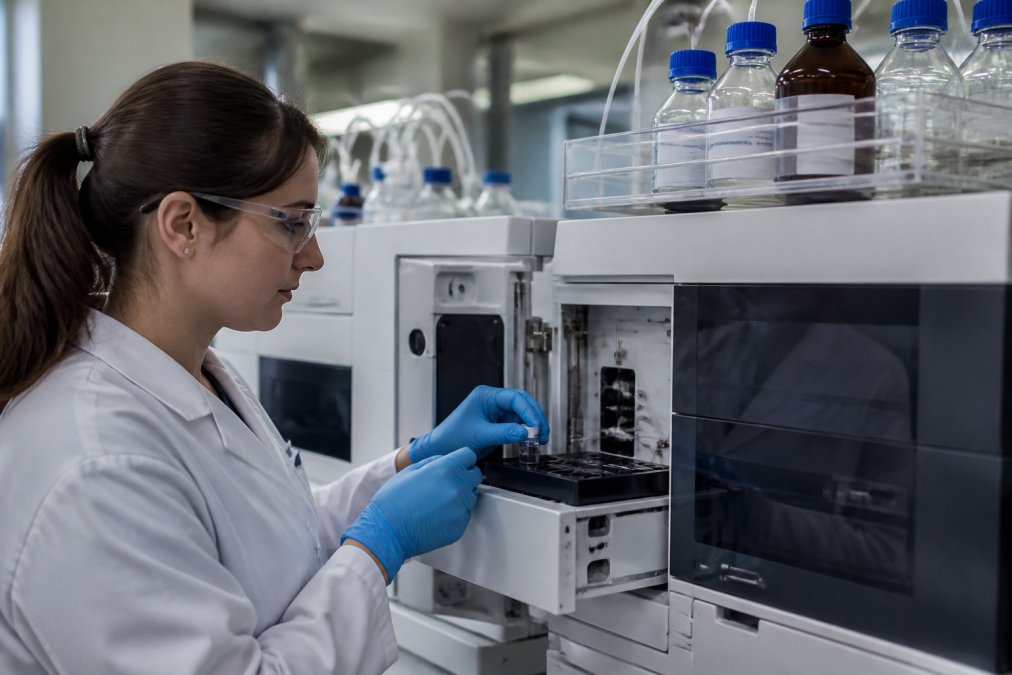
Mass spectrometry takes identification further by measuring the molecular weight of each compound. A mass spectrometer ionises molecules and sorts them by mass-to-charge ratio, producing a spectrum that acts like a fingerprint for each peptide. When combined with HPLC, this two-step process confirms not just the amount of peptide present, but also that it's the correct peptide with the correct molecular structure.
These methods are complementary. HPLC tells you purity percentage. Mass spectrometry confirms identity. Together, they provide the analytical precision that research-grade peptides require.
Some laboratories also perform additional tests depending on the peptide type and intended use: amino acid analysis (breaking down the peptide into individual amino acids to verify composition), endotoxin testing (checking for bacterial contamination), and stability testing (confirming the peptide remains stable under specified storage conditions).
The quality of your test results depends on whether the laboratory uses validated, standardised protocols. This is where ISO 17025 accreditation becomes relevant, it's the credential that proves a lab follows rigorous analytical standards.
Understanding the Peptide Certificate of Analysis Explained
A Certificate of Analysis (COA) is a formal laboratory document that reports the results of analytical testing performed on a peptide sample. It serves as your proof that independent testing occurred and what the results were.
A complete COA includes several key sections. The sample identification section states the product name, batch number, and testing date. The analytical results section reports the specific measurements: purity percentage (usually expressed as a percentage of the total sample), identity confirmation (whether the peptide matched the expected molecular weight), and any detected impurities or contaminants. The methodology section describes which analytical techniques were used, typically HPLC, mass spectrometry, or both. The laboratory credentials section lists the lab's name, address, and accreditation status.
Red flags on a COA include vague purity reporting (e.g., "greater than 90%" instead of a specific figure like "97.3%"), missing analytical methodology details, lack of batch-specific information, or absence of laboratory contact information. A legitimate COA ties results to a specific batch and testing date, not generic claims.
The net peptide content figure is particularly important. This represents the actual amount of active peptide in your sample, accounting for water molecules, residual solvents, and other non-peptide material. A peptide reported as "95% purity" means 95% of the sample is the desired peptide; the remaining 5% consists of other substances. Understanding this distinction prevents dosing errors and ensures your research uses the correct quantity of active compound.
Many researchers overlook the COA or treat it as a formality. In reality, it's your primary evidence that the product you received matches what you ordered. When you work with a supplier like Everform Research that provides transparent COAs with every batch, you're establishing a documented trail of quality that protects both your research and your institution's reputation.
ISO 17025 Accredited Labs for Peptides: What You Need to Know
ISO 17025 is an international standard that specifies the requirements for laboratory competence. A laboratory holding ISO 17025 accreditation has undergone independent assessment and proven it meets strict criteria for analytical accuracy, equipment calibration, staff training, and quality management.
For peptide testing, ISO 17025 accreditation matters because it's the credential that separates rigorous, audited laboratories from facilities that may lack standardised protocols. An accredited lab must maintain documented procedures for every test it performs, calibrate its instruments regularly against known standards, and participate in proficiency testing programmes where its results are compared to other laboratories analysing the same samples.
This accreditation is voluntary, a laboratory can operate without it. However, for research-grade peptides and institutional procurement, ISO 17025 accreditation is increasingly the baseline expectation. Many academic institutions and regulatory bodies now require it as a condition of supplier approval.
When reviewing a laboratory's credentials, look for the specific scope of accreditation. ISO 17025 can be granted for certain analytical methods but not others. A lab might be accredited for HPLC analysis but not mass spectrometry, or accredited for peptide testing but not for endotoxin analysis. The COA should specify which tests fall within the lab's accredited scope and which do not.
The accreditation body matters too. In the United States, accreditation typically comes through A2LA (American Association for Laboratory Accreditation) or similar bodies that meet international standards. Verify the accrediting body name on the laboratory's documentation.
Accreditation doesn't guarantee perfection, but it does guarantee systematic quality management, documented procedures, and regular external audits. For researchers and organisations with strict procurement requirements, this assurance is worth prioritising in supplier selection.
How to Interpret Lab Test Results and Spot Red Flags
Reading a peptide test report requires attention to specific figures and methodologies. Here's how to assess whether the testing was thorough and the results reliable.
Start with the purity percentage. A peptide reported as 95% pure means the sample contains 95% of the target peptide and 5% other substances. For research applications, 95% purity is generally acceptable; for clinical or pharmaceutical use, 98%+ is standard. The specific purity threshold depends on your application, check your protocol requirements or consult with your research team before accepting a batch.

Next, examine the impurity profile. The COA should list what makes up the remaining 5% (or whatever the non-target percentage is). Residual solvents, water content, and related peptides are common. Unexpected contaminants, heavy metals, microbial endotoxins, or unidentified compounds, are red flags that warrant clarification with the supplier.
Check the analytical methods used. If the report lists only HPLC without mass spectrometry confirmation, you have purity data but not definitive identity confirmation. For critical applications, both methods together provide stronger assurance. If the report mentions methods you don't recognise, ask the supplier for clarification or consult a chemist familiar with peptide analysis.
Verify the testing date. A COA dated six months ago tells you the peptide was pure at that time, but peptides can degrade during storage. For long-term storage, request stability data or recent retesting. A fresh COA (within the last month) is preferable, especially for sensitive applications.
Look for batch-specific information. A legitimate COA ties results to a specific batch number and manufacturing date, not generic claims about the product line. This specificity allows you to correlate results with your own experimental outcomes if issues arise.
Common discrepancies occur when reported purity doesn't match your experimental results. This usually indicates storage problems (degradation), improper handling, or occasionally, labelling errors. If your results consistently differ from the COA, contact the supplier immediately. Everform Research and other quality-focused suppliers investigate such discrepancies because they indicate either a process issue or a customer handling problem that needs resolution.
Risks of Unverified Peptides and How Testing Protects Your Research
Unverified peptides carry multiple risks that independent testing mitigates. Understanding these risks clarifies why third-party validation has become non-negotiable for serious research and performance work.
The most obvious risk is identity uncertainty. Without testing, you don't know whether the peptide you received is actually the peptide you ordered. Mislabelling, cross-contamination during synthesis, or deliberate substitution can occur. A researcher using an unverified peptide might spend months troubleshooting methodology when the real problem is that the compound was incorrectly labelled. Testing confirms identity and prevents wasted effort.
Purity variation introduces another layer of risk. Two batches of nominally identical peptides might have different purity levels due to synthesis variations or storage conditions. Without testing, you won't know which batch is 95% pure and which is 85% pure. This variation directly affects your dosing accuracy and experimental reproducibility. Testing establishes a documented baseline for each batch.
Contamination represents a safety and efficacy risk. Residual solvents, bacterial endotoxins, or heavy metals can compromise results or cause adverse effects. For athletes and fitness professionals, contamination is a health concern. For researchers, it's both a safety issue and a confounding variable that undermines data integrity. Testing screens for these contaminants before they reach your laboratory.
Regulatory and institutional risk is often overlooked. If you publish research based on unverified peptides and the results cannot be replicated, questions about material quality will arise. Institutions increasingly require documented third-party verification as a condition of research approval. Using unverified materials can complicate grant applications, institutional review board (IRB) approvals, and publication processes.
The cost of unverified peptides may appear lower, but hidden costs accumulate quickly. Failed experiments, repeated batches, publication delays, and reputational damage far exceed the modest premium for verified, tested compounds. Suppliers like Everform Research include third-party testing as standard practice, not as an optional add-on, because quality-conscious customers recognise that verification is an investment in reliable research outcomes.
Testing doesn't eliminate all risks, no analytical method is 100% accurate, but it transforms peptide sourcing from a trust-based transaction into a verification-based one. That shift is foundational to reproducible research and safe performance applications.
Ready to source peptides backed by rigorous third-party testing?
Everform Research provides premium-quality peptides with comprehensive third-party COAs, cGMP-compliant manufacturing, and transparent documentation for every batch. Whether you're running high-throughput screening, optimising athletic performance, or conducting foundational research, verified peptide quality protects your results and your reputation.
Use discount code EVER15 for 15% off your first order and experience the Everform Research difference: consistency, transparency, and dependable quality.
Frequently Asked Questions
What is third-party peptide testing and why is it different from supplier testing?
Third-party peptide testing involves sending samples to an independent laboratory that has no financial relationship with the peptide manufacturer. Unlike supplier testing, which the manufacturer may conduct in-house, independent verification removes conflicts of interest and provides unbiased analytical results. An accredited third-party lab applies standardised methods such as high-performance liquid chromatography (HPLC) and mass spectrometry to verify purity, identity, and contaminant screening. This separation ensures your results are trustworthy for research applications.
How do I know if a peptide certificate of analysis is legitimate?
A legitimate certificate of analysis should include the testing laboratory's name and contact information, the analytical methods used (HPLC, mass spectrometry, or both), specific purity percentages, batch numbers matching your order, and the testing date. Verify that the laboratory holds ISO 17025 accreditation, which demonstrates compliance with international standards for analytical competence. Cross-reference the COA's batch number with your shipment documentation, and contact the testing lab directly if anything appears unclear. Legitimate labs welcome verification inquiries from end-users.
Why does ISO 17025 accreditation matter for peptide testing?
ISO 17025 accreditation certifies that a laboratory meets international standards for technical competence, quality assurance, and analytical precision. Accredited labs follow documented standard operating procedures, maintain equipment calibration records, and undergo regular external audits. For peptide research, this means your test results are reproducible, defensible, and suitable for publication or regulatory submission. Non-accredited labs may use identical equipment but lack the documented quality systems that ensure consistency across batches and over time.
What are the main risks of using peptides without third-party verification?
Unverified peptides carry several risks: hidden contaminants that compromise experimental reproducibility, lower actual purity than claimed, batch inconsistency that ruins data across multiple experiments, and potential exposure to harmful impurities. Without independent verification, you cannot distinguish between legitimate quality issues and deliberate misrepresentation. For high-throughput screening or regulatory work, unverified compounds can invalidate months of research. Third-party testing provides documented evidence of identity, purity, and safety, protecting both your research integrity and your team's confidence in results.
This article was written using GrandRanker