 ultimate-guide
Risks of Buying Low Purity Research Peptides
Table of Contents
- What Makes Low Purity Research Peptides Risky
- How to Verify Peptide Purity Before You Buy
- Understanding the Peptide Certificate of Analysis
- Research Peptide Vendor Red Flags to Avoid
- Are Research Peptides Safe for Human Use
- Contamination Pathways and Quality Control Failures
- Building a Risk Assessment Framework for Peptide Selection
- Frequently Asked Questions
Last Updated: October 12, 2026
What Makes Low Purity Research Peptides Risky
Low purity research peptides present significant challenges for anyone conducting serious research. When a peptide batch contains impurities or falls short of stated purity levels, the consequences ripple through your entire experimental workflow. At Everform Research, we've seen firsthand how purity issues compromise data integrity, waste resources, and create safety concerns that extend beyond the laboratory.
The core problem is straightforward: if your peptide isn't what the label claims, your results won't be reproducible. A batch marked as 95% pure might actually contain degradation products, manufacturing residue, or entirely different compounds. These contaminants interfere with cellular responses, skew dose-response curves, and make it impossible to establish whether your findings reflect genuine biological effects or simply reflect impure material.
Beyond data quality, low purity introduces health risks. Research on unregulated peptide use from PubMed Central identifies mislabelling, contamination, and inaccurate product contents as immediate risks associated with unregulated peptide sources. When researchers or individuals administer impure peptides, they expose themselves to unknown compounds, bacterial endotoxins, and manufacturing byproducts that can trigger infections, immune responses, or other adverse effects.
The financial impact compounds these concerns. Low purity batches often require higher doses to achieve target effects, increasing costs whilst simultaneously amplifying exposure to contaminants. Researchers who discover purity problems mid-experiment face wasted time, ruined datasets, and the need to restart protocols from scratch.
How to Verify Peptide Purity Before You Buy
Verifying peptide purity before purchase is non-negotiable. Don't rely solely on vendor claims, demand independent verification through certificates of analysis and direct communication about testing methodology.
Start by requesting a certificate of analysis (COA) from any supplier before committing to a purchase. A legitimate COA should specify the testing method used (typically high-performance liquid chromatography, or HPLC), the exact purity percentage, and the date of testing. Ask whether the testing was conducted by the manufacturer's in-house laboratory or by a genuinely independent third party. In-house testing carries inherent bias; independent testing provides credibility.
Contact the supplier directly with specific questions: Which independent laboratory performed the analysis? Can they provide the lab's accreditation credentials? How recently was the batch tested, and how does the supplier ensure consistency between batches? Evasive answers or delayed responses are red flags.
Cross-reference the supplier's claims against industry standards. Research-grade peptides should typically meet purity thresholds of 95% or higher for serious applications. Anything below 90% purity warrants scrutiny unless the supplier provides a compelling explanation tied to the peptide's chemical properties.
Compare multiple suppliers' documentation. Inconsistent purity claims for the same peptide across vendors suggest that at least one source is unreliable. Everform Research maintains transparent documentation and third-party testing for every batch, allowing researchers to compare our standards directly against competitors.
Request batch-specific documentation, not generic product sheets. Each manufactured batch should have its own COA reflecting that specific production run. Generic certificates claiming "all batches meet X purity" lack the specificity needed to verify quality.
Understanding the Peptide Certificate of Analysis
A certificate of analysis is your primary defence against low purity peptides, but only if you know how to read it correctly. The document itself isn't a guarantee of quality, the methodology, the testing lab's independence, and the document's specificity determine its value.
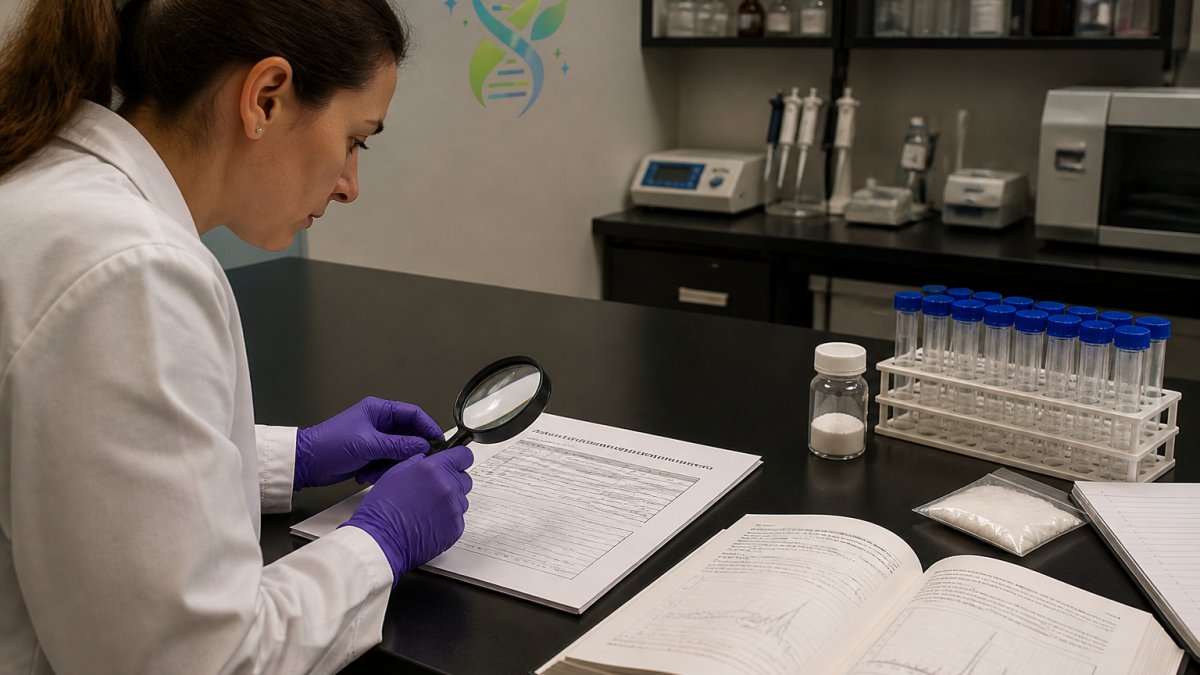
A proper COA should include several essential components. The peptide's exact molecular formula and molecular weight appear first, allowing you to verify that the tested compound matches what you ordered. The purity percentage follows, typically expressed as a single figure (e.g., "97.3% pure by HPLC") or as a range if multiple batches are summarised.
The testing methodology matters enormously. HPLC is the gold standard for peptide purity analysis, separating compounds by their chemical properties and measuring the percentage of the target peptide versus impurities. Mass spectrometry (MS) provides additional confirmation by identifying the exact molecular weight and structure. A COA citing only "purity testing" without specifying the method is vague and potentially unreliable.
The testing date is critical. Peptides degrade over time, especially if stored improperly. A COA dated six months or a year prior doesn't reflect the current state of a stored vial. Request COAs dated within the last 30 days of your intended purchase, or ask whether the supplier can provide fresh testing for older batches.
The testing laboratory's name and accreditation status deserve attention. Independent, ISO-certified laboratories carry more weight than in-house testing. Look for accreditation from recognised bodies such as ISO/IEC 17025, which indicates the laboratory meets international standards for competence and impartiality.
Impurity profiles add another layer of insight. A detailed COA lists not just the overall purity percentage but identifies specific impurities detected. This information tells you whether contaminants are minor degradation products (relatively benign) or unknown compounds (potentially problematic). A COA that lists "impurities detected: <3%" without identifying what those impurities are raises questions about transparency.
What a COA Does and Does Not Establish
Most researchers treat a COA as a single pass-or-fail document. In practice, it reports several distinct measurements, and each one answers a different question. Understanding the difference is the only way to judge whether a certificate actually supports the claim being made about a batch.
- Identity confirms that the material in the vial is the peptide named on the label. Mass spectrometry and, where relevant, amino acid analysis support this. A high purity figure tells you nothing about identity on its own, a vial of the wrong peptide can still be 98% pure.
- Purity reports the percentage of the main peak relative to other peaks detected by HPLC. It is a relative measure, not an absolute one. A 98% purity result means 2% of the detected signal came from something else, it does not mean the remaining 2% is harmless.
- Potency describes how much biological or chemical activity the material retains. Purity and potency are not the same thing. A peptide can be chemically pure yet have lost potency through degradation, oxidation, or incorrect folding.
- Contaminant testing covers residual solvents, heavy metals, microbial bioburden, and endotoxins. These tests are usually separate from the purity assay and are frequently absent from vendor-provided COAs.
A common pattern is a certificate that reports a single HPLC purity figure and nothing else. That document establishes one narrow fact, the relative proportion of the main peak in one sample, and leaves identity, potency, sterility, and endotoxin status unaddressed. Treating it as a full quality statement overstates what the analysis can support.
The Limits of Vendor-Provided Documents
A COA supplied by the seller is a claim, not an independent finding. Several practical limitations apply:
- The sample tested may not be the sample shipped. Batch-level testing assumes the tested vial is representative of the entire production run. Without chain-of-custody records linking the tested sample to the shipped vial, that assumption is unverified.
- In-house laboratories face commercial pressure. A laboratory employed by the vendor has an interest in the batch passing. Independent laboratories have no such incentive, which is why accreditation and independence are worth confirming separately.
- Documents can be reused or altered. Generic certificates, copied chromatograms, and edited purity figures appear in this market. Cross-checking the batch number, test date, and laboratory details against the supplier's other documentation helps reveal inconsistencies.
- A COA is a snapshot. It describes the material on the day of testing. Storage, shipping, and handling after that point can change the product. A certificate dated months before delivery says little about the vial in your hand.
A Practical Reading Checklist
When you receive a certificate, work through it in order rather than scanning for the purity number:
- Confirm the peptide name, molecular formula, and molecular weight match your order.
- Note the analytical method, HPLC alone, or HPLC with mass spectrometry confirmation.
- Check the test date and compare it against the shipping date.
- Identify the testing laboratory and whether it is independent and accredited.
- Look for a batch or lot number that matches the vial label.
- Check whether impurity peaks are identified or merely counted.
- Confirm whether sterility, endotoxin, and residual solvent testing were performed, or state clearly that they were not.
If any of these items are missing, ask the supplier directly. A supplier who answers clearly and promptly is demonstrating the transparency that matters more than any single document. A supplier who deflects or provides vague reassurances is telling you something useful about how the rest of the transaction is likely to go.
Research Peptide Vendor Red Flags to Avoid
Identifying unreliable vendors before placing an order protects your research and your safety. Certain patterns consistently indicate low-quality suppliers or outright scams.
Vendors offering peptides at prices significantly below market rates warrant immediate suspicion. If comparable peptides from established suppliers cost £500 per vial and a new vendor offers the same peptide for £150, the pricing disparity suggests either misrepresentation, low purity, or contaminated material. Legitimate suppliers maintain consistent pricing because quality costs money.
Evasive or missing documentation is a dealbreaker. A vendor unable or unwilling to provide a COA, manufacturing details, or information about testing labs is signalling that they have something to hide. Legitimate suppliers like Everform Research provide comprehensive documentation as standard practice because transparency builds trust.
Vague product descriptions are another warning sign. Phrases like "research-grade peptide" without specifying purity, "pharmaceutical-quality compounds" without certifications, or "tested for safety" without naming the testing methodology lack the precision that credible vendors employ. Real suppliers specify exact purity percentages, testing methods, and batch numbers.
Lack of contact information or unresponsive customer service indicates unprofessionalism. Established vendors maintain accessible support channels and respond to technical questions within hours. If you can't reach someone to ask about a COA or testing methodology, you can't verify the product's quality.
Claims of "exclusive" or "proprietary" peptide formulations without supporting documentation should raise scepticism. Peptides are well-characterised molecules; there's no such thing as a secret peptide that only one supplier can produce. Vendors making such claims are often repackaging generic peptides under inflated branding.
Payment methods matter as well. Vendors accepting only cryptocurrency, wire transfers to obscure accounts, or refusing to issue invoices operate outside normal business practices. Reputable suppliers accept standard payment methods and provide detailed invoices for your records.
Check whether the vendor displays any certifications or compliance standards. cGMP (current Good Manufacturing Practice) compliance, ISO certifications, or third-party quality audits demonstrate a commitment to quality control. The absence of any such credentials doesn't automatically mean the supplier is unreliable, but it's a factor to weigh against other information.
Are Research Peptides Safe for Human Use
This question requires a straightforward answer: research peptides are not approved for human use, and administering them carries substantial risks.
Research peptides are explicitly labelled "for research use only" because they haven't undergone the rigorous safety testing, efficacy validation, and quality control that regulatory agencies require for human pharmaceuticals. The FDA has issued warning letters regarding unapproved peptide products products marketed for research that have not been reviewed for safety, effectiveness, or quality.
The distinction between "research-grade" and "pharmaceutical-grade" is legally and practically significant. Pharmaceutical-grade peptides are manufactured under strict regulations, tested extensively in clinical trials, and approved by regulatory bodies before human use. Research-grade peptides bypass these safeguards entirely. Even high-purity research peptides may contain trace impurities, endotoxins, or manufacturing residue that wouldn't be acceptable in a pharmaceutical product.
Administering research peptides introduces several specific hazards. Contamination with bacterial endotoxins can trigger severe immune responses, fever, and sepsis. Mislabelled peptides mean you're administering an unknown compound at an unknown dose. Low-purity batches expose you to degradation products and byproducts whose biological effects are unstudied.
The absence of standardised dosing protocols for research peptides means users lack guidance on safe administration. Pharmaceutical peptides come with established dose ranges, administration schedules, and contraindication information. Research peptides have none of this. Determining a "safe" dose for a compound that hasn't been tested in humans is guesswork.
If you've been exposed to a research peptide or suspect an adverse event following administration, seek immediate medical attention. Inform healthcare providers of the exact peptide name, source, purity, and batch number if available. This information helps clinicians identify potential contaminants or degradation products and tailor treatment accordingly.
Contamination Pathways and Quality Control Failures
Understanding how contamination enters peptide batches and where quality control fails helps you evaluate vendor credibility and recognise high-risk products. The pathways are well characterised, and each one leaves a different signature that only specific tests can detect.
Synthesis and Raw Material Contamination
Manufacturing contamination begins at the synthesis stage. Peptides are built amino acid by amino acid using chemical reactions that require precise conditions. Incomplete reactions leave truncated peptides, shorter chains missing one or more amino acids. Unwanted side reactions produce modified amino acids or cross-linked peptides. Poor process control allows these byproducts to accumulate, diluting the final purity.
Raw material quality directly impacts finished product purity. If the amino acids, solvents, or reagents used in synthesis are themselves contaminated or substandard, the resulting peptide batch will be compromised. Residual solvents from synthesis and purification are a particular concern, they are not visible, not detected by HPLC purity assays, and require separate gas chromatography testing to identify.
Microbial and Endotoxin Contamination
Environmental contamination occurs during manufacturing and packaging. Bacterial or fungal spores in the facility, dust, or moisture can contaminate peptide solutions. Improper handling during weighing, dissolution, or vial filling introduces foreign material. Inadequate sterilisation of equipment or packaging materials leaves residue that contaminates the final product.
Endotoxins deserve separate attention because they behave differently from other contaminants. Endotoxins are fragments of bacterial cell walls, they are not living organisms, and they survive standard sterilisation methods such as autoclaving. A vial can be sterile, free of viable bacteria, and still contain endotoxins capable of triggering fever, immune activation, and in severe cases sepsis. Detecting them requires a limulus amebocyte lysate (LAL) assay, a test that is rarely included in standard peptide COAs.
Microbial contamination and endotoxin contamination are therefore two separate problems requiring two separate tests. A certificate reporting sterility says nothing about endotoxin status, and vice versa.
Cross-Contamination Between Batches
Facilities producing multiple peptides in the same equipment create cross-contamination risk. Shared synthesis vessels, purification columns, and filling lines can carry trace residues from one peptide into the next batch. The result is a product that is mostly the intended peptide but contains small amounts of an unrelated compound.
Cross-contamination is difficult to detect because the contaminating peptide may be structurally similar and produce overlapping peaks on HPLC. Mass spectrometry is more reliable for identifying unexpected molecular weights, but only if the laboratory is looking for them. A standard purity assay reports the main peak percentage without identifying what the minor peaks represent.
Why Appearance Is Not a Reliable Test
A common assumption is that contaminated or degraded peptides will look different, discoloured, cloudy, or containing visible particles. This assumption fails in both directions.
- Endotoxins are invisible. A clear, colourless solution can carry a significant endotoxin load.
- Residual solvents are invisible. Trace chemical residues from synthesis do not alter the appearance of a lyophilised powder.
- Many degradation products are invisible. Oxidation and deamidation change the molecule without changing how the vial looks.
- Visible particles are not always present when contamination exists, and when they are present, they may indicate a handling problem rather than a manufacturing one.
Visual inspection is a basic check, not a quality test. It can catch gross problems such as cracked vials or obvious discolouration, but it cannot confirm that a product is free from the contaminants most likely to cause harm.
Storage and Handling Degradation
Storage and handling failures degrade peptides over time. Peptides are sensitive to temperature, light, and humidity. Vials stored at room temperature instead of refrigerated conditions undergo accelerated degradation. Exposure to light breaks peptide bonds. Repeated freeze-thaw cycles from improper handling cause precipitation and degradation. A high-purity batch can become contaminated simply through poor storage.
Degradation is not always visible and not always reflected in a purity figure. A peptide that has oxidised at a single residue may still show 95% purity by HPLC if the oxidised form elutes close to the main peak. Potency, however, may have dropped substantially. This is one reason purity and potency should be treated as separate measures.
Where Quality Control Fails
Quality control gaps allow contaminated batches to reach customers. Common failure points include:
- Visual-only inspection. Vendors checking for discolouration or cloudiness miss most contamination.
- Single-batch testing. Testing one vial from a large production run fails to catch variation between vials.
- Outdated testing. A certificate from months or years ago does not reflect the current state of stored inventory.
- Missing test categories. Purity testing without endotoxin, sterility, residual solvent, or heavy metal testing leaves major contamination pathways unexamined.
- In-house testing without independent verification. Internal laboratories face pressure to approve batches and keep production moving.
| Contamination Source | Indicator | Detection Method |
|---|---|---|
| Incomplete synthesis | Low purity percentage | HPLC analysis |
| Bacterial endotoxins | Immune response, fever | LAL testing |
| Residual solvents | None visible | Gas chromatography |
| Trace metals | Discoloration, precipitation | ICP-MS analysis |
| Moisture / degradation | Cloudiness, reduced potency | HPLC, moisture analysis |
| Cross-contamination | Unexpected compounds | Mass spectrometry |
| Microbial bioburden | None visible | Sterility testing |
When evaluating a supplier, ask which of these tests were performed on the specific batch you are considering. A supplier who can answer that question clearly, and who distinguishes between the tests rather than lumping them under a general quality claim, is demonstrating the kind of process control that reduces contamination risk.
Building a Risk Assessment Framework for Peptide Selection
Creating a systematic approach to evaluating peptides reduces the likelihood of purchasing low-purity products and protects your research integrity.
Start by defining your purity requirements based on your research goals. If you're conducting basic exploratory work, 90% purity might suffice. If you're running dose-response studies or preparing data for publication, demand 95% or higher. If you're validating a therapeutic target, 98%+ purity becomes essential. Document these requirements before evaluating vendors so you're comparing apples to apples.
Assess vendor documentation comprehensively. Create a checklist: Does the vendor provide batch-specific COAs? Are those COAs from independent laboratories? Do they specify testing methodology (HPLC, MS)? Do they identify impurities detected? Are certifications current and verifiable? Score vendors on completeness and transparency.
Request references from other researchers who've purchased from the vendor. Ask specifically about batch consistency, whether products matched their COAs, and whether they experienced any unexpected results. Direct feedback from peers carries more weight than vendor testimonials.
Evaluate pricing against quality markers. A vendor offering lower prices should justify that difference through lower purity specifications, smaller volumes, or longer lead times, not through vague claims of efficiency. If pricing is significantly below market rate without clear explanation, treat it as a red flag.
Establish a trial protocol before committing to large orders. Purchase a single vial from a new vendor and verify it independently before ordering in bulk. Run your own testing or send the vial to an independent laboratory for analysis. Confirm that the received product matches the COA provided. This small investment prevents costly mistakes.
Document your vendor decisions and outcomes. Record which suppliers you've used, which batches you've purchased, and whether results matched expectations. Over time, this record reveals patterns, which vendors consistently deliver quality, which ones occasionally slip, and which ones you should avoid entirely.
Selecting high-purity research peptides requires diligence, but the investment in vendor evaluation and documentation verification pays dividends through reproducible research and reduced safety risks. Everform Research simplifies this process by providing third-party tested peptides with transparent documentation, cGMP-compliant manufacturing, and responsive support that answers your questions directly. Use discount code EVER15 for 15% off your first order and experience the difference that genuine quality and transparency make in your research.
Frequently Asked Questions
How do I know if my research peptides are actually the purity stated on the label?
Request an independent certificate of analysis from your vendor. A legitimate certificate shows the testing method, date, batch number, and purity percentage. Cross-reference the batch number on your vial with the COA. Red flags include missing test dates, vague methodology, or certificates from the supplier's own laboratory rather than a third-party testing facility. A 2026 analysis found that fewer than 6 in 10 research-peptide samples met both purity and label-accuracy criteria, making independent verification essential.
What contaminants can be found in low-purity research peptides?
Low-purity peptides often contain residual solvents, bacterial endotoxins, heavy metals, and incomplete or truncated peptide chains. A 2026 peer-reviewed study identified mislabelling, contamination, and inaccurate product contents as likely immediate risks of grey-market peptide use. Close to 30% of analysed peptide vials in one independent testing operation were mislabelled or incorrectly quantified, creating risks of dosage errors and unintended biological responses in research applications.
Can research peptides be used safely for human administration?
Research peptides are explicitly labelled for research use only and have not undergone FDA safety or efficacy review for human use. Using them outside authorised research protocols violates federal regulations and poses serious health risks, including infection, sepsis, and adverse reactions from unknown contaminants or incorrect potency. The FDA has issued warning letters about products labelled for research that lack safety review. Any human use falls outside the intended scope and legal framework.
What should I look for when choosing a peptide vendor?
Prioritise vendors offering third-party certificates of analysis, cGMP-compliant manufacturing documentation, batch consistency records, and transparent sourcing information. Verify the testing laboratory is independent and accredited. Request documentation of quality-control procedures and ask about batch-to-batch variability. Avoid vendors with vague claims, no published COAs, or pressure to buy without documentation. Check whether they provide institutional compliance support if your research requires it. Everform Research offers rigorous third-party testing and cGMP-compliant manufacturing with clear documentation to support reproducible research.