 ultimate-guide
Impact of AI on Peptide Manufacturing: A 2026 Guide
Table of Contents
- How AI Is Reshaping Peptide Manufacturing in 2026
- AI Peptide Design: From Sequence to Synthesis
- Machine Learning Peptide Synthesis and Process Integration
- Peptide Quality Control in an AI-Assisted Workflow
- Peptide Stability Prediction and Formulation Decisions
- What AI Still Cannot Do: Limitations and Failure Modes
- The Realistic Impact of AI on Peptide Manufacturing
- Frequently Asked Questions
Last Updated: October 15, 2026
How AI Is Reshaping Peptide Manufacturing in 2026
Peptide manufacturing is the process of producing short chains of amino acids at consistent purity and scale, and it sits at the center of a shift that is quietly rewriting how research compounds get made.
The market reflects that momentum. Analysts forecast the peptide synthesis market to reach USD 872.68 million in 2026, growing at roughly 12.74% annually through 2035, according to Towards Healthcare's peptide synthesis market sizing. A separate estimate from Precedence Research's peptide synthesis market analysis puts 2026 at USD 732.58 million, rising to USD 1.438 billion by 2035.
Here's the tension worth understanding: almost every headline about AI in peptides is about discovery, not production. This guide focuses on where AI actually touches the manufacturing workflow, and where it still falls short.
AI Peptide Design: From Sequence to Synthesis
AI peptide design is the use of computational models to propose or refine amino acid sequences with desired properties before synthesis begins. It is the most mature application of AI in this field, and it directly shapes what manufacturing teams are later asked to produce.
A 2024 review of AI applications in peptide research describes how genomic, proteomic, and structural data can be analyzed to identify candidate sequences and optimize modifications (Nissan et al., "Future Perspective: Harnessing the Power of Artificial Intelligence").
De Novo Design and Structure Prediction
De novo design refers to generating entirely new peptide sequences rather than modifying known ones. A 2026 review in Ekambaram et al., "Peptide-based drug design using generative AI" describes generative models producing novel sequences with therapeutic potential.
Structure prediction feeds directly into this. When a model can estimate folding patterns and molecular interactions in silico, chemists can screen chemical space and sequence space before committing to automated synthesis. That is where discovery acceleration turns into real cost reduction.
Hit Discovery and Candidate Prioritization
Hit discovery is where AI's filtering power matters most. Rather than synthesizing hundreds of variants, teams rank candidates by predicted stability and binding behavior, then synthesize the shortlist.
Viva Biotech reports generating peptide candidates computationally and validating them with surface plasmon resonance and related assays (Viva Biotech, "Advancing AI-powered Peptide Drug Discovery"). The company states that more than half of the tested peptides maintained their intended behavior. That is a discovery-stage result, not a manufacturing yield, and the distinction matters.
Machine Learning Peptide Synthesis and Process Integration
Machine learning peptide synthesis covers the models applied to the production side: predicting coupling efficiency, flagging problematic sequences, and supporting process decisions. A 2025 review reports that AI algorithms enable rapid identification of bioactive sequences and optimization for stability (Wang et al., "From precision synthesis to cross-industry applications").
Where this lands in practice is narrower than the marketing suggests. Most production teams we speak with use AI for candidate triage and documentation support, not for closed-loop control of synthesis equipment.
Where AI Actually Touches the Production Line
Solid-phase peptide synthesis (SPPS) is a repeating cycle of coupling, washing, deprotection, and cleavage. Each cycle has variables, resin loading, reagent equivalents, coupling time, temperature, solvent, and each variable interacts with the sequence itself. Difficult sequences (those rich in beta-branched residues, or prone to aggregation) fail in predictable ways, and that predictability is what models can exploit.
A realistic integration map looks like this:
- Synthesis planning. Models trained on historical batch records flag sequences likely to suffer incomplete coupling or aspartimide formation, so chemists can adjust the protocol before the first cycle rather than after a failed run.
- In-process monitoring. Raman and FTIR spectroscopy generate large spectral datasets during coupling. Pattern-recognition models can flag a cycle that is drifting from its historical norm, giving operators an earlier signal than a single endpoint test.
- Purification support. Reverse-phase HPLC method scouting benefits from models that predict retention behaviour from sequence properties, reducing the number of trial gradients needed.
- Documentation and batch review. Natural-language and anomaly-detection tools can pre-screen batch records for missing fields, out-of-trend values, or transcription errors before a qualified person reviews them.
What the Published Evidence Actually Shows
This is where the honest picture differs from the headline picture. Peer-reviewed reports of AI delivering measured yield gains, cycle-time reductions, or cost-per-batch improvements in peptide manufacturing remain scarce.
A common pattern practitioners describe is a modest reduction in wasted synthesis cycles, because poor candidates are filtered out earlier. That is a real saving, but it is a discovery-stage saving that shows up as fewer failed runs, not as a higher yield on the runs that proceed.
Why Closed-Loop Control Is Still Rare
The barrier is not model quality. It is the validation burden. A model that influences a regulated manufacturing decision becomes part of the process, and that means it needs to be qualified, versioned, and change-controlled like any other process element. Most contract manufacturers and research suppliers are not yet staffed for that, so AI stays in an advisory role, useful, but not authoritative.
| Stage | What AI Contributes | What Still Requires Bench Work |
|---|---|---|
| Sequence design | Candidate generation, property prediction | Confirmation of synthesized structure |
| Synthesis planning | Flagging difficult sequences | Coupling and deprotection optimization |
| In-process monitoring | Spectral drift detection | Method validation and operator judgement |
| Purification | Retention prediction, gradient scouting | Chromatography method development |
| Quality control | Data pattern review | Identity and purity testing |
| Batch review | Anomaly and gap detection | Qualified person sign-off |
The Practical Takeaway for Buyers
If a supplier claims AI-driven manufacturing, the useful question is not whether they use models, it is where in the workflow the model sits, and whether its outputs are confirmed by validated testing. A supplier using AI to triage candidates and organise documentation is being honest. A supplier claiming AI has replaced analytical release testing is not.
Peptide Quality Control in an AI-Assisted Workflow
Peptide quality control is the analytical testing and documentation that confirms a batch meets its stated identity, purity, and content specifications.
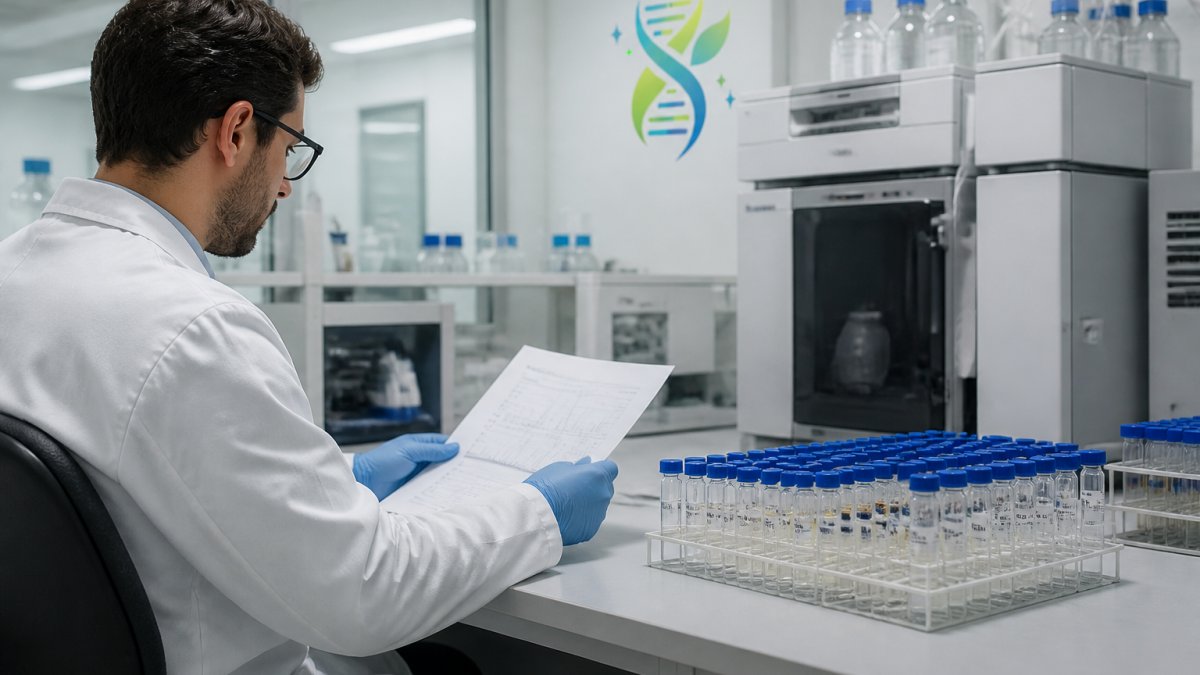
The realistic role for AI here is pattern recognition across large analytical datasets: spotting drift in purity trends, flagging batches that deviate from historical norms, and organizing documentation. The actual measurements still come from validated methods.
This is the part most AI coverage skips. A model can tell you a chromatogram looks unusual. It cannot certify that a batch meets specification.
Peptide Stability Prediction and Formulation Decisions
Peptide stability prediction uses models to estimate how a sequence will hold up under storage, temperature, and pH conditions. It is one of the more useful applications because stability problems are expensive to discover late.
A 2025 review describes AI algorithms optimizing peptide structures for stability and efficacy (Wang et al., "From precision synthesis to cross-industry applications").
The caveat is that predictions are only as good as the data behind them. Stability behavior depends on formulation, container, and handling conditions that a sequence-level model does not fully capture.
What AI Still Cannot Do: Limitations and Failure Modes
The honest answer is that AI has not delivered measured manufacturing gains in the published literature, and anyone claiming otherwise is overselling. Viva Biotech has stated an intent to expand AI use across decisions from discovery through manufacturing, but the company has not published quantified manufacturing outcomes (Viva Biotech, "Advancing AI-powered Peptide Drug Discovery").
That is the headline limitation. Underneath it sit five failure modes that matter more to anyone actually running a production workflow.
1. Data Quality Is the Ceiling
Models learn from the data they are given. Peptide manufacturing data is often fragmented across paper batch records, instrument software, and spreadsheets, with inconsistent naming and units. A model trained on that produces recommendations that look precise but are not reproducible. The fix is unglamorous: standardise data capture before expecting anything from a model.
2. Model Bias and Narrow Training Sets
Most published peptide models are trained on sequences that resemble known drugs or well-studied motifs. They perform poorly on genuinely novel scaffolds, unusual modifications, or non-canonical residues. A model that is 90% accurate on its training distribution can be far worse on the sequence a research team actually cares about.
3. Interpretability and the Trust Problem
A chemist who cannot see why a model flagged a sequence will not act on it. Deep learning models are often opaque, and in a manufacturing environment an unexplained recommendation is difficult to justify in a deviation investigation or a batch review. This is a real operational barrier, not a philosophical one.
4. Reproducibility Across Versions
A model updated between two batches is, in effect, a different process input. Without version control, change records, and a documented rationale for each update, a manufacturer cannot demonstrate that a decision made in March is consistent with the same decision made in September. This is a data-integrity issue as much as a technical one.
5. Validation Burden Under Current Quality Expectations
Any computerised system that influences a regulated decision falls within the scope of validation expectations set out in frameworks such as 21 CFR Part 11 (electronic records and signatures) and the FDA's guidance on computer software assurance. In practice this means:
- Documented intended use and risk assessment for the model
- Traceability from input data to output recommendation
- Change control for every model update
- Audit trails that cannot be edited without a record
- Periodic review to confirm the model still performs as validated
None of this is impossible. All of it is work, and it is work that most AI-in-peptides coverage ignores entirely.
What This Means for Experimental Confirmation
The consistent theme across all five failure modes is that a model output is a hypothesis, not a result. Experimental confirmation is not a formality, it is the step that converts a prediction into a fact. Teams that treat it as optional are the ones most likely to be surprised by a failed batch.
The Realistic Impact of AI on Peptide Manufacturing
The impact of AI on peptide manufacturing today is concentrated in discovery and candidate prioritization, with genuine but modest support for quality data review.
That does not make the technology unimportant. It makes it early.
For researchers, the practical takeaway is to judge a supplier on verifiable quality signals: independent testing, clear documentation, and consistency across batches. Those fundamentals matter more than any software claim.
The challenge for research teams is that AI-era hype has made it harder to tell which suppliers actually deliver consistent, verified compounds.
Frequently Asked Questions
How is AI used in peptide manufacturing?
AI supports peptide manufacturing by analyzing large datasets to optimize synthesis routes and predict properties like stability. According to a 2025 article in ScienceDirect, AI algorithms enable rapid identification of bioactive peptide sequences and optimization of structure for stability. Viva Biotech reports using computationally generated candidates validated with surface plasmon resonance. The technology assists decision-making rather than replacing the chemist's bench work.
Can AI improve peptide synthesis yields?
The research does not establish a measured yield improvement from AI in peptide manufacturing. A 2024 PMC review notes AI's potential for optimizing peptide modifications, and a 2026 Royal Society of Chemistry article describes generative AI for designing novel sequences. However, no supplied study quantifies yield gains. AI can help prioritize which sequences to synthesize and flag likely problematic modifications, but bench validation remains necessary.
What are the limitations of AI in peptide manufacturing?
The main limitations are the lack of quantified manufacturing outcomes in published research and the gap between in silico predictions and bench results. The Viva Biotech case study reports that more than half of tested peptides maintained an unspecified result, showing that computational candidates still require experimental validation. AI cannot yet replace analytical testing or guarantee batch-to-batch consistency without rigorous quality control systems.
How can AI support peptide quality control?
AI can support quality control by analyzing analytical data patterns and flagging deviations, but the supplied research does not quantify its impact on QC outcomes. For reproducible research, third-party testing and transparent documentation remain the foundation. AI tools can help visualize and analyze data from techniques like surface plasmon resonance, but human oversight and validated methods are still required for release testing.