 how-to
What Is Peptide Purity Fraud Detection? A 2026 Guide
Table of Contents
- What Peptide Purity Fraud Detection Actually Means
- How to Read a Certificate of Analysis: Peptide Certificate of Analysis Interpretation
- Third-Party Peptide Testing Standards: HPLC, Mass Spectrometry, and What They Prove
- Identifying Fake Peptide Lab Reports: A Step-by-Step Checklist
- The Angles Most Buyers Miss: Batch Variability, Solvents, and Heavy Metals
- How Peptide Purity Fraud Detection Fits Into Your Sourcing Process
- Frequently Asked Questions
Last Updated: October 3, 2026
What Peptide Purity Fraud Detection Actually Means
Peptide purity fraud detection is the process of checking whether a vial of peptides really contains what its label and paperwork claim. It means testing the Certificate of Analysis (CoA) against independent lab data, not just trusting the PDF that came with your order.
The problem is bigger than most buyers realise. According to TransUnion's 2026 consumer fraud report, 26% of consumers reported losing money to digital fraud.
So what does real verification look like? It comes down to three checks:
- Confirm the CoA is genuine and matches the batch
- Confirm independent lab data backs the purity claim
- Confirm the compound's identity, not just its percentage
Miss any one of those and you are guessing.
How to Read a Certificate of Analysis: Peptide Certificate of Analysis Interpretation
A Certificate of Analysis is a document that reports the test results for a specific batch of peptides. Peptide certificate of analysis interpretation means reading past the headline purity number and checking the method, the date, and the sample details behind it.
Most people scan for "98% pure" and stop. That is the first mistake.
A proper CoA should show:
- The testing laboratory's name and contact details
- The batch or lot number, matched to your vial
- The analytical method used, such as HPLC or mass spectrometry
If any of those are missing, treat the document as unverified. A purity figure without a method is just a claim.
Purity Percentage vs. Net Peptide Content
Purity percentage and net peptide content are not the same thing, and confusing them leads to bad research decisions. Purity measures how much of the detected material is your target compound.
A vial can be 98% pure by HPLC and still contain far less usable peptide than the label implies. The gap comes from acetate content, trifluoroacetic acid, and residual moisture.
Why UV Detection Can Be Misleading
UV detection can overstate purity because it only sees molecules that absorb ultraviolet light at the chosen wavelength. Compounds that do not absorb at that setting stay invisible, so they never show up in the percentage.
Change the wavelength and the same sample can read differently. That is why a single UV number is weak evidence on its own. Mass spectrometry fills the gap by confirming molecular weight and structure.
Third-Party Peptide Testing Standards: HPLC, Mass Spectrometry, and What They Prove
Third-party peptide testing standards exist to confirm two things: how clean a sample is and whether it is the right molecule.
HPLC works by pushing the sample through a column and measuring when each component exits. That timing, called retention time, helps identify the target compound.
Mass spectrometry answers a different question. It tells you whether the molecule is actually the one on the label.
A 2008 PubMed study on synthetic peptide impurity profiling found that one analysed product was an entirely different substance, and two-thirds of other samples failed to meet sufficient quality standards.
Common Impurities: Deletion Sequences, Oxidation, and Residual Reagents
Common peptide impurities fall into three groups: deletion sequences, oxidation products, and residual synthesis reagents. Each one tells you something different about how the peptide was made.
- Deletion sequences: shorter peptide chains missing one or more amino acids
- Oxidation products: damaged molecules, often from poor storage or handling
- Residual reagents: leftover chemicals from synthesis, including solvents
Chromatographic cleanliness is the goal. A clean chromatogram with low baseline noise and sharp peaks suggests a well-made batch. A messy one with extra peaks warns you that something went wrong.
Identifying Fake Peptide Lab Reports: A Step-by-Step Checklist
Identifying fake peptide lab reports comes down to one habit: never trust a document you cannot cross-check. Fake CoAs are common, and they often look more polished than the real thing.
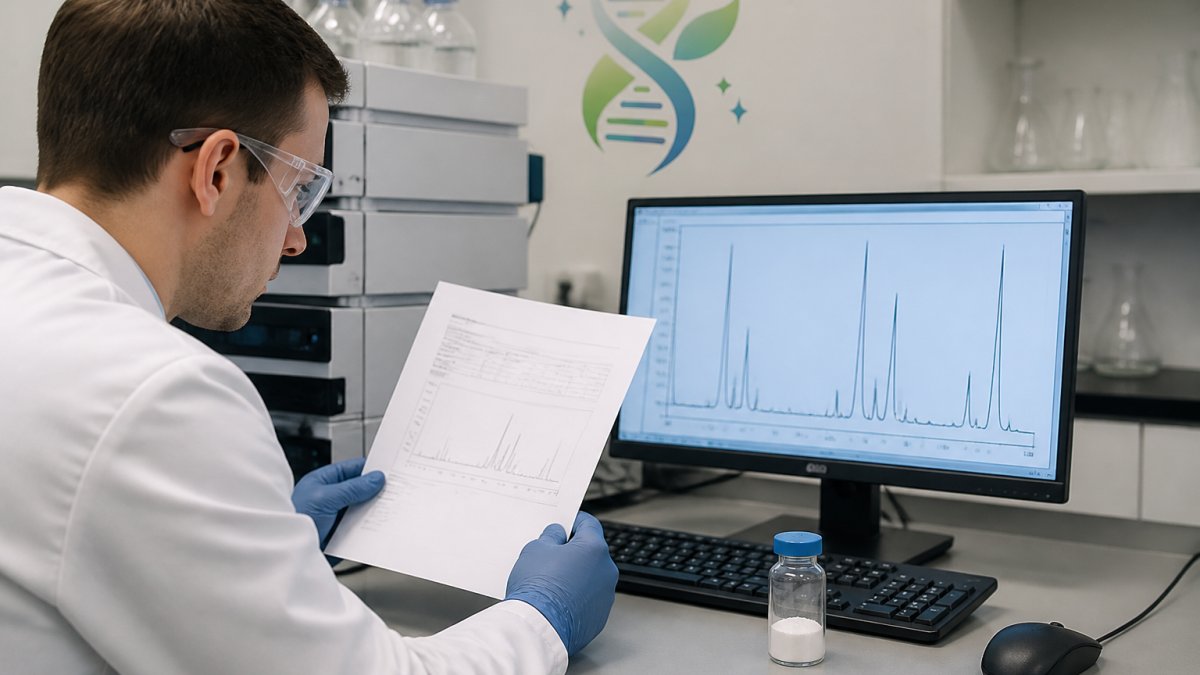
The Forensic Checklist
Run every CoA through these checks before you trust it:
- Match the lot number to the vial. The batch code on the CoA must match your vial exactly, not a similar code, not a code from the same week. Fraudsters reuse a real CoA from a legitimate batch and ship a different one.
- Verify the lab exists independently. Search the lab's name and address outside the supplier's website. Call or email the lab directly using contact details you found yourself, never the ones printed on the CoA.
- Inspect the PDF metadata. Open the file properties. A CoA created three days ago for a batch supposedly tested six months ago is a red flag. Look at the 'Author' and 'Producer' fields, mismatched software or a personal name instead of a lab name is suspicious.
- Zoom in on the numbers. Edited figures often sit on a slightly different baseline, use a marginally different font weight, or have faint rectangular artifacts around them from the editing tool. Compare the purity figure's font to the rest of the document.
- Check the chromatogram for consistency. The retention time on the chromatogram should match the method description. A chromatogram with no axis labels, no integration marks, or a suspiciously smooth baseline is often a stock image or a screenshot from a different compound.
- Look for recycled wording. Copy a distinctive sentence from the CoA into a search engine. If the same phrasing appears on other suppliers' documents, the report is a template.
- Confirm the test date against the batch date. A CoA dated before the batch was manufactured is impossible. A CoA dated the same day as a large batch is unlikely for a real lab.
- Request the raw data file. Ask for the original instrument file (often a .raw, .d, or .wiff file), not a PDF. Genuine labs can provide it. Resellers working from a template cannot.
Most fake reports fail at step three, four, or six. The numbers look fine, but the document's digital fingerprint does not.
Why This Matters More Than Purity Percentages
A forged CoA does not just misstate purity, it misstates identity. A report claiming 99% purity for a compound that is actually a different peptide is more dangerous than an honest 90% report, because it removes the buyer's ability to make an informed decision. Fraud detection is therefore not a paperwork exercise; it is the first line of research safety.
The Angles Most Buyers Miss: Batch Variability, Solvents, and Heavy Metals
Batch-to-batch variability is the quiet problem in peptide sourcing. Two vials from the same supplier can differ in purity, and that difference ruins reproducibility across a long study. Most guides treat a single CoA as proof of a supplier's quality, but a single report only describes one batch. It says nothing about the next one.
How to Track Batch Consistency
If you run 50 experiments, you need the same compound each time. A batch that reads 98% followed by one at 96% introduces a variable you did not plan for.
A practical way to track consistency is to build a simple log:
- Record the lot number, purity figure, and test date for every batch you receive.
- Note the retention time from each chromatogram. A shift of more than a few tenths of a minute between batches can indicate a different synthesis route or column condition.
- Compare the peak shape. A batch that suddenly shows a shoulder on the main peak, or a new small peak, has changed.
Over three or four orders, patterns emerge. A supplier whose purity figures drift downward is either changing source or cutting corners. A supplier whose figures stay within a tight band is demonstrating process control.
Residual Solvents and Heavy Metals: The Safety Blind Spot
Residual solvent and heavy metal testing is the second blind spot. Most CoAs report purity and identity but skip solvent residues entirely. Synthesis leaves behind reagents, and those residues can interfere with sensitive work.
The two tests that matter most here are:
- Residual solvent testing by gas chromatography (GC), which detects leftover organic solvents from synthesis and purification. Common residues include acetonitrile, methanol, and dichloromethane.
- Heavy metal testing by inductively coupled plasma mass spectrometry (ICP-MS), which detects trace metals such as lead, arsenic, cadmium, and mercury that can carry over from reagents or equipment.
A CoA that reports only HPLC purity and mass spectrometry identity is incomplete for any work where trace contamination matters. Ask specifically for GC residual solvent data and ICP-MS heavy metal data.
Why This Changes Your Sourcing Decisions
What most guides miss is that verification is not a one-time event. It is a process you repeat with every order. Ask four questions each time:
- Does this batch have its own CoA, dated after the batch was made?
- Does the CoA include solvent and metal testing, not just purity?
- Does the purity data come from an independent lab, not an in-house one?
If the answer to any of those is no, you are carrying risk you did not sign up for. The goal is not to find a perfect supplier, it is to build a record that lets you spot a change before it affects your work.
How Peptide Purity Fraud Detection Fits Into Your Sourcing Process
Peptide purity fraud detection belongs at the start of your sourcing process, not the end.
A practical sourcing flow looks like this:
| Stage | What to Check | Why It Matters |
|---|---|---|
| Supplier screening | Third-party testing claims | Filters out unverified sellers |
| Before ordering | Sample CoA and lab name | Confirms real testing exists |
| On delivery | Lot number match | Ties the vial to its report |
| Before use | Raw chromatogram and spectrum | Confirms identity and purity |
| Ongoing | Per-batch documentation | Protects reproducibility |
Industry focus is shifting toward real-time intelligence in fraud prevention, moving from simple detection to resilient, verification-first systems (Valid Advantage industry analysis).
The market numbers back this up. The global fraud detection and prevention market was valued at $63.50 billion in 2023 (Market.us market valuation data), and projections put it at $243.72 billion by 2034 (Atna.ai market growth projections).
For researchers, the takeaway is simple. Treat every CoA as a claim to be tested, not a fact to be trusted.
At Everform Research, we are committed to providing premium-quality peptide products backed by rigorous quality standards, transparency, and exceptional customer service.
Frequently Asked Questions
What is a Certificate of Analysis (COA) in peptide testing?
A Certificate of Analysis is the document a supplier provides to show what a batch contains and how it was tested. For peptides, a useful COA lists the compound name, batch or lot number, molecular weight, test method (usually HPLC and mass spectrometry), purity percentage, and the date of testing. It should carry the name of the testing laboratory, not just the vendor. A COA without a lab name, a batch number, or a test date tells you almost nothing about peptide purity fraud detection, because you cannot trace the result back to a specific vial.
How can I verify the authenticity of a peptide purity report?
Start by checking that the report names the testing laboratory, the batch number, and the analytical method used. Contact the lab directly using contact details you find independently, not the ones printed on the report, and ask them to confirm the batch. Look for chromatograms and mass spectra attached to the report rather than a purity number alone. Under third-party peptide testing standards, a genuine report includes raw data such as retention time, peak integration, and mass-to-charge ratio, so you can see how the result was reached rather than trusting a single figure.
What are the common signs of fraudulent peptide testing documentation?
Watch for reports with no lab letterhead or contact details, identical purity figures across every batch, missing chromatograms or spectra, and dates that do not line up with the order. A 2008 PubMed analysis of synthetic peptides found one product was an entirely different substance, and two-thirds of other samples failed to meet sufficient quality standards. Reused document numbers, mismatched compound names, and purity claims with no method described are all warning signs when identifying fake peptide lab reports.
Why is third-party testing critical for peptide quality assurance?
Independent testing separates the company selling the peptide from the company checking it. When the same vendor manufactures and self-certifies, there is no external check on the result. Third-party peptide testing standards rely on an unconnected laboratory running High-Performance Liquid Chromatography and mass spectrometry on the batch. Always ask who ran the test and whether you can contact them.
Sourcing peptides you can actually rely on is harder than it should be. That is exactly why we built Everform Research around rigorous third-party testing, cGMP-compliant manufacturing, and clearer documentation you can check line by line. Every batch is built for consistency, so your results hold up across experiments. Use code EVER15 for 15% off, and shop our compounds to see the difference verified quality makes.