 how-to
How to Choose High-Quality Peptide Products for Cellular Research
Table of Contents
- Step 1: Define Your Cellular Assay Requirements Before You Buy
- Step 2: Read a Peptide Certificate of Analysis Like a Reviewer
- Step 3: Understand Peptide Purity Testing Methods and Their Limits
- Step 4: Build a Research Peptide Supplier Checklist
- Step 5: Run Your Own Laboratory Verification Workflow
- Step 6: Plan Peptide Storage and Handling for Batch Consistency
- Step 7: Document Everything for Experimental Reproducibility
- How to Compare High-Quality Peptide Products and Sourcing Options
- Frequently Asked Questions
Last Updated: October 8, 2026
Step 1: Define Your Cellular Assay Requirements Before You Buy
The biggest mistake in peptide sourcing is buying first and matching later. Before opening a catalogue, write down what your assay needs: concentration range, buffer compatibility, and solution stability.
If you cannot answer those three questions, you are not ready to buy.
The peptide therapeutics market was valued at $140.9 billion in 2025 and is projected to reach $164.0 billion in 2026, growing at 8.7% annually through 2033 (Grand View Research peptide therapeutics market report).
Matching Peptide Solubility and Stability to Your Assay
Solubility decides whether your peptide reaches the cells. A compound that dissolves poorly in your buffer gives erratic dose-response curves no matter how pure it is. Check the sequence for hydrophobic residues, confirm the recommended solvent, and test a small reconstitution before committing to a full batch.
Purity Thresholds That Protect Reproducibility
Purity percentage is the number buyers fixate on, and the one most often misunderstood.
A 2025 review indexed by PubMed Central describes peptides as active ingredients that may improve collagen synthesis, enhance skin-cell proliferation, or decrease inflammation (PubMed Central review on peptides).
For most cellular work, 98% or higher is often treated as the working floor. For sensitive assays, pushing for 99% is recommended.
Step 2: Read a Peptide Certificate of Analysis Like a Reviewer
A peptide certificate of analysis is a batch-specific document reporting the measured identity, purity, and testing methods for one lot. It is not a marketing sheet. If it has no batch number, no method detail, or no testing laboratory named, you have a brochure, not documentation.
What a Complete COA Must Contain
A complete certificate of analysis for research peptides should include:
- Batch or lot number matching the vial label exactly
- Peptide sequence and molecular weight as the reference standard
- Purity percentage with the analytical method stated
Supplier guidance increasingly treats independent third-party testing and COA access as the baseline for assessing peptide products (PS Peptides vendor comparison guide). We agree, with one addition: read the document, do not just confirm it exists.
Step 3: Understand Peptide Purity Testing Methods and Their Limits
Peptide purity testing relies on two complementary techniques; neither alone is sufficient. HPLC separates components by retention time and tells you how much of your sample is the target peptide; mass spectrometry confirms the molecular identity of what eluted. A COA with only one has a blind spot.
How to Interpret HPLC and Mass Spectrometry Results
When reading an HPLC trace, look at the main peak percentage and then at what else is on the chromatogram.
Mass spectrometry should show a single dominant mass matching your calculated molecular weight. Extra peaks mean the sample contains something the sequence does not predict.
Neither method detects endotoxin, sterility, or residual solvents.
Step 4: Build a Research Peptide Supplier Checklist
A research peptide supplier checklist turns vague trust into a repeatable test. Run every vendor through the same questions:
- Will they send a batch-specific COA before you order?
- Is the testing laboratory named and independent of the vendor?
- Do they publish purity by method, not just a headline number?
Red Flags That Should End a Vendor Conversation
Some answers should end the discussion immediately. Pressure to buy before documentation arrives. A COA that changes between requests. Purity claims with no method attached.
A 2026 University of New South Wales article notes that unregulated peptides may be mislabelled, contaminated, or incorrectly dosed (University of New South Wales on injectable peptides).
Step 5: Run Your Own Laboratory Verification Workflow
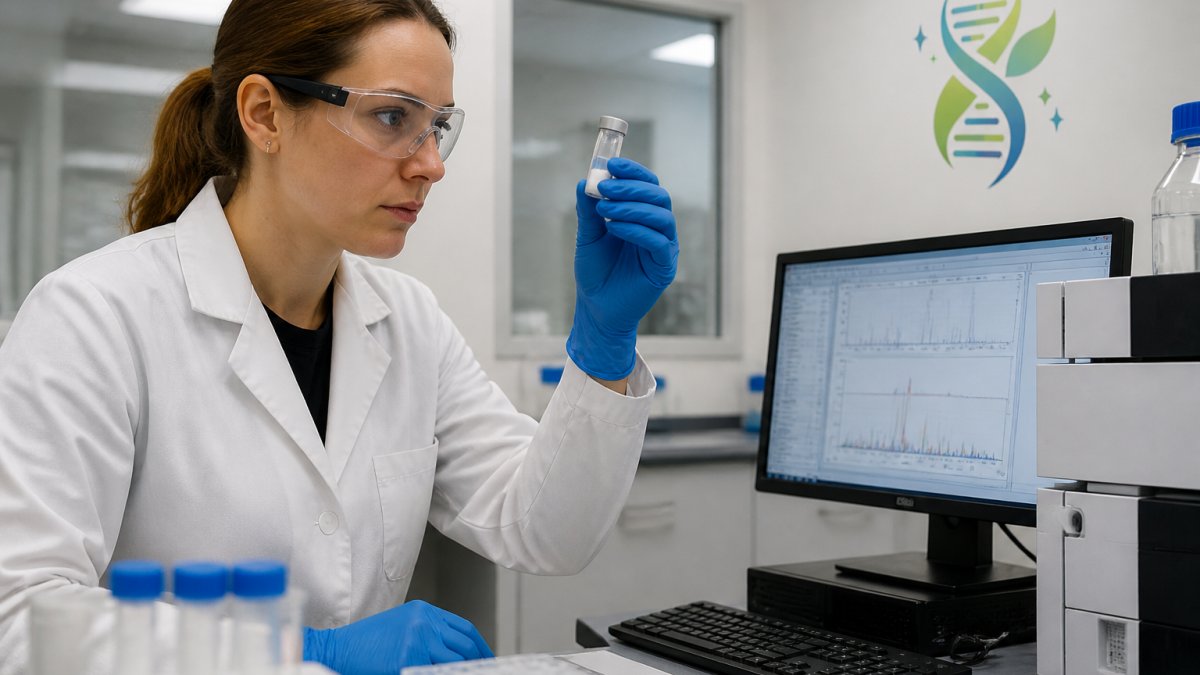
Most guides stop at "check the certificate of analysis." That is a starting point, not a verification workflow: a certificate describes a sample the supplier selected, not the vial in your hand.
Stage 1: Documentation Review (Before You Open the Vial)
Match the vial label to the certificate line by line. The batch or lot number must be identical, not similar. Confirm the peptide sequence, molecular weight, purity figure, analytical method, testing laboratory name, and date of analysis are present. If any field is missing, request a corrected document rather than proceeding on a verbal assurance.
Stage 2: Physical Inspection (On Arrival)
Inspect the lyophilized powder under good light. Note colour, texture, and whether the cake is intact or fractured. A uniform white to off-white cake is typical; discoloration, clumping, or visible particulates warrant a query before use. Check the vial seal, stopper, and crimp for tampering or poor sealing, and weigh the sealed vial against the expected fill mass if stated.
Stage 3: Reconstitution Check
Reconstitute a small aliquot in the solvent the certificate recommends. Observe whether the powder clears fully and how long it takes. Most research peptides dissolve within minutes with gentle swirling; avoid vortexing, which can shear the peptide. If the solution stays cloudy, contains undissolved particles, or develops a colour, quarantine the vial and document it.
Stage 4: Analytical Confirmation (If You Have Capacity)
If your laboratory has HPLC or mass spectrometry, run an identity check on a small sample and compare it against the certificate. You are confirming the dominant peak or mass matches the expected value, not reproducing the supplier's exact purity figure. A mismatch is a stop-work signal.
Stage 5: Quarantine and Release
Hold the material in quarantine until stages one through four are complete and the records match, then release it into your working inventory. If any stage fails, document it, contact the supplier, and do not use the material in an assay.
Acceptance Criteria at a Glance
- Documentation matches the vial label exactly
- Powder is uniform, intact, and free of discoloration
- Reconstitution clears fully in the recommended solvent
This workflow replaces trust with evidence at each step, so when a result looks strange you can rule out the material before questioning the biology.
Step 6: Plan Peptide Storage and Handling for Batch Consistency
Peptide storage and handling decisions made in week one determine whether your results hold in month six. The advice below covers the trade-offs that affect cellular assays.
Lyophilized Versus Reconstituted: Two Different Stability Problems
Lyophilized powder is the more stable form, and most research peptides tolerate ambient shipping for short periods. Once reconstituted, the clock starts: in solution, peptides face hydrolysis, oxidation, and microbial growth, at a rate depending on sequence, solvent, and concentration. Keep material lyophilized until you are ready to run an experiment, and reconstitute only what you will use within the working window the certificate recommends.
Temperature, Light, and Moisture
Store lyophilized vials at the temperature the certificate specifies, typically frozen or refrigerated. Protect them from light, which can degrade aromatic residues, and moisture, which can collapse the cake; desiccant packs help. Avoid repeated warming and cooling of the stock vial, and aliquot before freezing where possible.
Freeze-Thaw Cycles: The Silent Variable
Every freeze-thaw cycle can alter the concentration and aggregation state of a peptide solution, introducing a variable unrelated to your treatment. Aliquot reconstituted solution into single-use volumes, label them with batch number and date, and discard any aliquot thawed more than once.
Cold-Chain Handling From Dock to Bench
Cold-chain integrity matters at every step: shipping, receiving, internal transfer, and storage. A peptide that sat on a loading dock for two days in summer has a different stability profile than one that arrived on ice. Record packaging condition on arrival, note temperature indicator readings, and move material to storage promptly.
Reconstitution and Storage Records
For each batch, keep a log that includes:
- Batch number and supplier
- Certificate reference and date received
- Reconstitution solvent, volume, and final concentration
This log is what allows you to compare results across experiments and across batches. Without it, a shift in your data is unattributable.
Batch-to-Batch Consistency in Practice
Batch-to-batch consistency depends on all of the above. If storage conditions drift between experiments, you will chase variance unrelated to the compound. When a new batch arrives, run the verification workflow and compare its certificate against the previous batch, noting any change in purity, method, or testing laboratory.
A Note on Assay-Specific Stability
Stability is not a single number. A peptide stable in one buffer may degrade quickly in another, and a concentration that works for one assay may precipitate in another. Before committing a full batch to a long experiment, run a small pilot to confirm the peptide stays in solution and active under your exact assay conditions.
Step 7: Document Everything for Experimental Reproducibility
Experimental reproducibility starts with records a colleague could follow without asking a single question. Every peptide use should be traceable to a batch, a COA, and a storage history.
Record the following for each experiment:
- Batch number and supplier
- COA reference and date received
- Reconstitution solvent, concentration, and date
This is unglamorous work, but it is the difference between a result you can defend and one you cannot repeat.
How to Compare High-Quality Peptide Products and Sourcing Options
Comparing high-quality peptide products comes down to documentation, verification, and consistency, not the headline purity number. Two vendors can both claim 99% and be worlds apart in what they can prove. Use this framework:
| Criterion | What to Look For | Why It Matters |
|---|---|---|
| COA completeness | Batch number, method, lab name | Confirms the claim is traceable |
| Independent testing | Accredited third-party laboratory | Removes vendor self-reporting bias |
| Purity method | HPLC plus mass spectrometry | Identity and purity are different questions |
| Batch consistency | Documented lot-to-lot data | Protects long-running experiments |
| Storage guidance | Temperature, light, cold chain | Stability affects every downstream result |
| Research-use labelling | Clear intended-application statement | Defines what the product is for |
| Technical support | Answers on solubility and handling | Signals real product knowledge |
Cost matters, but it should be the last column, not the first.
Choosing peptides for cellular research in 2026 means choosing documentation over marketing. The vendors worth your budget hand over batch-specific COAs, name their testing laboratories, and answer technical questions without hesitation.
Frequently Asked Questions
How can researchers assess the quality of high-quality peptide products?
Start with the certificate of analysis: check that it reports a specific purity percentage from HPLC, confirms molecular identity by mass spectrometry, and lists a batch number you can trace. Then verify the testing laboratory is genuinely independent rather than affiliated with the supplier. Finally, confirm the documentation covers contamination and endotoxin testing where your cellular assay requires it. A purity claim alone is not enough; the supporting documentation is what makes a product verifiable.
What should a peptide certificate of analysis include for a research peptide?
A complete peptide certificate of analysis should include the peptide sequence, molecular weight, batch number, date of manufacture, analytical method used (typically HPLC for purity and mass spectrometry for identity), the measured purity percentage, and the name of the testing laboratory. If the COA omits the testing lab, the batch number, or the raw analytical data, you cannot independently verify the claim. Treat an incomplete COA as a reason to request more documentation or look elsewhere.
Why can peptide purity results vary between suppliers?
Purity results vary because of differences in synthesis methods, purification steps, analytical equipment, and how purity is calculated. Some suppliers report purity based on a single HPLC run at one wavelength, while others use more rigorous multi-method analysis. Storage and shipping conditions also affect the peptide before it reaches you. This is why comparing a purity percentage across vendors is only meaningful when you know the testing method, the laboratory, and the batch documentation behind each figure.
How should researchers evaluate peptide storage and handling information?
Look for clear guidance on storage temperature for lyophilized powder, recommended reconstitution solvents, and stability after reconstitution. Suppliers should specify whether cold-chain handling is used during shipping and provide storage conditions on the batch documentation, not just a generic website page. For cellular research, inconsistent storage can change assay results between batches, so treat storage and handling instructions as part of the product specification rather than an afterthought.